
- Android 基礎
- Android - 首頁
- Android - 概覽
- Android - 環境搭建
- Android - 架構
- Android - 應用程式元件
- Android - Hello World 示例
- Android - 資源
- Android - 活動
- Android - 服務
- Android - 廣播接收器
- Android - 內容提供器
- Android - 碎片
- Android - 意圖/過濾器
- Android - 使用者介面
- Android - UI 佈局
- Android - UI 控制元件
- Android - 事件處理
- Android - 樣式和主題
- Android - 自定義元件
- Android 高階概念
- Android - 拖放
- Android - 通知
- 基於位置的服務
- Android - 傳送電子郵件
- Android - 傳送簡訊
- Android - 電話呼叫
- 釋出 Android 應用程式
- Android 實用示例
- Android - 警報對話方塊
- Android - 動畫
- Android - 音訊捕獲
- Android - AudioManager
- Android - 自動完成
- Android - 最佳實踐
- Android - 藍牙
- Android - 相機
- Android - 剪貼簿
- Android - 自定義字型
- Android - 資料備份
- Android - 開發者工具
- Android - 模擬器
- Android - Facebook 整合
- Android - 手勢
- Android - Google 地圖
- Android - 影像效果
- Android - ImageSwitcher
- Android - 內部儲存
- Android - JetPlayer
- Android - JSON 解析器
- Android - Linkedin 整合
- Android - 載入微調器
- Android - 本地化
- Android - 登入螢幕
- Android - MediaPlayer
- Android - 多點觸控
- Android - 導航
- Android - 網路連線
- Android - NFC 指南
- Android - PHP/MySQL
- Android - 進度圓圈
- Android - 進度條
- Android - 推送通知
- Android - RenderScript
- Android - RSS 閱讀器
- Android - 螢幕錄製
- Android - SDK 管理器
- Android - 感測器
- Android - 會話管理
- Android - 共享首選項
- Android - SIP 協議
- Android - 拼寫檢查器
- Android - SQLite 資料庫
- Android - 支援庫
- Android - 測試
- Android - 文字轉語音
- Android - TextureView
- Android - Twitter 整合
- Android - UI 設計
- Android - UI 模式
- Android - UI 測試
- Android - WebView 佈局
- Android - Wi-Fi
- Android - 小部件
- Android - XML 解析器
- Android 實用資源
- Android - 問答
- Android - 實用資源
- Android - 討論
Android - 碎片過渡
什麼是過渡?
Lollipop 中的活動和碎片過渡建立在一個名為 Transitions 的 Android 中相對較新的功能之上。過渡框架在 KitKat 中引入,為應用程式中不同 UI 狀態之間的動畫提供了方便的 API。該框架建立在兩個關鍵概念之上:場景和過渡。場景定義了應用程式 UI 的給定狀態,而過渡定義了兩個場景之間的動畫更改。
當場景發生變化時,過渡有兩個主要職責 -
- 捕獲開始和結束場景中每個檢視的狀態。
- 根據差異建立動畫器,該動畫器將檢視從一個場景動畫到另一個場景。
示例
此示例將向您解釋如何使用碎片過渡建立自定義動畫。因此,讓我們按照以下步驟操作,類似於我們在建立 Hello World 示例時所遵循的步驟 -
| 步驟 | 描述 |
|---|---|
| 1 | 您將使用 Android Studio 建立一個 Android 應用程式,並將其命名為 fragmentcustomanimations,放在包 com.example.fragmentcustomanimations 下,使用空白活動。 |
| 2 | 修改 activity_main.xml,它位於 res/layout/activity_main.xml 中,以新增一個文字檢視。 |
| 3 | 在目錄 res/layout 下建立一個名為 fragment_stack.xml.xml 的佈局,以定義您的碎片標籤和按鈕標籤。 |
| 4 | 建立一個資料夾,該資料夾位於 res/ 下,並將其命名為 animation,並新增 fragment_slide_right_enter.xml fragment_slide_left_exit.xml、fragment_slide_right_exit.xml 和 fragment_slide_left_enter.xml。 |
| 5 | 在 MainActivity.java 中,需要新增碎片棧、碎片管理器和 onCreateView()。 |
| 6 | 執行應用程式以啟動 Android 模擬器並驗證對應用程式所做的更改的結果。 |
以下是 res.layout/activity_main.xml 的內容,它包含 TextView。
<?xml version="1.0" encoding="utf-8"?>
<TextView xmlns:android="http://schemas.android.com/apk/res/android"
   android:id="@+id/text"
   android:layout_width="match_parent"
   android:layout_height="match_parent"
   android:gravity="center_vertical|center_horizontal"
   android:text="@string/hello_world"
   android:textAppearance="?android:attr/textAppearanceMedium" />
以下是 res/animation/fragment_stack.xml 檔案的內容。它包含框架佈局和按鈕。
<?xml version="1.0" encoding="utf-8"?>
<LinearLayout
   xmlns:android="http://schemas.android.com/apk/res/android"
   android:layout_width="match_parent"
   android:layout_height="match_parent"
   android:orientation="vertical" >

   <fragment
      android:id="@+id/fragment1"
      android:name="com.pavan.listfragmentdemo.MyListFragment"
      android:layout_width="match_parent"
      android:layout_height="match_parent" />

</LinearLayout>
以下是 res/animation/fragment_slide_left_enter.xml 檔案的內容。它包含 set 方法和物件動畫器。
<?xml version="1.0" encoding="utf-8"?>
<set xmlns:android="http://schemas.android.com/apk/res/android">
   <objectAnimator
      android:interpolator="@android:interpolator/decelerate_quint"
      android:valueFrom="100dp" android:valueTo="0dp"
      android:valueType="floatType"
      android:propertyName="translationX"
      android:duration="@android:integer/config_mediumAnimTime" />

   <objectAnimator
      android:interpolator="@android:interpolator/decelerate_quint"
      android:valueFrom="0.0" android:valueTo="1.0"
      android:valueType="floatType"
      android:propertyName="alpha"
      android:duration="@android:integer/config_mediumAnimTime" />
</set>
以下是 res/animation/fragment_slide_left_exit.xml 檔案的內容。它包含 set 和物件動畫器標籤。
<?xml version="1.0" encoding="utf-8"?>
<set xmlns:android="http://schemas.android.com/apk/res/android">
   <objectAnimator
      android:interpolator="@android:interpolator/decelerate_quint"
      android:valueFrom="0dp" android:valueTo="-100dp"
      android:valueType="floatType"
      android:propertyName="translationX"
      android:duration="@android:integer/config_mediumAnimTime" />

   <objectAnimator
      android:interpolator="@android:interpolator/decelerate_quint"
      android:valueFrom="1.0" android:valueTo="0.0"
      android:valueType="floatType"
      android:propertyName="alpha"
      android:duration="@android:integer/config_mediumAnimTime" />
</set>
以下程式碼將是 res/animation/fragment_slide_right_enter.xml 檔案的內容。它包含 set 和物件動畫器標籤。
<?xml version="1.0" encoding="utf-8"?>
<set xmlns:android="http://schemas.android.com/apk/res/android">
   <objectAnimator
      android:interpolator="@android:interpolator/decelerate_quint"
      android:valueFrom="-100dp" android:valueTo="0dp"
      android:valueType="floatType"
      android:propertyName="translationX"
      android:duration="@android:integer/config_mediumAnimTime" />

   <objectAnimator
      android:interpolator="@android:interpolator/decelerate_quint"
      android:valueFrom="0.0" android:valueTo="1.0"
      android:valueType="floatType"
      android:propertyName="alpha"
      android:duration="@android:integer/config_mediumAnimTime" />
</set>
以下程式碼將是 res/animation/fragment_slide_right_exit.xml 檔案的內容,它包含 set 和物件動畫器標籤。
<?xml version="1.0" encoding="utf-8"?>
<set xmlns:android="http://schemas.android.com/apk/res/android">
   <objectAnimator
      android:interpolator="@android:interpolator/decelerate_quint"
      android:valueFrom="0dp" android:valueTo="100dp"
      android:valueType="floatType"
      android:propertyName="translationX"
      android:duration="@android:integer/config_mediumAnimTime" />

   <objectAnimator
      android:interpolator="@android:interpolator/decelerate_quint"
      android:valueFrom="1.0" android:valueTo="0.0"
      android:valueType="floatType"
      android:propertyName="alpha"
      android:duration="@android:integer/config_mediumAnimTime" />
</set>
以下程式碼將是 src/main/java/MainActivity.java 檔案的內容。它包含按鈕偵聽器、碎片棧和 onCreateView。
package com.example.fragmentcustomanimations;

import android.app.Activity;
import android.app.Fragment;
import android.app.FragmentTransaction;
import android.os.Bundle;

import android.view.LayoutInflater;
import android.view.View;
import android.view.View.OnClickListener;
import android.view.ViewGroup;

import android.widget.Button;
import android.widget.TextView;

/**
 * Demonstrates the use of custom animations in a FragmentTransaction when
 * pushing and popping a stack.
 */
public class FragmentCustomAnimations extends Activity {
   int mStackLevel = 1;

   @Override
   protected void onCreate(Bundle savedInstanceState) {
      super.onCreate(savedInstanceState);
      setContentView(R.layout.fragment_stack);

      // Watch for button clicks.
      Button button = (Button)findViewById(R.id.new_fragment);

      button.setOnClickListener(new OnClickListener() {
         public void onClick(View v) {
            addFragmentToStack();
         }
      });

      if (savedInstanceState == null) {
         // Do first time initialization -- add initial fragment.
         Fragment newFragment = CountingFragment.newInstance(mStackLevel);
         FragmentTransaction ft = getFragmentManager().beginTransaction();
         ft.add(R.id.simple_fragment, newFragment).commit();
      }
      else
      {
         mStackLevel = savedInstanceState.getInt("level");
      }
   }

   @Override
   public void onSaveInstanceState(Bundle outState) {
      super.onSaveInstanceState(outState);
      outState.putInt("level", mStackLevel);
   }

   void addFragmentToStack() {
      mStackLevel++;

      // Instantiate a new fragment.
      Fragment newFragment = CountingFragment.newInstance(mStackLevel);

      // Add the fragment to the activity, pushing this transaction
      // on to the back stack.
      FragmentTransaction ft = getFragmentManager().beginTransaction();
      ft.setCustomAnimations(R.animator.fragment_slide_left_enter,
      R.animator.fragment_slide_left_exit,
      R.animator.fragment_slide_right_enter,
      R.animator.fragment_slide_right_exit);
      ft.replace(R.id.simple_fragment, newFragment);
      ft.addToBackStack(null);
      ft.commit();
   }

   public static class CountingFragment extends Fragment {
      int mNum;
      /**
      * Create a new instance of CountingFragment, providing "num"
      * as an argument.
      */
      static CountingFragment newInstance(int num) {
         CountingFragment f = new CountingFragment();

         // Supply num input as an argument.
         Bundle args = new Bundle();
         args.putInt("num", num);
         f.setArguments(args);
         return f;
      }

      /**
      * When creating, retrieve this instance's number from its arguments.
      */

      @Override
      public void onCreate(Bundle savedInstanceState) {
         super.onCreate(savedInstanceState);
         mNum = getArguments() != null ? getArguments().getInt("num") : 1;
      }
      /**
      * The Fragment's UI is just a simple text view showing its
      * instance number.
      */

      @Override
      public View onCreateView(LayoutInflater inflater,
         ViewGroup container,Bundle savedInstanceState) {
         View v = inflater.inflate(R.layout.hello_world, container, false);
         View tv = v.findViewById(R.id.text);
         ((TextView)tv).setText("Fragment #" + mNum);
         tv.setBackgroundDrawable(getResources().
            getDrawable(android.R.drawable.gallery_thumb));
         return v;
      }
   }
}
以下是 AndroidManifest.xml 的內容。
<?xml version="1.0" encoding="utf-8"?>
   <manifest xmlns:android="http://schemas.android.com/apk/res/android"
   package="com.example.fragmentcustomanimations"
   android:versionCode="1"
   android:versionName="1.0" >

   <application
      android:allowBackup="true"
      android:icon="@drawable/ic_launcher"
      android:label="@string/app_name"
      android:theme="@style/AppTheme" >

      <activity
         android:name="com.example.fragmentcustomanimations.MainActivity"
         android:label="@string/app_name" >

         <intent-filter>
            <action android:name="android.intent.action.MAIN" />
            <category android:name="android.intent.category.LAUNCHER" />
         </intent-filter>

      </activity>

   </application>
</manifest>
執行應用程式
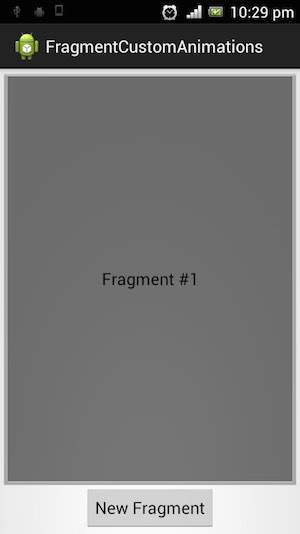
讓我們嘗試執行我們剛剛建立的 碎片過渡應用程式。我假設您在進行環境設定時建立了 AVD。要從 Android Studio 執行應用程式,請開啟專案的一個活動檔案,然後單擊工具欄中的執行  圖示。Android 將應用程式安裝到您的 AVD 上並啟動它,如果您的設定和應用程式一切正常,它將顯示以下模擬器視窗。
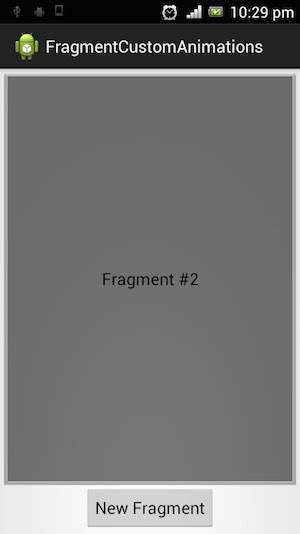
如果單擊新碎片,它將把第一個碎片更改為第二個碎片,如下所示。