
- Android 基礎
- Android - 首頁
- Android - 概述
- Android - 環境設定
- Android - 架構
- Android - 應用元件
- Android - Hello World 示例
- Android - 資源
- Android - 活動 (Activities)
- Android - 服務 (Services)
- Android - 廣播接收器 (Broadcast Receivers)
- Android - 內容提供器 (Content Providers)
- Android - 碎片 (Fragments)
- Android - 意圖/過濾器 (Intents/Filters)
- Android - 使用者介面
- Android - UI 佈局
- Android - UI 控制元件
- Android - 事件處理
- Android - 樣式和主題
- Android - 自定義元件
- Android 高階概念
- Android - 拖放
- Android - 通知
- 基於位置的服務
- Android - 傳送電子郵件
- Android - 傳送簡訊
- Android - 電話呼叫
- 釋出 Android 應用
- Android 有用示例
- Android - 警報對話方塊
- Android - 動畫
- Android - 音訊捕捉
- Android - AudioManager
- Android - 自動完成
- Android - 最佳實踐
- Android - 藍牙
- Android - 相機
- Android - 剪貼簿
- Android - 自定義字型
- Android - 資料備份
- Android - 開發者工具
- Android - 模擬器
- Android - Facebook 整合
- Android - 手勢
- Android - Google 地圖
- Android - 影像效果
- Android - ImageSwitcher
- Android - 內部儲存
- Android - JetPlayer
- Android - JSON 解析器
- Android - Linkedin 整合
- Android - 載入微調器
- Android - 本地化
- Android - 登入介面
- Android - MediaPlayer
- Android - 多點觸控
- Android - 導航
- Android - 網路連線
- Android - NFC 指南
- Android - PHP/MySQL
- Android - 進度圓圈
- Android - ProgressBar
- Android - 推送通知
- Android - RenderScript
- Android - RSS 閱讀器
- Android - 螢幕錄製
- Android - SDK 管理器
- Android - 感測器
- Android - 會話管理
- Android - Shared Preferences
- Android - SIP 協議
- Android - 拼寫檢查器
- Android - SQLite 資料庫
- Android - 支援庫
- Android - 測試
- Android - 文字轉語音
- Android - TextureView
- Android - Twitter 整合
- Android - UI 設計
- Android - UI 模式
- Android - UI 測試
- Android - WebView 佈局
- Android - Wi-Fi
- Android - 小部件
- Android - XML 解析器
- Android 有用資源
- Android - 問答
- Android - 有用資源
- Android - 討論
Android - 影像效果
Android 允許您透過在影像上新增不同型別的效果來操作影像。您可以輕鬆地應用影像處理技術來在影像上新增某些型別的效果。這些效果可能是亮度、暗度、灰度轉換等等。
Android 提供 Bitmap 類來處理影像。這可以在 android.graphics.bitmap 下找到。有很多方法可以例項化點陣圖。我們正在從 imageView 建立影像的點陣圖。
private Bitmap bmp;
private ImageView img;
img = (ImageView)findViewById(R.id.imageView1);
BitmapDrawable  abmp = (BitmapDrawable)img.getDrawable();
現在,我們將透過呼叫 BitmapDrawable 類的 getBitmap() 函式來建立點陣圖。其語法如下:
bmp = abmp.getBitmap();
影像只不過是一個二維矩陣。同樣,您將處理點陣圖。影像由畫素組成。因此,您將從此點陣圖中獲取畫素並對其應用處理。其語法如下:
for(int i=0; i<bmp.getWidth(); i++){
   for(int j=0; j<bmp.getHeight(); j++){
      int p = bmp.getPixel(i, j);
   }
}
getWidth() 和 getHeight() 函式返回矩陣的高度和寬度。getPixel() 方法返回指定索引處的畫素。一旦獲得畫素,就可以根據需要輕鬆地操作它。
除了這些方法之外,還有其他一些方法可以幫助我們更好地操作影像。
| 序號 | 方法及描述 |
|---|---|
| 1 |
copy(Bitmap.Config config, boolean isMutable) 此方法將此點陣圖的畫素複製到新的點陣圖中 |
| 2 |
createBitmap(DisplayMetrics display, int width, int height, Bitmap.Config config) 返回具有指定寬度和高度的可變點陣圖 |
| 3 |
createBitmap(int width, int height, Bitmap.Config config) 返回具有指定寬度和高度的可變點陣圖 |
| 4 |
createBitmap(Bitmap src) 從源點陣圖返回一個不可變的點陣圖 |
| 5 |
extractAlpha() 返回一個捕獲原始影像 alpha 值的新點陣圖 |
| 6 |
getConfig() 此方法返回該配置,否則返回 null |
| 7 |
getDensity() 返回此點陣圖的密度 |
| 8 | getRowBytes() 返回點陣圖畫素中行之間位元組數 |
| 9 |
setPixel(int x, int y, int color) 將指定的顏色寫入點陣圖(假設它是可變的)的 x,y 座標 |
| 10 |
setDensity(int density) 此方法指定此點陣圖的密度 |
示例
下面的示例演示了點陣圖上的一些影像效果。它建立了一個基本的應用程式,允許您將圖片轉換為灰度等等。
要試驗此示例,您需要在實際裝置上執行它。
| 步驟 | 描述 |
|---|---|
| 1 | 您將使用 Android Studio 在包 com.example.sairamkrishna.myapplication 下建立一個 Android 應用程式。 |
| 2 | 修改 src/MainActivity.java 檔案以新增必要的程式碼。 |
| 3 | 修改 res/layout/activity_main 以新增相應的 XML 元件 |
| 4 | 執行應用程式,選擇正在執行的 Android 裝置,將應用程式安裝在其上並驗證結果 |
以下是修改後的 **MainActivity.java** 的內容。(此處應插入MainActivity.java程式碼)
package com.example.sairamkrishna.myapplication;

import android.graphics.Bitmap;
import android.graphics.Color;
import android.graphics.drawable.BitmapDrawable;
import android.support.v7.app.ActionBarActivity;

import android.os.Bundle;
import android.view.View;
import android.widget.Button;
import android.widget.ImageView;

public class MainActivity extends ActionBarActivity {
   Button b1, b2, b3;
   ImageView im;

   private Bitmap bmp;
   private Bitmap operation;

   @Override
   protected void onCreate(Bundle savedInstanceState) {
      super.onCreate(savedInstanceState);
      setContentView(R.layout.activity_main);

      b1 = (Button) findViewById(R.id.button);
      b2 = (Button) findViewById(R.id.button2);
      b3 = (Button) findViewById(R.id.button3);
      im = (ImageView) findViewById(R.id.imageView);

      BitmapDrawable abmp = (BitmapDrawable) im.getDrawable();
      bmp = abmp.getBitmap();
   }

   public void gray(View view) {
      operation = Bitmap.createBitmap(bmp.getWidth(),bmp.getHeight(), bmp.getConfig());
      double red = 0.33;
      double green = 0.59;
      double blue = 0.11;

      for (int i = 0; i < bmp.getWidth(); i++) {
         for (int j = 0; j < bmp.getHeight(); j++) {
            int p = bmp.getPixel(i, j);
            int r = Color.red(p);
            int g = Color.green(p);
            int b = Color.blue(p);

            r = (int) red * r;
            g = (int) green * g;
            b = (int) blue * b;
            operation.setPixel(i, j, Color.argb(Color.alpha(p), r, g, b));
         }
      }
      im.setImageBitmap(operation);
   }

   public void bright(View view){
      operation= Bitmap.createBitmap(bmp.getWidth(), bmp.getHeight(),bmp.getConfig());

      for(int i=0; i<bmp.getWidth(); i++){
         for(int j=0; j<bmp.getHeight(); j++){
            int p = bmp.getPixel(i, j);
            int r = Color.red(p);
            int g = Color.green(p);
            int b = Color.blue(p);
            int alpha = Color.alpha(p);

            r = 100  +  r;
            g = 100  + g;
            b = 100  + b;
            alpha = 100 + alpha;
            operation.setPixel(i, j, Color.argb(alpha, r, g, b));
         }
      }
      im.setImageBitmap(operation);
   }

   public void dark(View view){
      operation= Bitmap.createBitmap(bmp.getWidth(),bmp.getHeight(),bmp.getConfig());

      for(int i=0; i<bmp.getWidth(); i++){
         for(int j=0; j<bmp.getHeight(); j++){
            int p = bmp.getPixel(i, j);
            int r = Color.red(p);
            int g = Color.green(p);
            int b = Color.blue(p);
            int alpha = Color.alpha(p);

            r =  r - 50;
            g =  g - 50;
            b =  b - 50;
            alpha = alpha -50;
            operation.setPixel(i, j, Color.argb(Color.alpha(p), r, g, b));
         }
      }
      im.setImageBitmap(operation);
   }

   public void gama(View view) {
      operation = Bitmap.createBitmap(bmp.getWidth(),bmp.getHeight(),bmp.getConfig());

      for(int i=0; i<bmp.getWidth(); i++){
         for(int j=0; j<bmp.getHeight(); j++){
            int p = bmp.getPixel(i, j);
            int r = Color.red(p);
            int g = Color.green(p);
            int b = Color.blue(p);
            int alpha = Color.alpha(p);

            r =  r + 150;
            g =  0;
            b =  0;
            alpha = 0;
            operation.setPixel(i, j, Color.argb(Color.alpha(p), r, g, b));
         }
      }
      im.setImageBitmap(operation);
   }

   public void green(View view){
      operation = Bitmap.createBitmap(bmp.getWidth(),bmp.getHeight(), bmp.getConfig());

      for(int i=0; <bmp.getWidth(); i++){
         for(int j=0; j<bmp.getHeight(); j++){
            int p = bmp.getPixel(i, j);
            int r = Color.red(p);
            int g = Color.green(p);
            int b = Color.blue(p);
            int alpha = Color.alpha(p);

            r =  0;
            g =  g+150;
            b =  0;
            alpha = 0;
            operation.setPixel(i, j, Color.argb(Color.alpha(p), r, g, b));
         }
      }
      im.setImageBitmap(operation);
   }

   public void blue(View view){
      operation = Bitmap.createBitmap(bmp.getWidth(),bmp.getHeight(), bmp.getConfig());

      for(int i=0; i<bmp.getWidth(); i++){
         for(int j=0; j<bmp.getHeight(); j++){
            int p = bmp.getPixel(i, j);
            int r = Color.red(p);
            int g = Color.green(p);
            int b = Color.blue(p);
            int alpha = Color.alpha(p);

            r =  0;
            g =  0;
            b =  b+150;
            alpha = 0;
            operation.setPixel(i, j, Color.argb(Color.alpha(p), r, g, b));
         }
      }
      im.setImageBitmap(operation);
   }
}
以下是修改後的 xml **res/layout/activity_main.xml** 的內容。(此處應插入activity_main.xml程式碼)
這裡 abc 指的是 tutorialspoint.com 的 logo
<?xml version="1.0" encoding="utf-8"?>
<RelativeLayout xmlns:android="http://schemas.android.com/apk/res/android"
   xmlns:tools="http://schemas.android.com/tools"
   android:layout_width="match_parent"
   android:layout_height="match_parent"
   android:paddingLeft="@dimen/activity_horizontal_margin"
   android:paddingRight="@dimen/activity_horizontal_margin"
   android:paddingTop="@dimen/activity_vertical_margin"
   android:paddingBottom="@dimen/activity_vertical_margin" tools:context=".MainActivity">

   <TextView
      android:layout_width="wrap_content"
      android:layout_height="wrap_content"
      android:id="@+id/textView"
      android:layout_alignParentTop="true"
      android:layout_centerHorizontal="true"
      android:textSize="30dp"
      android:text="Image Effects" />

   <TextView
      android:layout_width="wrap_content"
      android:layout_height="wrap_content"
      android:text="Tutorials Point"
      android:id="@+id/textView2"
      android:layout_below="@+id/textView"
      android:layout_centerHorizontal="true"
      android:textSize="35dp"
      android:textColor="#ff16ff01" />

   <ImageView
      android:layout_width="wrap_content"
      android:layout_height="wrap_content"
      android:id="@+id/imageView"
      android:layout_below="@+id/textView2"
      android:layout_centerHorizontal="true"
      android:src="@drawable/abc"/>

   <Button
      android:layout_width="wrap_content"
      android:layout_height="wrap_content"
      android:text="Gray"
      android:onClick="gray"
      android:id="@+id/button"
      android:layout_alignParentBottom="true"
      android:layout_alignParentLeft="true"
      android:layout_alignParentStart="true"
      android:layout_marginBottom="97dp" />

   <Button
      android:layout_width="wrap_content"
      android:layout_height="wrap_content"
      android:text="dark"
      android:onClick="dark"
      android:id="@+id/button2"
      android:layout_alignBottom="@+id/button"
      android:layout_alignParentRight="true"
      android:layout_alignParentEnd="true" />

   <Button
      android:layout_width="wrap_content"
      android:layout_height="wrap_content"
      android:text="Bright"
      android:onClick="bright"
      android:id="@+id/button3"
      android:layout_alignTop="@+id/button2"
      android:layout_centerHorizontal="true" />

   <Button
      android:layout_width="wrap_content"
      android:layout_height="wrap_content"
      android:text="Red"
      android:onClick="gama"
      android:id="@+id/button4"
      android:layout_below="@+id/button3"
      android:layout_alignParentLeft="true"
      android:layout_alignParentStart="true" />

   <Button
      android:layout_width="wrap_content"
      android:layout_height="wrap_content"
      android:text="Green"
      android:onClick="green"
      android:id="@+id/button5"
      android:layout_alignTop="@+id/button4"
      android:layout_alignLeft="@+id/button3"
      android:layout_alignStart="@+id/button3" />

   <Button
      android:layout_width="wrap_content"
      android:layout_height="wrap_content"
      android:text="blue"
      android:onClick="blue"
      android:id="@+id/button6"
      android:layout_below="@+id/button2"
      android:layout_toRightOf="@+id/textView"
      android:layout_toEndOf="@+id/textView" />

</RelativeLayout>
以下是 **AndroidManifest.xml** 檔案的內容。(此處應插入AndroidManifest.xml程式碼)
<?xml version="1.0" encoding="utf-8"?>
<manifest xmlns:android="http://schemas.android.com/apk/res/android"
   package="com.example.sairamkrishna.myapplication" >
   <application
      android:allowBackup="true"
      android:icon="@mipmap/ic_launcher"
      android:label="@string/app_name"
      android:theme="@style/AppTheme" >

      <activity
         android:name=".MainActivity"
         android:label="@string/app_name" >

         <intent-filter>
            <action android:name="android.intent.action.MAIN" />
            <category android:name="android.intent.category.LAUNCHER" />
         </intent-filter>

      </activity>

   </application>
</manifest>
讓我們嘗試執行我們剛剛修改的應用程式。我假設您在進行環境設定時建立了您的 **AVD**。要從 Android Studio 執行應用程式,請開啟專案的一個活動檔案,然後單擊工具欄中的執行  圖示。Android Studio 將應用程式安裝到您的 AVD 並啟動它,如果您的設定和應用程式一切正常,它將顯示以下模擬器視窗:
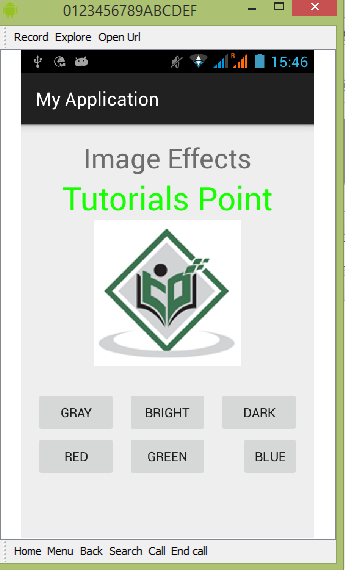
現在,如果您檢視您的裝置螢幕,您將看到一個 Android 影像以及三個按鈕。
現在只需選擇“灰色”按鈕,它會將您的影像轉換為灰度並更新 UI。如下所示:
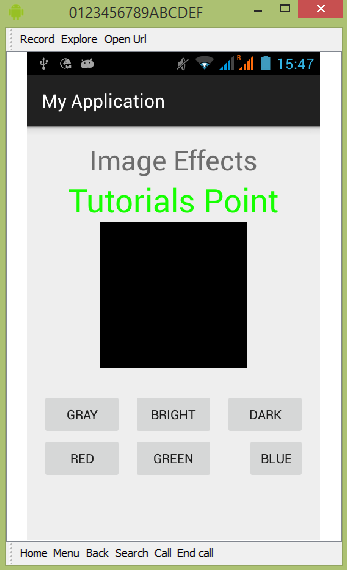
現在點選“明亮”按鈕,它會為影像的每個畫素新增一些值,從而產生亮度的錯覺。如下所示:
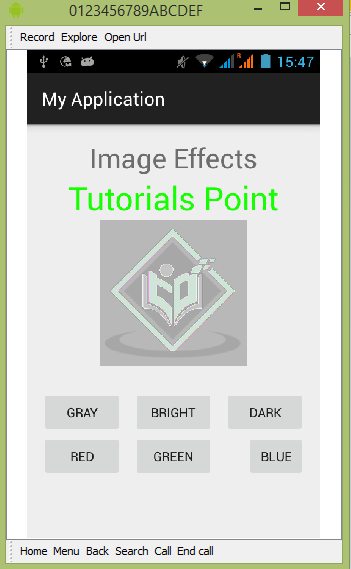
現在點選“黑暗”按鈕,它會從影像的每個畫素中減去一些值,從而產生黑暗的錯覺。如下所示:
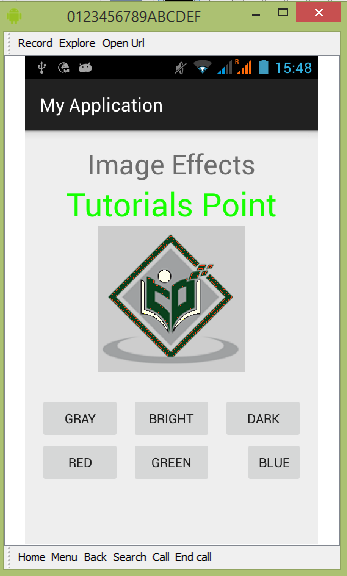
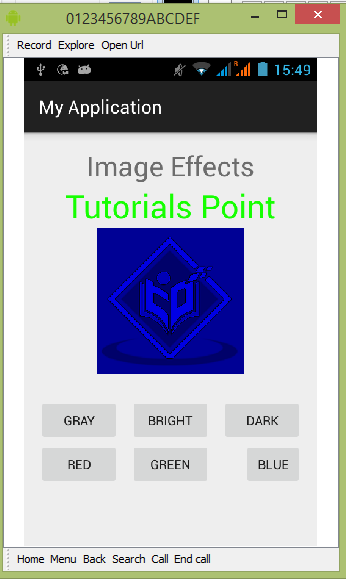
現在點選“紅色”按鈕,它會從影像的每個畫素中減去一些值,從而產生黑暗的錯覺。如下所示:
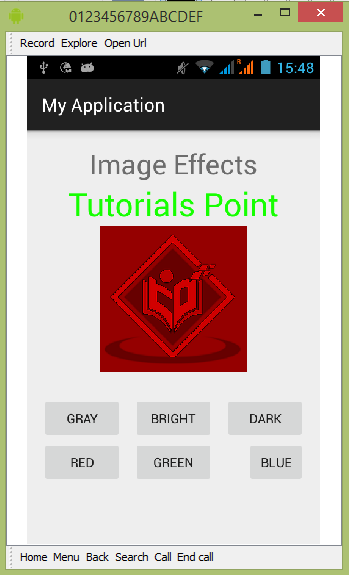
現在點選“綠色”按鈕,它會從影像的每個畫素中減去一些值,從而產生黑暗的錯覺。如下所示:
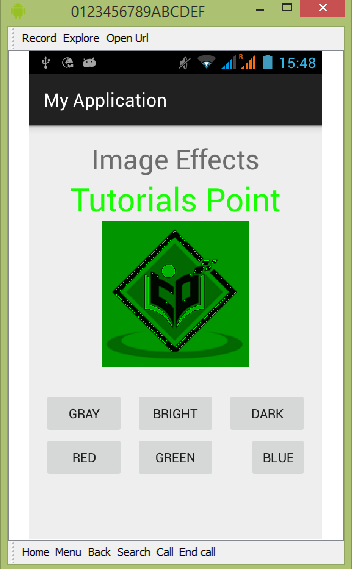
現在點選“藍色”按鈕,它會從影像的每個畫素中減去一些值,從而產生黑暗的錯覺。如下所示: