- Windows 10 開發教程
- Windows 10 - 首頁
- Windows 10 - 簡介
- Windows 10 – UWP
- Windows 10 – 第一個應用
- Windows 10 - 應用商店
- Windows 10 - XAML 控制元件
- Windows 10 - 資料繫結
- Windows 10 - XAML 效能
- Windows 10 - 自適應設計
- Windows 10 - 自適應 UI
- Windows 10 - 自適應程式碼
- Windows 10 - 檔案管理
- Windows 10 - SQLite 資料庫
- Windows 10 – 通訊
- Windows 10 - 應用本地化
- Windows 10 - 應用生命週期
- Windows 10 - 後臺執行
- Windows 10 - 應用服務
- Windows 10 - Web 平臺
- Windows 10 - 連線體驗
- Windows 10 - 導航
- Windows 10 - 網路
- Windows 10 - 雲服務
- Windows 10 - 動態磁貼
- Windows 10 - 共享契約
- Windows 10 - 移植到 Windows
- Windows 10 有用資源
- Windows 10 - 快速指南
- Windows 10 - 有用資源
- Windows 10 - 討論
Windows 10 開發 - XAML 效能
應用程式的效能,例如應用程式啟動速度或導航顯示下一段內容的速度等,非常重要。
應用程式的效能可能會受到許多因素的影響,包括 XAML 渲染引擎解析應用程式中所有 XAML 程式碼的能力。XAML 是建立 UI 的強大工具,但透過使用 Windows 10 應用程式中現在可用的新技術,可以使其更強大。
例如,在您的應用程式中,某些內容您希望在頁面載入時顯示,之後不再需要。也可能在啟動時不需要載入所有 UI 元素。
在 Windows 10 應用中,XAML 中添加了一些新功能,這些功能提高了 XAML 效能。
可以使用以下技術提高任何通用 Windows 應用程式的效能:
- 漸進式渲染
- 延遲載入
漸進式渲染
在 Windows 10 中,XAML 引入了兩個全新且非常酷的功能。它們是:
x:Bind
這是 XAML 中引入的一種用於繫結的新語法,其工作方式與Binding語法幾乎相同。x:Bind有兩個主要區別:它提供編譯時語法驗證和更好的效能。
x:Phase
它提供了一種優先渲染資料模板中 XAML 控制元件的功能。每個 UI 元素只能指定一個階段。如果指定了階段,則該階段將應用於元素上的所有繫結。如果未指定階段,則假定為階段 0。
在通用 Windows 平臺 (UWP) 應用程式中,這兩個新功能可提高效能。它也可以用於遷移到 Windows 10 的現有 Windows 8.x 應用程式。
下面是一個示例,其中員工物件使用x:Bind關鍵字與GridView繫結。
<Page
   x:Class = "XAMLPhase.MainPage"
   xmlns = "http://schemas.microsoft.com/winfx/2006/xaml/presentation"
   xmlns:x = "http://schemas.microsoft.com/winfx/2006/xaml"
   xmlns:local = "using:XAMLPhase"
   xmlns:d = "http://schemas.microsoft.com/expression/blend/2008"
   xmlns:mc = "http://schemas.openxmlformats.org/markup-compatibility/2006"
   mc:Ignorable = "d">

   <Grid Background = "{ThemeResource ApplicationPageBackgroundThemeBrush}">
      <GridView Name = "Presidents" ItemsSource = "{Binding}" Height = "300"
         Width = "400" Margin = "50">

         <GridView.ItemTemplate>
            <DataTemplate x:DataType = "local:Employee">

               <StackPanel Orientation = "Horizontal" Margin = "2">
                  <TextBlock Text = "{x:Bind Name}" Width = "95" Margin = "2" />
                  <TextBlock Text = "{x:Bind Title}" Width = "95" Margin = "2"
                     x:Phase = "1"/>
               </StackPanel>

            </DataTemplate>
         </GridView.ItemTemplate>

      </GridView>

   </Grid>

</Page>
在上例 XAML 程式碼中,x:Phase = "1" 與 Title 一起定義。因此,在第一階段,將渲染Name,然後渲染Title。
下面是 C# 中Employee 類的實現。
using System.Collections.ObjectModel;
using System.ComponentModel;
using System.Runtime.CompilerServices;
using Windows.UI.Xaml.Controls;

// The Blank Page item template is documented at
   http://go.microsoft.com/fwlink/?LinkId=402352&clcid=0x409

namespace XAMLPhase {

   /// <summary>
      /// An empty page that can be used on its own or navigated to within a Frame.
   /// </summary>

   public sealed partial class MainPage : Page {
      public MainPage() {
         this.InitializeComponent();
         DataContext = Employee.GetEmployees();
      }
   }

   public class Employee : INotifyPropertyChanged {
      private string name;

      public string Name {
         get { return name; }

         set {
            name = value;
            RaiseProperChanged();
         }
      }

      private string title;

      public string Title {
         get { return title; }

         set {
            title = value;
            RaiseProperChanged();
         }
      }

      public static Employee GetEmployee() {

         var emp = new Employee() {
            Name = "Waqas",
            Title = "Software Engineer"
         };

         return emp;
      }

      public event PropertyChangedEventHandler PropertyChanged;

      private void RaiseProperChanged(
         [CallerMemberName] string caller = "") {

         if (PropertyChanged != null) {
            PropertyChanged(this, new PropertyChangedEventArgs(caller));
         }

      }

      public static ObservableCollection<Employee> GetEmployees() {
         var employees = new ObservableCollection<Employee>();

         employees.Add(new Employee() { Name = "Ali", Title = "Developer" });
         employees.Add(new Employee() { Name = "Ahmed", Title = "Programmer" });
         employees.Add(new Employee() { Name = "Amjad", Title = "Desiner" });
         employees.Add(new Employee() { Name = "Waqas", Title = "Programmer" });
         employees.Add(new Employee() { Name = "Bilal", Title = "Engineer" });
         employees.Add(new Employee() { Name = "Waqar", Title = "Manager" });

         return employees;
      }

   }

}
執行上述程式碼後,您將看到以下視窗。
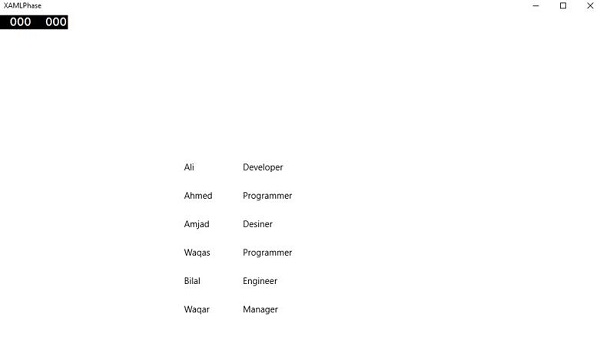
X:Phase與x:Bind一起用於增量渲染ListView和GridView項,並改善平移體驗。
延遲載入
延遲載入是一種技術,可用於透過減少應用程式啟動時的 XAML UI 元素數量來最大限度地減少啟動載入時間。如果您的應用程式包含 30 個 UI 元素,而使用者在啟動時不需要所有這些元素,則所有不需要的元素都可以透過延遲載入來節省一些載入時間。
x:DeferLoadStrategy = "Lazy" 會延遲建立元素及其子元素,這會減少啟動時間,但會略微增加記憶體使用量。
可以使用在元素上定義的名稱呼叫FindName來實現/建立延遲元素。
建立延遲元素後,將發生以下幾件事:
將引發元素上的 Loaded 事件。
將評估元素上的任何繫結。
如果應用程式註冊為接收包含延遲元素的屬性上的屬性更改通知,則將引發該通知。
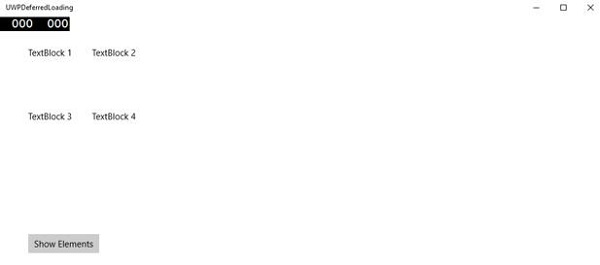
下面是一個示例,其中x:DeferLoadStrategy = "Lazy"用於包含四個文字塊的網格,並且在應用程式啟動時不會載入這些文字塊,直到您載入它。
<Page
   x:Class = "UWPDeferredLoading.MainPage"
   xmlns = "http://schemas.microsoft.com/winfx/2006/xaml/presentation"
   xmlns:x = "http://schemas.microsoft.com/winfx/2006/xaml"
   xmlns:local = "using:UWPDeferredLoading"
   xmlns:d = "http://schemas.microsoft.com/expression/blend/2008"
   xmlns:mc = "http://schemas.openxmlformats.org/markup-compatibility/2006"
   mc:Ignorable = "d">

   <Grid Background = "{ThemeResource ApplicationPageBackgroundThemeBrush}">
      <Grid x:Name = "DeferredGrid" x:DeferLoadStrategy = "Lazy" Margin = "50">
         <Grid.RowDefinitions>
            <RowDefinition Height = "Auto" />
            <RowDefinition Height = "Auto" />
         </Grid.RowDefinitions>

         <Grid.ColumnDefinitions>
            <ColumnDefinition Width = "Auto" />
            <ColumnDefinition Width = "Auto" />
         </Grid.ColumnDefinitions>

         <TextBlock Height = "100" Width = "100" Text = "TextBlock 1" Margin = "0,0,4,4" />

         <TextBlock Height = "100" Width = "100" Text = "TextBlock 2"
            Grid.Column = "1" Margin = "4,0,0,4" />

         <TextBlock Height = "100" Width = "100" Text = "TextBlock 3"
            Grid.Row = "1" Margin = "0,4,4,0" />

         <TextBlock Height = "100" Width = "100" Text = "TextBlock 4"
            Grid.Row = "1" Grid.Column = "1" Margin = "4,4,0,0" />
      </Grid>

      <Button x:Name = "RealizeElements" Content = "Show Elements"
         Click = "RealizeElements_Click" Margin = "50"/>

   </Grid>

</Page>
以下程式是單擊事件的實現,其中網格載入到應用程式主頁面上。
using Windows.UI.Xaml;
using Windows.UI.Xaml.Controls;

// The Blank Page item template is documented at
   http://go.microsoft.com/fwlink/?LinkId=402352&clcid=0x409

namespace UWPDeferredLoading {

   /// <summary>
      /// An empty page that can be used on its own or navigated to within a Frame.
   /// </summary>

   public sealed partial class MainPage : Page {
      public MainPage() {
         this.InitializeComponent();
      }

      private void RealizeElements_Click(object sender, RoutedEventArgs e) {
         this.FindName("DeferredGrid"); // This will realize the deferred grid
      }

   }

}
編譯並執行上述程式碼後,您只會看到一個按鈕。文字塊不會在啟動時載入。

現在,當您單擊顯示元素按鈕時,它將載入文字塊,這將提高應用程式的啟動效能。