- Windows 10 開發教程
- Windows 10 - 主頁
- Windows 10 - 簡介
- Windows 10 – UWP
- Windows 10 – 第一個應用
- Windows 10 - 應用商店
- Windows 10 - XAML 控制元件
- Windows 10 - 資料繫結
- Windows 10 - XAML 效能
- Windows 10 - 自適應設計
- Windows 10 - 自適應 UI
- Windows 10 - 自適應程式碼
- Windows 10 - 檔案管理
- Windows 10 - SQLite 資料庫
- Windows 10 – 通訊
- Windows 10 - 應用本地化
- Windows 10 - 應用生命週期
- Windows 10 - 後臺執行
- Windows 10 - 應用服務
- Windows 10 - Web 平臺
- Windows 10 - 連線體驗
- Windows 10 - 導航
- Windows 10 - 網路
- Windows 10 - 雲服務
- Windows 10 - 即時磁貼
- Windows 10 - 共享契約
- Windows 10 - 移植到 Windows
- Windows 10 有用資源
- Windows 10 - 快速指南
- Windows 10 - 有用資源
- Windows 10 - 討論
Windows 10 開發 - 自適應程式碼
在本章中,我們將演示如何使您的應用程式適應 Windows 10 支援的不同裝置。我們已經瞭解瞭如何適應您的 UI 以及 UWP 應用程式中使用的所有技巧、技術和控制元件。
現在,我們將學習如何適應您的程式碼,因為
應用程式程式碼在所有裝置上並不相同。
使用的 API,特別是針對 Xbox 的 API,在移動裝置上不可用。HoloLens 等裝置也是如此。

自適應程式碼可以根據條件啟用您的應用程式,並在特定裝置系列和/或特定版本的平臺/擴充套件 API 上執行時執行程式碼。
編寫程式碼
在 Windows 10 中,您可以使用 Visual Studio 使用 C++、C#、Visual Basic 或 JavaScript 來實現 UWP 應用程式。
使用 C# 和 Visual Basic,您可以使用 XAML 進行 UI 設計。
使用 C++,您可以使用 DirectX 而不是 XAML。
對於 JavaScript,您可以使用 HTML 作為您的表示層,它是一個跨平臺的 Web 標準。
Windows Core API 在所有裝置上都以相同的方式執行,其中包含程式碼和 UI 所需的大部分功能。但是,對於針對特定裝置系列的程式碼和 UI,您需要使用自適應程式碼和自適應 UI。
呼叫目標裝置系列未實現的 API -
UI 可以輕鬆適應不同的螢幕,但不同的裝置系列不僅僅具有不同的螢幕尺寸,還有更多差異。
例如,手機有一些硬體按鈕,如後退和攝像頭,這些按鈕在其他裝置(如 PC)上可能不可用。
預設情況下,核心 API 包含適用於所有裝置的大部分功能,但可以透過在您的 UWP 應用程式中引用擴充套件 SDK(就像外部程式集一樣)來使用裝置特定的功能。
要新增應用程式中需要的任何特定擴充套件 SDK,請按照以下步驟操作 -
右鍵單擊引用。
選擇“新增引用...”。將開啟以下對話方塊。
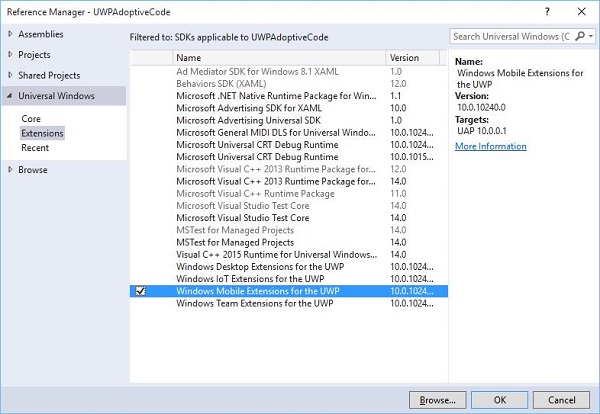
新增擴充套件就像新增專案引用一樣簡單。
現在,您可以從列表中新增任何擴充套件 SDK,其中包含桌面擴充套件、物聯網擴充套件和移動擴充套件等。
桌面和移動擴充套件是兩種最常見的平臺擴充套件 SDK。例如,移動擴充套件啟用了使用硬體攝像頭按鈕所需的 API。
您可以使用Windows.Foundation.Metadata.ApiInformation 類方法檢查裝置功能,如果當前裝置上支援該型別,則該方法返回布林輸出。例如,您可以使用以下程式碼啟用 Windows 應用以使用攝像頭按鈕 -
bool isHardwareButtonsAPIPresent =
   Windows.Foundation.Metadata.ApiInformation.
   IsTypePresent("Windows.Phone.UI.Inpu t.HardwareButtons");

if (isHardwareButtonsAPIPresent) {
   Windows.Phone.UI.Input.HardwareButtons.CameraPressed += HardwareButtons_CameraPressed;
}
只有在裝置上啟用了移動擴充套件 SDK 時,手機攝像頭按鈕程式碼才會執行。類似地,您還可以使用IsEventPresent、IsMethodPresent、IsPropertyPresent代替IsTypePresent來檢查當前 API 版本中的任何特定事件、方法或屬性,如下所示。
bool isHardwareButtons_CameraPressedAPIPresent =
   Windows.Foundation.Metadata.ApiInformation.IsEventPresent
   ("Windows.Phone.UI.Input.HardwareButtons", "CameraPressed");
UWP 中的 Win32 API
通用 Windows 平臺 (UWP) 應用程式或 Windows 執行時元件(使用 C++/CX 編寫)可以訪問 Win32 API,這些 API 現在也是 UWP 的一部分。所有 Windows 10 裝置系列都可以透過將應用程式與Windowsapp.lib連結來實現 Win32 API。
Windowsapp.lib是一個“傘形”庫,提供 UWP API 的匯出。連結到Windowsapp.lib將向您的應用新增對所有 Windows 10 裝置系列中存在的dll的依賴項。
讓我們來看一個簡單的示例,其中應用程式同時針對桌面和手機。因此,當應用程式在桌面上執行時,它不會顯示狀態列,但當相同的應用程式在手機上執行時,它將顯示狀態列。
以下是新增不同控制元件的 XAML 程式碼。
<Page
   x:Class = "UWPAdoptiveCode.MainPage"
   xmlns = "http://schemas.microsoft.com/winfx/2006/xaml/presentation"
   xmlns:x = "http://schemas.microsoft.com/winfx/2006/xaml"
   xmlns:local = "using:UWPAdoptiveCode"
   xmlns:d = "http://schemas.microsoft.com/expression/blend/2008"
   xmlns:mc = "http://schemas.openxmlformats.org/markup-compatibility/2006"
   mc:Ignorable = "d">

   <Page.Background>
      <SolidColorBrush Color = "Green"/>
   </Page.Background>

   <Page.BottomAppBar>
      <CommandBar x:Name = "commandBar" >
         <AppBarButton Icon = "Accept" Label = "appbarbutton"/>
         <AppBarButton Icon = "Cancel" Label = "appbarbutton"/>
      </CommandBar>
   </Page.BottomAppBar>

   <Grid Background = "AliceBlue">

      <VisualStateManager.VisualStateGroups>

         <VisualStateGroup>

            <VisualState>
               <VisualState.StateTriggers>
                  <local:DeviceFamilyTrigger DeviceFamily = "Desktop" />
               </VisualState.StateTriggers>

               <VisualState.Setters>
                  <Setter Target = "StatusBarControls.Visibility"
                     Value = "Collapsed"/>
               </VisualState.Setters>

            </VisualState>

         </VisualStateGroup>

      </VisualStateManager.VisualStateGroups>

      <StackPanel HorizontalAlignment = "Left" Margin = "75,164,0,0"
         VerticalAlignment = "Top" >

         <RadioButton x:Name = "ShowAppBarRadioButton" Content = "Show AppBar"
            HorizontalAlignment = "Stretch" VerticalAlignment = "Stretch"
            IsChecked = "True" Checked = "RadioButton_Checked"/>

         <RadioButton x:Name = "ShowOpaqueAppBarRadioButton"
            Content = "Show Transparent AppBar" HorizontalAlignment = "Stretch"
            VerticalAlignment = "Stretch" Checked = "RadioButton_Checked"/>

         <RadioButton x:Name = "HideAppBarRadioButton" Content = "Hide AppBar"
            HorizontalAlignment = "Stretch" VerticalAlignment = "Stretch"
            Checked = "RadioButton_Checked"/>

      </StackPanel>

      <StackPanel x:Name = "StatusBarControls" Orientation = "Vertical"
         Margin = "75,350,0,0" Visibility = "Visible">

         <CheckBox x:Name = "StatusBarBackgroundCheckBox"
            Content = "Set StatusBar Background"
            Checked = "StatusBarBackgroundCheckBox_Checked"
            Unchecked = "StatusBarBackgroundCheckBox_Unchecked"/>

         <CheckBox x:Name = "StatusBarHiddenCheckBox"
            Content = "Set StatusBar Hidden" Checked = "StatusBarHiddenCheckBox_Checked"
            Unchecked = "StatusBarHiddenCheckBox_Unchecked"/>

      </StackPanel>

   </Grid>

</Page>
以下是不同事件的 C# 實現。
using Windows.UI;
using Windows.UI.Xaml;
using Windows.UI.Xaml.Controls;

// The Blank Page item template is documented at
   http://go.microsoft.com/fwlink/?LinkId=402352&clcid=0x409

namespace UWPAdoptiveCode {
   /// <summary>
      /// An empty page that can be used on its own or navigated to within a Frame.
   /// </summary>

   public sealed partial class MainPage : Page {

      private Color? DefaultTitleBarButtonsBGColor;
      private Color? DefaultTitleBarBGColor;

      public MainPage() {
         this.InitializeComponent();

         //Windows.UI.ViewManagement.ApplicationView.GetForCurrentView().
            VisibleBoundsCh anged += MainPage_VisibleBoundsChanged;

         var viewTitleBar = Windows.UI.ViewManagement.ApplicationView.
            GetForCurrentView().TitleBar;

         DefaultTitleBarBGColor = viewTitleBar.BackgroundColor;
         DefaultTitleBarButtonsBGColor = viewTitleBar.ButtonBackgroundColor;
      }

      private void RadioButton_Checked(object sender, RoutedEventArgs e) {

         // Bottom AppBar shows on Desktop and Mobile
         if (ShowAppBarRadioButton != null) {

            if (ShowAppBarRadioButton.IsChecked.HasValue &&
               (ShowAppBarRadioButton.IsChecked.Value == true)) {
                 commandBar.Visibility = Windows.UI.Xaml.Visibility.Visible;
                 commandBar.Opacity = 1;
            } else {
               commandBar.Visibility = Windows.UI.Xaml.Visibility.Collapsed;
            }
         }

         if (ShowOpaqueAppBarRadioButton != null) {

            if (ShowOpaqueAppBarRadioButton.IsChecked.HasValue &&
               (ShowOpaqueAppBarRadioButton.IsChecked.Value == true)){
                  commandBar.Visibility = Windows.UI.Xaml.Visibility.Visible;
                  commandBar.Background.Opacity = 0;
            } else{
               commandBar.Background.Opacity = 1;
            }
         }

      }

      private void StatusBarHiddenCheckBox_Checked(object sender, RoutedEventArgs e){

         // StatusBar is Mobile only
         if (Windows.Foundation.Metadata.ApiInformation.
            IsTypePresent("Windows.UI.ViewManag ement.StatusBar")){
               var ignore = Windows.UI.ViewManagement.StatusBar.GetForCurrentView().HideAsync();
         }
      }

      private void StatusBarHiddenCheckBox_Unchecked(object sender, RoutedEventArgs e){

         // StatusBar is Mobile only
         if (Windows.Foundation.Metadata.ApiInformation.
            IsTypePresent("Windows.UI.ViewManag ement.StatusBar")){
               var ignore = Windows.UI.ViewManagement.StatusBar.GetForCurrentView().ShowAsync();
         }
      }

      private void StatusBarBackgroundCheckBox_Checked(object sender, RoutedEventArgs e){

         // StatusBar is Mobile only
         if (Windows.Foundation.Metadata.ApiInformation.
            IsTypePresent("Windows.UI.ViewManag ement.StatusBar")){

               Windows.UI.ViewManagement.StatusBar.GetForCurrentView().
                  BackgroundColor = Windows.UI.Colors.Blue;

               Windows.UI.ViewManagement.StatusBar.GetForCurrentView().
                   BackgroundOpacity = 1;
         }
      }

      private void StatusBarBackgroundCheckBox_Unchecked(object sender, RoutedEventArgs e){

         // StatusBar is Mobile only
         if (Windows.Foundation.Metadata.ApiInformation.
            IsTypePresent("Windows.UI.ViewManag ement.StatusBar")){
               Windows.UI.ViewManagement.StatusBar.GetForCurrentView().
                  BackgroundOpacity = 0;
         }
      }

   }

   public class DeviceFamilyTrigger : StateTriggerBase{

      //private variables
      private string _deviceFamily;

      //Public property
      public string DeviceFamily {

         get {
            return _deviceFamily;
         }
         set{
            _deviceFamily = value;
            var qualifiers = Windows.ApplicationModel.Resources.Core.ResourceContext.
               GetForCurrentView().Qua lifierValues;

            if (qualifiers.ContainsKey("DeviceFamily"))
               SetActive(qualifiers["DeviceFamily"] == _deviceFamily);
            else
               SetActive(false);
         }
      }
   }
}
當以上程式碼在手機上編譯並執行時,您將看到以下視窗。
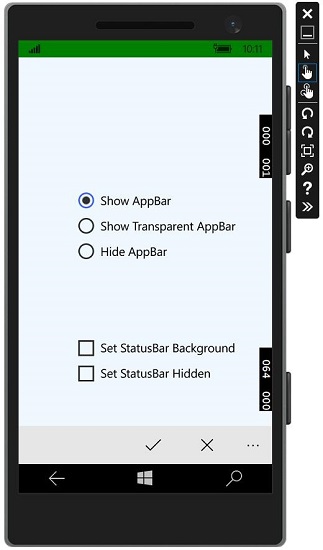
您可以使用複選框更改狀態列的背景顏色,如影像所示。
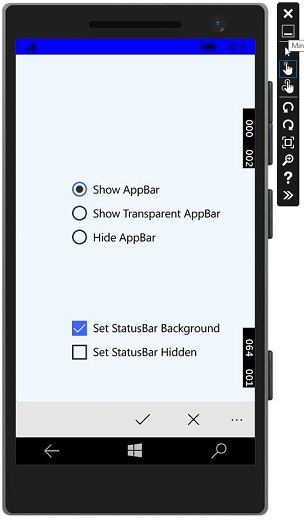
您還可以隱藏狀態列。
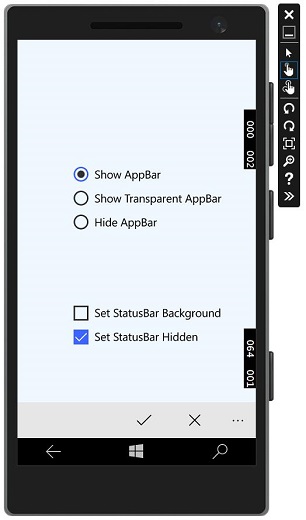
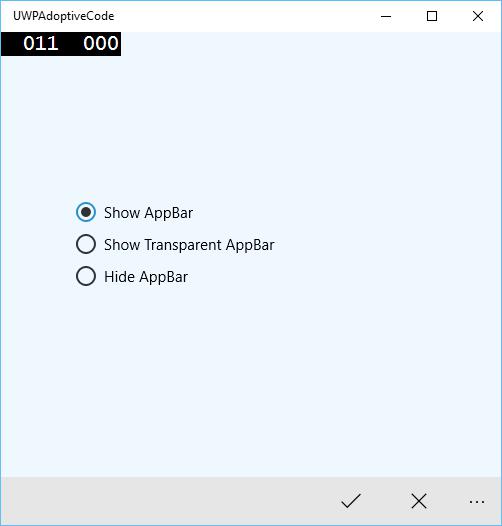
現在,當您在桌面裝置上執行相同的應用程式時,您將看到以下視窗,其中狀態列和特定於狀態列的複選框不可見。