
- WPF 教程
- WPF - 首頁
- WPF - 概述
- WPF - 環境設定
- WPF - Hello World
- WPF - XAML 概述
- WPF - 元素樹
- WPF - 依賴屬性
- WPF - 路由事件
- WPF - 控制元件
- WPF - 佈局
- WPF - 佈局巢狀
- WPF - 輸入
- WPF - 命令列
- WPF - 資料繫結
- WPF - 資源
- WPF - 模板
- WPF - 樣式
- WPF - 觸發器
- WPF - 除錯
- WPF - 自定義控制元件
- WPF - 異常處理
- WPF - 本地化
- WPF - 互動
- WPF - 2D 圖形
- WPF - 3D 圖形
- WPF - 多媒體
- WPF 有用資源
- WPF - 快速指南
- WPF - 有用資源
- WPF - 討論
WPF - 多點觸控
Windows 7 及其更高版本能夠接收來自多個觸敏裝置的輸入。WPF 應用程式還可以像處理滑鼠或鍵盤等其他輸入一樣處理觸控輸入,在發生觸控時引發事件。
當發生觸控時,WPF 會公開兩種型別的事件 - **觸控事件** 和 **操作事件**。觸控事件提供有關觸控式螢幕上每個手指及其移動的原始資料。操作事件將輸入解釋為某些操作。本節將討論這兩種型別的事件。
開發能夠響應觸控的應用程式需要以下元件。
- Microsoft Visual Studio 2010 或更高版本。
- Windows 7 或更高版本。
- 支援 Windows Touch 的裝置,例如觸控式螢幕。
在討論觸控輸入時,通常會使用以下術語 -
**觸控** - 在 Windows 7 或更高版本中可以識別的使用者輸入型別。觸控輸入由觸敏螢幕發起。
**多點觸控** - 來自多個點同時發生的輸入型別。在 WPF 中,當討論觸控時,通常是指多點觸控。
**操作** - 當觸控被推斷為應用於物件的物理動作時發生。在 WPF 中,操作事件將輸入解釋為平移、擴充套件或旋轉操作。
**觸控裝置** - 代表產生觸控輸入的裝置,例如觸控式螢幕上的單個手指。
示例
為了理解所有這些概念,讓我們建立一個名為 WPFTouchInput 的新 WPF 專案。
從工具箱中將一個矩形拖到設計視窗,並用影像或任何顏色填充矩形。如果要使用影像,請不要忘記將影像包含在您的解決方案中,否則程式將無法執行。
以下 XAML 程式碼使用不同的屬性和事件初始化一個矩形。
<Window x:Class = "WPFMultiTouchInput.MainWindow"
   xmlns = "http://schemas.microsoft.com/winfx/2006/xaml/presentation"
   xmlns:x = "http://schemas.microsoft.com/winfx/2006/xaml"
   xmlns:d = "http://schemas.microsoft.com/expression/blend/2008"
   xmlns:mc = "http://schemas.openxmlformats.org/markup-compatibility/2006"
   xmlns:local = "clr-namespace:WPFMultiTouchInput"
   mc:Ignorable = "d" Title = "MainWindow" Height = "350" Width = "604">

   <Window.Resources>
      <MatrixTransform x:Key = "InitialMatrixTransform">
         <MatrixTransform.Matrix>
            <Matrix OffsetX = "200" OffsetY = "200"/>
         </MatrixTransform.Matrix>
      </MatrixTransform>
   </Window.Resources>

   <Canvas>
      <Rectangle Name = "manRect" Width = "321" Height = "241"
         RenderTransform = "{StaticResource InitialMatrixTransform}"
         IsManipulationEnabled = "true" Canvas.Left = "-70" Canvas.Top = "-170">
         <Rectangle.Fill>
            <ImageBrush ImageSource = "Images/DSC_0076.JPG"/>
         </Rectangle.Fill>
      </Rectangle>
   </Canvas>

</Window>
以下是不同操作事件的實現 -
using System.Windows;
using System.Windows.Input;
using System.Windows.Media;
using System.Windows.Shapes;

namespace WPFMultiTouchInput {

   public partial class MainWindow : Window {

      public MainWindow() {
         InitializeComponent();
      }

      void Window_ManipulationStarting(object sender, ManipulationStartingEventArgs e) {
         e.ManipulationContainer = this;
         e.Handled = true;
      }

      void Window_ManipulationDelta(object sender, ManipulationDeltaEventArgs e) {
         Rectangle rectToMove = e.OriginalSource as Rectangle;
         Matrix rectsMatrix = ((MatrixTransform)rectToMove.RenderTransform).Matrix;

         rectsMatrix.RotateAt(e.DeltaManipulation.Rotation, e.ManipulationOrigin.X, e.ManipulationOrigin.Y);

         rectsMatrix.ScaleAt(e.DeltaManipulation.Scale.X, e.DeltaManipulation.Scale.X,
            e.ManipulationOrigin.X, e.ManipulationOrigin.Y);

         rectsMatrix.Translate(e.DeltaManipulation.Translation.X,
            e.DeltaManipulation.Translation.Y);

         rectToMove.RenderTransform = new MatrixTransform(rectsMatrix);
         Rect containingRect = new Rect(((FrameworkElement)e.ManipulationContainer).RenderSize);

         Rect shapeBounds = rectToMove.RenderTransform.TransformBounds(new Rect(rectToMove.RenderSize));

         if (e.IsInertial && !containingRect.Contains(shapeBounds)) {
            e.Complete();
         }

         e.Handled = true;
      }

      void Window_InertiaStarting(object sender, ManipulationInertiaStartingEventArgs e) {
         e.TranslationBehavior.DesiredDeceleration = 10.0 * 96.0 / (1000.0 * 1000.0);
         e.ExpansionBehavior.DesiredDeceleration = 0.1 * 96 / (1000.0 * 1000.0);
         e.RotationBehavior.DesiredDeceleration = 720 / (1000.0 * 1000.0);
         e.Handled = true;
      }

   }
}
編譯並執行上述程式碼後,將生成以下視窗。
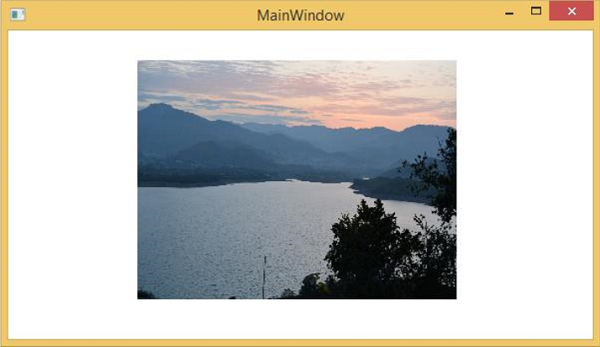
現在,您可以在觸控式螢幕上用手指旋轉、放大和縮小此影像。
wpf_input.htm
廣告