
第一章 - 認識數字
引言
幾千年前,人們用手指計數到10。如果物體的數量超過10,他們使用記號。
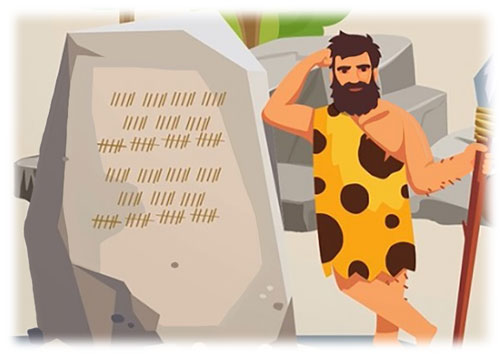
伊尚戈骨
伊尚戈骨是在非洲剛果國發現的。這些骨頭上刻有64道類似記號的劃痕,用於記錄數字。但這對於計數大數來說是不夠的。
數字系統
蘇美爾人和埃及人發展了自己的數字系統,但它們都有各自的問題。
蘇美爾數字系統並不固定或標準化。每個城市都有自己不同的寫數字的方式。
埃及人使用符號來表示數字。這些符號適合計數,但對於表示大數效率低下。
隨著人類文明的發展,他們需要更先進的數字系統。
羅馬數字系統
羅馬數字系統在中世紀後期廣泛用於歐洲。羅馬數字至今仍在鐘錶和國王、君主、教皇的名字中使用,例如查理四世、教皇保羅二世、理查三世等等。
羅馬數字系統中沒有零。
印度-阿拉伯數字系統
目前,印度-阿拉伯數字系統在世界各地使用。該系統大約在公元7世紀在印度發展起來。
最初,它只有1到9的數字。零0這個數字是在後來由傑出的印度天文學家和數學家阿耶波多發明後新增的。
後來,義大利數學家萊昂納多·斐波那契將這個系統引入了歐洲。
比較數字
數字的位值
數字中不同位置的數字具有不同的位值。
- 一位數只有一個個位。
- 兩位數有十位和個位。
- 三位數有百位、十位和個位。
比較一組數字時,我們考慮最左邊的數字,因為它的位值是該數字所有數字中最大的。
- 個位上的數字是1的倍數。
- 十位上的數字是10的倍數。
- 百位上的數字是100的倍數,以此類推。
示例
Question: Compare the numbers: 893 and 398.
Solution:
   The number 893 has 8 hundreds, 9 tens, and 3 ones
   The number 398 has 3 hundreds, 9 tens, and 8 ones.
   893 has more number of hundreds than 398.
   Hence, 893 > 398
可以使用以下規則比較一組數字。
規則1
計算每個數字的位數。
- 數字位數越多,數字越大。
- 但0在非零數字之前的例外情況除外。例如,數字00073只有兩位數,因為前面的0被忽略了。
示例
Question: Identify the largest and the smallest numbers among 9785, 879, 94567, and 78.
Solution:
   The number 94567 has 5 digits; it is the largest in the given list.
   The number 78 has only 2 digits; it is the smallest.
規則2
如果兩個數字的位數相同,則比較給定數字的最左邊的數字來確定哪個數字更大或更小。
示例
Question: Compare the numbers: 9867 and 2347.
Solution:
   Both these numbers have the same number of digits, i.e., 4.
   They have 9 and 2 as their leftmost digits.
   Since 9 > 2, the number 9867 > 2347.
示例
Question: Compare the numbers: 531 and 764.
Solution:
   Both the numbers have 3 digits each.
   The leftmost digits of the numbers are 5 and 7.
   Since 5 < 7, 531 < 764.
規則3
如果數字的位數相同且最左邊的數字相同,則比較數字的下一個最左邊的數字,並重復此過程。
示例
Question: Compare the numbers: 6791 and 6340
Solution:
   Both the numbers have the same number of digits, i.e., 4 each.
   The leftmost digits of the numbers are same, i.e., 6
   So, we move to the next leftmost digit.
   The next leftmost digits of the numbers are 7 and 3.
   Since 7 > 3, 6791 > 6340
移動數字
給定一定數量的數字,可以透過移動和排列數字來形成許多新的數字。例如:
- 用3個不同的數字,可以形成6個不同的數字。
- 用4個不同的數字,可以形成24個不同的數字,以此類推。
示例
Question: Form as many new numbers as possible with the digits 1, 7, and 9.
Solution:
   We can form 6 different numbers by shifting and shuffling the given digits.
   The numbers are:
      197, 179, 791, 719, 917, and 971
最大數和最小數
要從給定的數字中得到最大數,先寫下最大的數字,然後在其右邊寫下第二大的數字,依此類推。
同樣,要從給定的數字中得到最小數,先寫下最小的數字,然後在其右邊寫下第二小的數字,依此類推。
升序和降序
如果我們將一組數字從小到大排列,則稱為升序。
另一方面,如果數字從大到小排列,則稱為降序。
示例
Question: Form new numbers using the digits 2, 3, and 5. Identify the largest
and the smallest numbers. Then, arrange the numbers in ascending
and descending orders.
Solution:
   The numbers that can be formed using 2, 3, and 5 are:
      235, 253, 352, 325, 523, and 532
   The largest number in the list = 532
   The smallest number in the list = 235
   Arranging the numbers in ascending order:
      235, 253, 325, 352, 523, 532
   Arranging the numbers in descending order:
      532, 523, 352, 325, 253, 235
閱讀數字
在讀寫數字時,我們使用數字中數字的位值。
數字的展開式
數字的展開式是其所有數字乘以其位值的總和。
例如,數字15826可以展開為:
| 萬位 | 千位 | 百位 | 十位 | 個位 |
| 1 | 5 | 8 | 2 | 6 |
15826 = 10000 + 5000 + 800 + 20 + 6
= (1 × 10000) + (5 × 1000) + (8 × 100) + (2 × 10) + (6 × 1)
示例:數字7893的展開式是什麼?
解答
7893對應的位值是:
| 千位 | 百位 | 十位 | 個位 |
| 7 | 8 | 9 | 3 |
67893的展開式
| 7000 | 800 | 90 | 3 |
| 7 × 1000 | 8 × 100 | 9 × 10 | 3 × 1 |
示例
Question: Write and expand the number thirty-five thousand two hundred and sixty-nine.
Solution:
   Thirty-five thousand two hundred and sixty-nine is = 35,269
      35,269 = 30000 + 5000 + 200 + 60 + 9
   = 3 × 10000 + 5 × 1000 + 2 × 100 + 6 × 10 + 9 × 1
展開式到標準形式
示例
Question: Write the standard form of the number from its expanded form,
   8 × 10000 + 8 × 1000 + 6 × 100 + 1 × 10 + 9 × 1
Solution:
   8 × 10000 + 8 × 1000 + 6 × 100 + 1 × 10 + 9 × 1
   = 80,000 + 8000 + 600 + 10 + 9
   = 88,619
記數系統
我們知道如何使用位值來讀寫數字;但是一遍又一遍地在數字上寫位值不是一個好主意,尤其是在大數的情況下。
有一種更好的方法可以使用逗號來讀寫大數。
記數系統
有兩種記數系統,即:
- 印度記數系統和
- 國際記數系統。
印度記數系統
在印度記數系統中,逗號用於分隔千位、十萬位和千萬位。在這個系統中:
- 第一個逗號放在百位之後,以標記千位;
- 第二個逗號放在左邊接下來的兩位數字之後,以標記十萬位;
- 第三個逗號放在左邊接下來的兩位數字之後,以標記千萬位。
示例
Question: Write the number 528792432 as per the Indian System of Numeration.
Solution:
   Placing commas as per the Indian System of Numeration,
      52,87,92,432
   This number can be read as,
      52 crores, 87 lakhs, 92 thousands and 432
國際記數系統
在這個系統中,有 個位、十位、百位、千位和百萬位。在這裡:
- 第一個逗號放在從右數的三個數字之後,以標記千位;
- 第二個逗號放在左邊再三個數字之後,以標記百萬位。
在這個系統中,逗號每隔三個數字從右往左放置。
示例
Question: Write the number 15862942 as per the International System of Numeration.
Solution:
   Placing commas as per the International System of Numeration,
      15,862,942
   This number can be read as,
      15 million, 862 thousands and 942
   The number greater than a million is a billion and 1 billion = 1000 million.
   The same number is represented differently in the two systems of numeration.
示例
Question: Represent the number 85122263 in both the Indian System of Numeration and the International System of Numeration.
Solution:
   This number, when represented in the Indian system of numeration, is written as,
      8,51,22,263
   It's read as 8 crores, 51 lakhs, 22 thousand and 263.
   The same number, in the International system of numeration is written as,
      85,122,263
   It's read as 85 million, 122 thousand and 263.
計量單位
我們有很多工具和儀器可用於以不同的單位測量長度、重量和體積等引數。這些儀器可以用來測量從小的種子到高大的山脈。
測量長度和距離
尺子或刻度尺用於在紙上畫線。它有兩種標記:
- 大標記表示釐米 (cm)。
- 小標記表示毫米 (mm)。
這兩個單位都用於測量像鉛筆一樣又小又細的東西。
對於測量像房子一樣較大的東西,使用捲尺,其標記為毫米、釐米和米 (m)。
米比釐米或毫米大得多。
1 m = 100 cm = 1000 mm
1 cm = 10 mm
還有更大的單位,如公里 (km)
1 km = 1000 m
測量質量或重量
為了測量重量,有像毫克 (mg)、克 (g) 和千克 (kg) 這樣的單位。
克比毫克大。
1 g = 1000 mg
同樣,1 kg 比克和毫克都大。
1 kg = 1000 g
測量體積
也有不同的單位來測量體積。例如,毫升、升和千升:
1 升 (l) = 1000 毫升 (ml)
1 千升 (kl) = 1000 升 (l)
需要注意的是,在所有測量中,無論是長度、重量還是體積,某些術語是通用的,如千、釐和毫。其中:
毫 < 釐 < 千
千是基本單位的1000倍
1 km = 1000 m;1 kg = 1000 g;1 kl = 1000 l
釐是基本單位的100分之一
100 cm = 1 m
毫是基本單位的千分之一
1000 mm = 1 m;1000 mg = 1 g;1000 ml = 1 l
理解估計
什麼是估計?
估計或近似值意味著對某個數量或計算結果有一個大致的瞭解。作為估計給出的數字不是精確的數量,而是一個近似值,它可以很好地表示實際數字。
示例
通常說印度人口是13億。這不是確切的數字,而是對人口的估計。
據估計,體育場內的觀眾人數約為10,000人。這意味著觀眾人數可能在9,500人左右或11,500人左右,而不是像50,000人這樣的大數字。
四捨五入到十位
四捨五入到最接近的十位意味著將數字四捨五入到0、10、20、30等。
考慮數字13。它位於數軸上的10和20之間。在這兩個數字中,13更接近10。所以13四捨五入到10。
52四捨五入到50,因為它更接近50。
78四捨五入到80,因為它更接近80。
5與0和10的距離相等。在這種情況下,一般規則是將中間值四捨五入到較大的數字。因此,5四捨五入到10。
四捨五入到百位
這意味著將給定數字四捨五入到0、100、200、300等。
示例
Question: Round off 528, 798, and 350 to their nearest hundreds.
Solution:
   a) 528 is closer to 500; so it is rounded off to 500.
   b) 798 is closer to 800; so it is rounded off to 800.
   c) 350 is equidistant from 300 and 400. Applying general rule, it is rounded off to the larger value which is 400.
四捨五入到千位
將數字估計到最接近的千位意味著將它們估計到0、1000、2000、3000等。
- 考慮0到1000之間的數字。
- 數字2、3、4…499更接近0,因此四捨五入到0。
- 數字501、502…999更接近1000,因此四捨五入到1000。
- 500與0和1000的距離相等。根據一般規則,500四捨五入到較大的數字1000。
估計和與差
我們已經學習瞭如何將數字四捨五入。現在是時候學習如何在進行加法、減法和乘法運算時估計數字了。
示例
Question: A trader is to receive ₹13,569 from one source and₹26,785 from another.
He has to make a payment of ₹37,000 to someone else by the evening. Does the trader
have enough money for the day?
Solution:
   Rounding off ₹13,569 to thousands = ₹14,000
   Rounding off ₹26,785 to thousands = ₹27,000
   The trader will get approximately,
      ₹14,000 + ₹27,000 = ₹41,000
   He has to pay = ₹37,000
      ₹41,000 − ₹37,000 = ₹4000
   The trader has enough money for the day.
示例
Question: Estimate the difference between two numbers, 5673 − 436.
Solution:
   5,673 rounded off to thousands = 6,000
   436 rounded off to thousands = 0
      6000 − 0 = 6000
   This is not a good estimate.
   We can get a better estimate if the numbers are rounded off to the nearest hundreds.
   5,673 rounded off to hundreds = 5,700
   436 rounded off to hundreds = 400
      5700 − 400 = 5300
   So, the difference between 5673 and 436 is approximately 5300.
羅馬數字
羅馬數字起源於古羅馬。與其他數字系統一樣,羅馬數字使用不同的符號來表示不同的數字。
事實上,羅馬人使用拉丁字母中的7個符號來表示數字。
- "I" 用於表示1
- "V" 用於表示5
- "X" 用於表示10
- 同樣,L = 50,C = 100,D = 500,M = 1000
任何數字都可以使用這7個符號來書寫。但是,有一些規則需要遵守:
規則1
如果重複數字或符號,則其值將根據其出現的次數相加。例如:
- II 表示 1 + 1 = 2 (因為 I = 1)
- III 表示 1 + 1 + 1 = 3。
規則2
一個符號不能重複超過三次。
三個符號 V、L 和 D 永遠不能重複。
規則3
如果較小值的符號寫在另一個較大值符號的前面,則其值將從較大值符號中減去。例如:
- IV = 5 − 1 = 4
- IX = 10 − 1 = 9
根據此規則,不能在較高值符號之前寫兩個符號。例如:
IIV 是無效的數字。
IIV ≠ 3
III = 3
規則4
如果較小值的符號寫在較大值符號的右邊,則這兩個值將相加。例如:
VI = 5 + 1 = 6
XI = 10 + 1 = 11
規則 5
符號 V、L 和 D 不能寫在比其數值更大的符號的左邊。這意味著 V、L 和 D 的值不能從比其數值更大的符號中減去。
此外,一個值不能從比其值大十倍以上的數值中減去。例如:
I 可以從 V 中減去,即 IV = 4
I 可以從 X 中減去,即 IX = 9
但是,I 不能從 XX 中減去。因此,IXX 是一個無效的羅馬數字。
規則 6
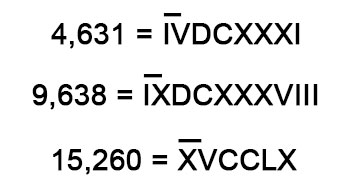
要寫出大於或等於 4000 的數字,IV、V、VI 要加上上劃線。例如:
羅馬數字的缺點
用羅馬數字書寫大數字並不容易。因此,它最終被印度-阿拉伯數字系統所取代。
羅馬數字系統的另一個主要缺點是缺少相當於“0”的符號。