
- R 教程
- R - 首頁
- R - 概覽
- R - 環境設定
- R - 基本語法
- R - 資料型別
- R - 變數
- R - 運算子
- R - 決策制定
- R - 迴圈
- R - 函式
- R - 字串
- R - 向量
- R - 列表
- R - 矩陣
- R - 陣列
- R - 因子
- R - 資料框
- R - 軟體包
- R - 資料重塑
R - 非線性最小二乘
在為迴歸分析建模真實世界資料時,我們觀察到模型的方程很少是產生線性圖表的線性方程。大多數情況下,真實世界資料的模型方程涉及較高次冪的數學函式,如 3 次冪或正弦函式。在這樣的場景中,模型的圖給出的是曲線而不是直線。線性迴歸和非線性迴歸的目標都是調整模型引數的值,以找到最接近您資料的直線或曲線。在找到這些值後,我們將能夠非常準確地估計響應變數。
在最小二乘迴歸中,我們建立一個迴歸模型,其中不同點到迴歸曲線的垂直距離的平方和最小。我們通常從一個已定義的模型開始,並假設一些係數的值。然後,我們應用 R 的 nls() 函式來獲取更準確的值以及置信區間。
語法
在 R 中建立非線性最小二乘檢驗的基本語法為 −
nls(formula, data, start)
以下是所用引數的描述 −
formula 是包括變數和引數的非線性模型公式。
data 是用於評估公式中變數的資料框。
start 是起始估計值的命名列表或命名的數字向量。
示例
我們將考慮一個非線性模型,並假設其係數的初始值。接下來,我們將檢視這些假定值的置信區間,以便判斷這些值在模型中擬合得如何。
因此,讓我們為此考慮以下方程 −
a = b1*x^2+b2
我們假設初始係數為 1 和 3,並將這些值代入 nls() 函式。
xvalues <- c(1.6,2.1,2,2.23,3.71,3.25,3.4,3.86,1.19,2.21)
yvalues <- c(5.19,7.43,6.94,8.11,18.75,14.88,16.06,19.12,3.21,7.58)

# Give the chart file a name.
png(file = "nls.png")


# Plot these values.
plot(xvalues,yvalues)


# Take the assumed values and fit into the model.
model <- nls(yvalues ~ b1*xvalues^2+b2,start = list(b1 = 1,b2 = 3))

# Plot the chart with new data by fitting it to a prediction from 100 data points.
new.data <- data.frame(xvalues = seq(min(xvalues),max(xvalues),len = 100))
lines(new.data$xvalues,predict(model,newdata = new.data))

# Save the file.
dev.off()

# Get the sum of the squared residuals.
print(sum(resid(model)^2))

# Get the confidence intervals on the chosen values of the coefficients.
print(confint(model))
當我們執行上述程式碼時,它產生以下結果 −
[1] 1.081935
Waiting for profiling to be done...
       2.5%    97.5%
b1 1.137708 1.253135
b2 1.497364 2.496484
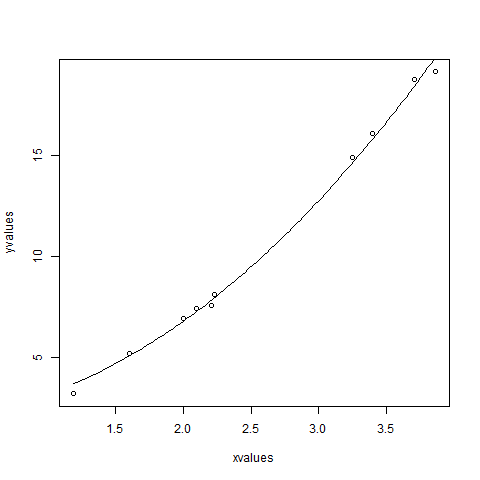
我們可以得出結論:b1 的值更接近 1,而 b2 的值更接近 2,而不是 3。
廣告