
- Behave 教程
- Behave - 首頁
- Behave - 簡介
- Behave - 安裝
- Behave - 命令列
- Behave - 配置檔案
- Behave - 特性測試設定
- Behave - Gherkin 關鍵字
- Behave - 特性檔案
- Behave - 步驟實現
- Behave - 初步步驟
- Behave - 支援的語言
- Behave - 步驟引數
- Behave - 場景大綱
- Behave - 多行文字
- Behave - 設定表
- Behave - 步驟中的步驟
- Behave - 背景
- Behave - 資料型別
- Behave - 標籤
- Behave - 列舉
- Behave - 步驟匹配器
- Behave - 正則表示式
- Behave - 可選部分
- Behave - 多方法
- Behave - 步驟函式
- Behave - 步驟引數
- Behave - 執行指令碼
- Behave - 排除測試
- Behave - 重試機制
- Behave - 報告
- Behave - 鉤子
- Behave - 除錯
- Behave 有用資源
- Behave - 快速指南
- Behave - 有用資源
- Behave - 討論
Behave - 列舉
列舉用於將多個不同的基於字串的單詞對映到值。
我們可能需要一個具有以下特徵的使用者定義資料型別:
必須匹配少數幾個單詞。
在測試執行之前預定義值。
對於上述場景,可以使用基於字串的列舉。
特性檔案
考慮一個名為“支付流程”的特性檔案的示例,如下所示:
Feature − Payment Process
Scenario − Response
      When User asks "Is payment done?"
      Then response is "No"
在步驟實現檔案中,TypeBuilder.make_enum 函式評估為提供的單詞或字串列舉提供的正則表示式模式。register_type 方法用於註冊使用者定義的型別,該型別可以在匹配步驟時解析任何型別轉換。
此外,我們將傳遞引數:用“{}”括起來的使用者定義列舉資料型別。
相應的步驟實現檔案
上面特性檔案的步驟實現檔案如下所示:
from behave import *
from behave import register_type
from parse_type import TypeBuilder
# -- ENUM: Yields True (for "yes"), False (for "no")
parse_response = TypeBuilder.make_enum({"yes": True, "no": False})
register_type(Response=parse_response)
@when('User asks "{q}"')
def step_question(context, q):
   print("Question is: ")
   print(q)
@then('response is "{a:Response}"')
def step_answer(context, a):
   print("Answer is: ")
   print(a)
輸出
執行特性檔案後獲得的輸出如下所示。這裡,我們使用了命令behave --no-capture -f plain。
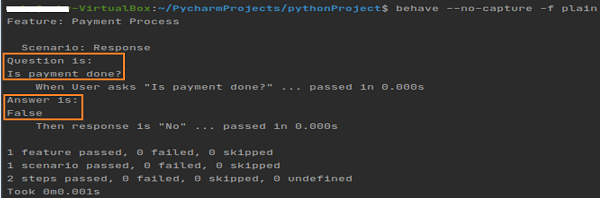
輸出顯示“支付完成了嗎?”和“False”。輸出 False 來自列舉資料型別。
廣告