- XAML 教程
- XAML - 首頁
- XAML - 概述
- XAML - 環境設定
- 在 MAC OS 上編寫 XAML 應用程式
- XAML 與 C# 程式碼
- XAML 與 VB.NET
- XAML - 構建塊
- XAML - 控制元件
- XAML - 佈局
- XAML - 事件處理
- XAML - 資料繫結
- XAML - 標記擴充套件
- XAML - 依賴屬性
- XAML - 資源
- XAML - 模板
- XAML - 樣式
- XAML - 觸發器
- XAML - 除錯
- XAML - 自定義控制元件
- XAML 有用資源
- XAML - 快速指南
- XAML - 有用資源
- XAML - 討論
XAML - 資料繫結
資料繫結是 XAML 應用程式中的一種機制,它為使用部分類的 Windows 執行時應用程式提供了一種簡單易行的方式來顯示和互動資料。在此機制中,資料的管理與資料在 UI 中的顯示方式完全分離。
資料繫結允許資料在 UI 元素和使用者介面上的資料物件之間流動。當建立繫結並且資料或業務模型發生變化時,它將自動反映更新到 UI 元素,反之亦然。也可以繫結到頁面上的另一個元素,而不是標準資料來源。資料繫結可以分為兩種型別:
- 單向資料繫結
- 雙向資料繫結
單向資料繫結
在單向繫結中,資料從其源(即儲存資料的物件)繫結到其目標(即顯示資料的物件)。
讓我們來看一個簡單的單向資料繫結的示例。以下 XAML 程式碼建立了四個文字塊,並設定了一些屬性。
<Window x:Class = "DataBindingOneWay.MainWindow"
   xmlns = "http://schemas.microsoft.com/winfx/2006/xaml/presentation"
   xmlns:x = "http://schemas.microsoft.com/winfx/2006/xaml"
   Title = "MainWindow" Height = "350" Width = "604">

   <Grid>
      <StackPanel Name = "Display">
         <StackPanel Orientation = "Horizontal" Margin = "50, 50, 0, 0">
            <TextBlock Text = "Name: " Margin = "10" Width = "100" />
            <TextBlock Margin = "10" Width = "100" Text = "{Binding Name}" />
         </StackPanel>

         <StackPanel Orientation = "Horizontal" Margin = "50,0,50,0">
            <TextBlock Text = "Title: " Margin = "10" Width = "100" />
            <TextBlock Margin = "10" Width = "100" Text = "{Binding Title}" />
         </StackPanel>
      </StackPanel>
   </Grid>

</Window>
兩個文字塊的 Text 屬性分別靜態設定為“Name”和“Title”,而其他兩個文字塊的 Text 屬性則繫結到“Name”和“Title”,它們是 Employee 類的類變數,如下所示。
using System;
using System.Collections.Generic;
using System.Linq;
using System.Text;
using System.Threading.Tasks;

namespace DataBindingOneWay {
   public class Employee {
      public string Name { get; set; }
      public string Title { get; set; }

      public static Employee GetEmployee() {
         var emp = new Employee() {
            Name = "Ali Ahmed", Title = "Developer"
         };
         return emp;
      }
   }
}
在這個類中,我們只有兩個變數,Name 和 Title,以及一個靜態方法,其中初始化 Employee 物件並返回該 Employee 物件。因此,我們繫結到一個屬性 Name 和 Title,但我們沒有選擇該屬性屬於哪個物件。最簡單的方法是將一個物件分配給 DataContext,我們在以下 C# 程式碼中繫結該物件的屬性:
using System;
using System.Windows;
using System.Windows.Controls;

namespace DataBindingOneWay {
   /// <summary>
      /// Interaction logic for MainWindow.xaml
   /// </summary>

   public partial class MainWindow : Window {
      public MainWindow() {
         InitializeComponent();
         DataContext = Employee.GetEmployee();
      }
   }
}
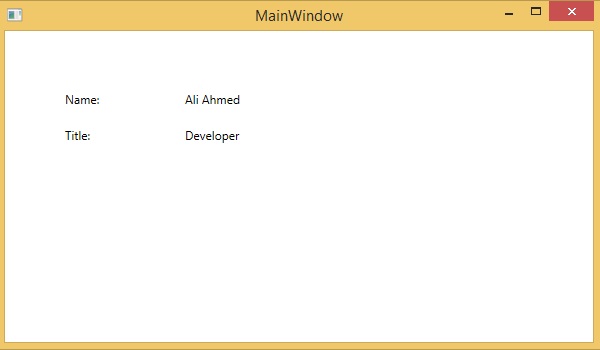
讓我們執行此應用程式,您可以在我們的 MainWindow 中立即看到我們已成功繫結到該 Employee 物件的 Name 和 Title。
雙向資料繫結
在雙向繫結中,使用者可以透過使用者介面修改資料,並使該資料在源中更新。如果源在使用者檢視檢視時發生更改,則需要更新檢視。
示例
讓我們來看以下示例,其中建立了一個帶有三個組合框項的組合框和一個文字框,並設定了一些屬性。在此示例中,我們沒有任何標準資料來源,但 UI 元素繫結到其他 UI 元素。
<Window x:Class = "XAMLTestBinding.MainWindow"
   xmlns = "http://schemas.microsoft.com/winfx/2006/xaml/presentation"
   xmlns:x = "http://schemas.microsoft.com/winfx/2006/xaml"
   Title = "MainWindow" Height = "350" Width = "604">

   <StackPanel>
      <ComboBox Name = "comboBox"  Margin = "50" Width = "100">
         <ComboBoxItem Content = "Green" />
         <ComboBoxItem Content = "Yellow" IsSelected = "True" />
         <ComboBoxItem Content = "Orange" />
      </ComboBox>

      <TextBox  Name = "textBox" Margin = "50"
         Width = "100" Height = "23" VerticalAlignment = "Top"
         Text  = "{Binding ElementName = comboBox, Path = SelectedItem.Content,
         Mode = TwoWay, UpdateSourceTrigger = PropertyChanged}"
         Background = "{Binding ElementName = comboBox, Path = SelectedItem.Content}">
      </TextBox>
   </StackPanel>

</Window>
編譯並執行上述程式碼後,將產生以下輸出。當用戶從組合框中選擇一個專案時,文字框文字和背景顏色將相應更新。
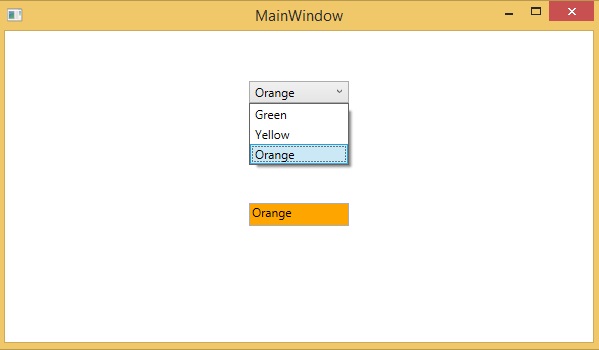
同樣,當用戶在文字框中輸入有效的顏色名稱時,組合框和文字框的背景顏色也將更新。