
- Struts 2 教程
- Struts2 - 首頁
- Struts2 - 基本 MVC 架構
- Struts2 - 概述
- Struts2 - 環境設定
- Struts2 - 架構
- Struts2 - 示例
- Struts2 - 配置
- Struts2 - Action
- Struts2 - 攔截器
- Struts2 - 結果型別
- Struts2 - 值棧/OGNL
- Struts2 - 檔案上傳
- Struts2 - 資料庫訪問
- Struts2 - 傳送郵件
- Struts2 - 驗證
- Struts2 - 國際化
- Struts2 - 型別轉換
- Struts2 - 主題/模板
- Struts2 - 異常處理
- Struts2 - 註解
- Struts 2 標籤
- Struts2 - 控制標籤
- Struts2 - 資料標籤
- Struts2 - 表單標籤
- Struts2 - Ajax 標籤
- Struts 2 整合
- Struts2 - Spring
- Struts2 - Tiles
- Struts2 - Hibernate
- Struts 2 有用資源
- Struts2 - 問答
- Struts2 - 快速指南
- Struts2 - 有用資源
- Struts2 - 討論
Struts 2 - text 標籤
text 標籤是一個通用標籤,用於呈現國際化文字訊息。請遵循以下三個步驟之一:
該訊息必須位於與關聯的 Action 同名的資源包中。在實踐中,這意味著您應該在 Java 類所在的同一包中建立一個與類同名但副檔名為 .properties 的屬性檔案。
如果未找到命名的訊息,則標籤的主體將用作預設訊息。
如果未使用主體,則將使用訊息的名稱。
讓我們檢查以下示例以瞭解text 標籤的用法:
建立 Action 類
package com.tutorialspoint.struts2;

public class HelloWorldAction {
   private String name;

   public String execute() throws Exception {
      return "success";
   }

   public String getName() {
      return name;
   }

   public void setName(String name) {
      this.name = name;
   }
}
建立檢視
讓我們使用以下內容建立HelloWorld.jsp:
<%@ taglib prefix = "s" uri = "/struts-tags"%>

<!DOCTYPE html PUBLIC "-//W3C//DTD HTML 4.01 Transitional//EN"
   "http://www.w3.org/TR/html4/loose.dtd">

<html>
   <head>
      <title>Text Tag Example</title>
   </head>

   <body>
      <s:i18n name = "HelloWorldAction">
         <s:text name = "name.success"/><br>
         <s:text name = "name.xyz">Message doesn't exists</s:text><br>
         <s:text name = "name.msg.param">
            <s:param >ZARA</s:param>
         </s:text>
      </s:i18n>
   </body>
</html>
配置檔案
讓我們建立一個與 Action 類包名稱同名的屬性檔案。因此,在本例中,我們將建立HelloWorldAction.properties檔案並將其保留在類路徑中:
name.success = This is success message
name.msg.param = The param example - param : {0}
您的struts.xml應如下所示:
<?xml version = "1.0" Encoding = "UTF-8"?>
<!DOCTYPE struts PUBLIC
   "-//Apache Software Foundation//DTD Struts Configuration 2.0//EN"
   "http://struts.apache.org/dtds/struts-2.0.dtd">

<struts>
   <constant name = "struts.devMode" value = "true" />
   <constant name = "struts.custom.i18n.resources" value = "ApplicationResources"/>

   <package name = "helloaction" extends = "struts-default">
      <action name = "hello"
         class = "com.tutorialspoint.struts2.HelloWorldAction"
         method = "execute">
         <result name = "success">/HelloWorld.jsp</result>
      </action>
   </package>
</struts>
您的web.xml應如下所示:
<?xml version = "1.0" Encoding = "UTF-8"?>
<web-app xmlns:xsi = "http://www.w3.org/2001/XMLSchema-instance"
   xmlns = "http://java.sun.com/xml/ns/javaee"
   xmlns:web = "http://java.sun.com/xml/ns/javaee/web-app_2_5.xsd"
   xsi:schemaLocation = "http://java.sun.com/xml/ns/javaee
   http://java.sun.com/xml/ns/javaee/web-app_3_0.xsd"
   id = "WebApp_ID" version = "3.0">

   <display-name>Struts 2</display-name>

   <welcome-file-list>
      <welcome-file>index.jsp</welcome-file>
   </welcome-file-list>

   <filter>
      <filter-name>struts2</filter-name>
      <filter-class>
         org.apache.struts2.dispatcher.FilterDispatcher
      </filter-class>
   </filter>

   <filter-mapping>
      <filter-name>struts2</filter-name>
      <url-pattern>/*</url-pattern>
   </filter-mapping>
</web-app>
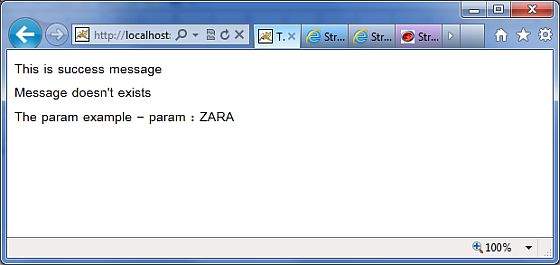
右鍵單擊專案名稱,然後單擊匯出 > WAR 檔案以建立 WAR 檔案。然後將此 WAR 部署到 Tomcat 的 webapps 目錄中。最後,啟動 Tomcat 伺服器並嘗試訪問 URL https://:8080/HelloWorldStruts2/hello.action。這將生成以下螢幕:
struts_data_tags.htm
廣告