
- Angular 6 教程
- Angular 6 - 首頁
- Angular 6 - 概述
- Angular 6 - 環境搭建
- Angular 6 - 專案搭建
- Angular 6 - 元件
- Angular 6 - 模組
- Angular 6 - 資料繫結
- Angular 6 - 事件繫結
- Angular 6 - 模板
- Angular 6 - 指令
- Angular 6 - 管道
- Angular 6 - 路由
- Angular 6 - 服務
- Angular 6 - Http 服務
- Angular 6 - Http 客戶端
- Angular 6 - 表單
- Angular 6 - 動畫
- Angular 6 - Material Design
- Angular 6 - CLI
- Angular 6 有用資源
- Angular 6 - 快速指南
- Angular 6 - 有用資源
- Angular 6 - 討論
Angular 6 - 模板
Angular 6 使用 <ng-template> 作為標籤,類似於 Angular 4,而不是 Angular 2 中使用的 <template>。Angular 4 將 <template> 更改為 <ng-template> 的原因是 <template> 標籤與 html <template> 標準標籤之間存在命名衝突。未來它將完全棄用。
現在讓我們結合if else條件使用模板,並檢視輸出。
app.component.html
<!--The content below is only a placeholder and can be replaced.-->
<div style = "text-align:center">
   <h1>
      Welcome to {{title}}.
   </h1>
</div>
<div> Months :
   <select (change) = "changemonths($event)" name = "month">
      <option *ngFor = "let i of months">{{i}}</option>
   </select>
</div>
<br/>
<div>
   <span *ngIf = "isavailable;then condition1 else condition2">Condition is valid.</span>
   <ng-template #condition1>Condition is valid from template</ng-template>
   <ng-template #condition2>Condition is invalid from template</ng-template>
</div>
<button (click) = "myClickFunction($event)">Click Me</button>
對於 Span 標籤,我們添加了帶有else條件的if語句,並將呼叫模板 condition1,否則呼叫 condition2。
模板的呼叫方式如下:
<ng-template #condition1>Condition is valid from template</ng-template>
<ng-template #condition2>Condition is invalid from template</ng-template>
如果條件為真,則呼叫 condition1 模板,否則呼叫 condition2 模板。
app.component.ts
import { Component } from '@angular/core';
@Component({
   selector: 'app-root',
   templateUrl: './app.component.html',
   styleUrls: ['./app.component.css']
})
export class AppComponent {
   title = 'Angular 6 Project!';
   //array of months.
   months = ["January", "February", "March", "April",
      "May", "June", "July", "August", "September",
      "October", "November", "December"];
   isavailable = false;
   myClickFunction(event) {
      this.isavailable = false;
   }
   changemonths(event) {
      alert("Changed month from the Dropdown");
      console.log(event);
   }
}
瀏覽器中的輸出如下:

變數isavailable 為 false,因此列印 condition2 模板。如果單擊按鈕,則將呼叫相應的模板。如果檢查瀏覽器,您會發現 DOM 中從未出現 span 標籤。以下示例將幫助您理解這一點。
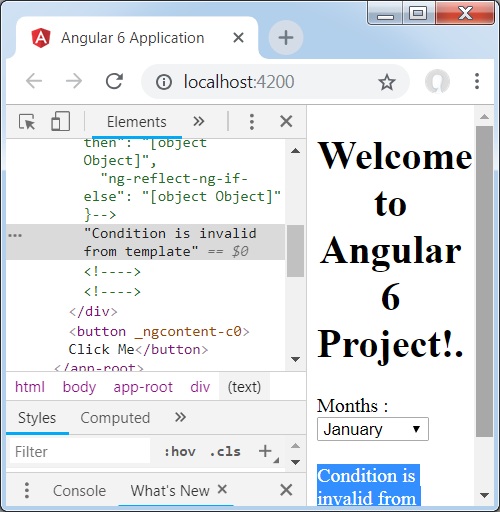
如果檢查瀏覽器,您會看到 DOM 中沒有 span 標籤。DOM 中只有“Condition is invalid from template”。
html 中的以下程式碼行將幫助我們在 DOM 中獲取 span 標籤。
<!--The content below is only a placeholder and can be replaced.-->
<div style = "text-align:center">
   <h1>
      Welcome to {{title}}.
   </h1>
</div>
<div> Months :
   <select (change) = "changemonths($event)" name = "month">
      <option *ngFor = "let i of months">{{i}}</option>
   </select>
</div>
<br/>
<div>
   <span *ngIf = "isavailable; else condition2">Condition is valid.</span>
   <ng-template #condition1>Condition is valid from template</ng-template>
   <ng-template #condition2>Condition is invalid from template</ng-template>
</div>
<button (click)="myClickFunction($event)">Click Me</button>
如果我們刪除 then 條件,則瀏覽器中會顯示“Condition is valid” 訊息,並且 span 標籤也出現在 DOM 中。例如,在app.component.ts 中,我們將isavailable 變數設定為 true。
 列印
列印
廣告