- GWT 教程
- GWT - 首頁
- GWT - 概述
- GWT - 環境設定
- GWT - 應用
- GWT - 建立應用
- GWT - 部署應用
- GWT - 使用 CSS 樣式
- GWT - 基本部件
- GWT - 表單部件
- GWT - 複雜部件
- GWT - 佈局面板
- GWT - 事件處理
- GWT - 自定義部件
- GWT - UIBinder
- GWT - RPC 通訊
- GWT - JUnit 整合
- GWT - 除錯應用
- GWT - 國際化
- GWT - 歷史類
- GWT - 書籤支援
- GWT - 日誌框架
- GWT 有用資源
- GWT - 問題與解答
- GWT - 快速指南
- GWT - 有用資源
- GWT - 討論
GWT - 標籤部件
簡介
標籤只能包含任意文字,不能解釋為 HTML。此部件使用 <div> 元素,使其以塊佈局顯示。
類宣告
以下是 com.google.gwt.user.client.ui.Label 類的宣告:
public class Label
   extends Widget
      implements HasHorizontalAlignment, HasText, HasWordWrap,
         HasDirection, HasClickHandlers, SourcesClickEvents,
            SourcesMouseEvents, HasAllMouseHandlers
CSS 樣式規則
以下預設 CSS 樣式規則將應用於所有標籤。您可以根據您的需求覆蓋它。
.gwt-Label { }
類建構函式
| 序號 | 建構函式 & 描述 |
|---|---|
| 1 |
Label() 建立一個空標籤。 |
| 2 |
protected Label(Element element) 子類可以使用此建構函式顯式地使用現有元素。 |
| 3 |
Label(java.lang.String text) 使用指定的文字建立一個標籤。 |
| 4 |
Label(java.lang.String text, boolean wordWrap) 使用指定的文字建立一個標籤。 |
類方法
| 序號 | 方法 & 描述 |
|---|---|
| 1 |
void addClickListener(ClickListener listener) 新增一個監聽器介面來接收點選事件。 |
| 2 |
void addMouseListener(MouseListener listener) 新增一個監聽器介面來接收滑鼠事件。 |
| 3 |
void addMouseWheelListener(MouseWheelListener listener) 獲取此部件的父面板。 |
| 4 |
HasDirection.Direction getDirection() 獲取部件的方向性。 |
| 5 |
HasHorizontalAlignment. HorizontalAlignmentConstant getHorizontalAlignment() 獲取水平對齊方式。 |
| 6 |
java.lang.String getText() 獲取此物件的文字。 |
| 7 |
boolean getWordWrap() 獲取是否啟用了自動換行。 |
| 8 |
void onBrowserEvent(Event event) 刪除先前新增的監聽器介面。 |
| 9 |
void removeClickListener(ClickListener listener) 此方法在部件將從瀏覽器的文件中分離之前立即呼叫。 |
| 10 |
void removeMouseListener(MouseListener listener) 刪除先前新增的監聽器介面。 |
| 11 |
void removeMouseWheelListener(MouseWheelListener listener) 刪除先前新增的監聽器介面。 |
| 12 |
void setDirection(HasDirection.Direction direction) 設定部件的方向性。 |
| 13 |
void setHorizontalAlignment(HasHorizontalAlignment. HorizontalAlignmentConstant align) 設定水平對齊方式。 |
| 14 |
void setText(java.lang.String text) 設定此物件的文字。 |
| 15 |
void setWordWrap(boolean wrap) 設定是否啟用自動換行。 |
| 16 |
static Label wrap(Element element) 建立一個 Label 部件,它包裝一個現有的 <div> 或 <span> 元素。 |
繼承的方法
此類繼承自以下類:
com.google.gwt.user.client.ui.UIObject
com.google.gwt.user.client.ui.Widget
標籤部件示例
此示例將引導您完成簡單的步驟,以顯示如何在 GWT 中使用標籤部件。按照以下步驟更新我們在GWT - 建立應用章節中建立的 GWT 應用:
| 步驟 | 描述 |
|---|---|
| 1 | 在包 com.tutorialspoint 下建立一個名為 HelloWorld 的專案,如GWT - 建立應用章節中所述。 |
| 2 | 修改 HelloWorld.gwt.xml、HelloWorld.css、HelloWorld.html 和 HelloWorld.java,如下所述。保持其餘檔案不變。 |
| 3 | 編譯並執行應用程式以驗證已實現邏輯的結果。 |
以下是修改後的模組描述符 src/com.tutorialspoint/HelloWorld.gwt.xml 的內容。
<?xml version = "1.0" encoding = "UTF-8"?>
<module rename-to = 'helloworld'>
   <!-- Inherit the core Web Toolkit stuff.                        -->
   <inherits name = 'com.google.gwt.user.User'/>

   <!-- Inherit the default GWT style sheet.                       -->
   <inherits name = 'com.google.gwt.user.theme.clean.Clean'/>

   <!-- Specify the app entry point class.                         -->
   <entry-point class = 'com.tutorialspoint.client.HelloWorld'/>

   <!-- Specify the paths for translatable code                    -->
   <source path = 'client'/>
   <source path = 'shared'/>

</module>
以下是修改後的樣式表文件 war/HelloWorld.css 的內容。
body {
   text-align: center;
   font-family: verdana, sans-serif;
}

h1 {
   font-size: 2em;
   font-weight: bold;
   color: #777777;
   margin: 40px 0px 70px;
   text-align: center;
}

.gwt-Label{
   font-size: 150%;
   font-weight: bold;
   color:red;
   padding:5px;
   margin:5px;
}

.gwt-Green-Border{
   border:1px solid green;
}

.gwt-Blue-Border{
   border:1px solid blue;
}
以下是修改後的 HTML 宿主檔案 war/HelloWorld.html 的內容,以容納兩個按鈕。
<html>
   <head>
      <title>Hello World</title>
      <link rel = "stylesheet" href = "HelloWorld.css"/>
      <script language = "javascript" src = "helloworld/helloworld.nocache.js">
      </script>
   </head>

   <body>
      <h1>Label Widget Demonstration</h1>
      <div id = "gwtContainer"></div>
   </body>
</html>
讓我們使用以下 Java 檔案 src/com.tutorialspoint/HelloWorld.java 的內容,它將演示標籤部件的使用。
package com.tutorialspoint.client;

import com.google.gwt.core.client.EntryPoint;
import com.google.gwt.user.client.ui.Label;
import com.google.gwt.user.client.ui.RootPanel;
import com.google.gwt.user.client.ui.VerticalPanel;

public class HelloWorld implements EntryPoint {
   public void onModuleLoad() {
      // create two Labels
      Label label1 = new Label("This is first GWT Label");
      Label label2 = new Label("This is second GWT Label");

      // use UIObject methods to set label properties.
      label1.setTitle("Title for first Lable");
      label1.addStyleName("gwt-Green-Border");
      label2.setTitle("Title for second Lable");
      label2.addStyleName("gwt-Blue-Border");

      // add labels to the root panel.
      VerticalPanel panel = new VerticalPanel();
      panel.add(label1);
      panel.add(label2);

      RootPanel.get("gwtContainer").add(panel);
   }
}
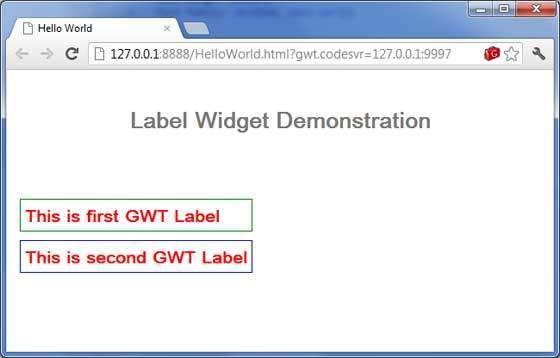
完成所有更改後,讓我們像在GWT - 建立應用章節中一樣,在開發模式下編譯並執行應用程式。如果您的應用程式一切正常,則將產生以下結果: