- GWT 教程
- GWT - 首頁
- GWT - 概述
- GWT - 環境搭建
- GWT - 應用
- GWT - 建立應用
- GWT - 部署應用
- GWT - 使用 CSS 樣式
- GWT - 基本元件
- GWT - 表單元件
- GWT - 複雜元件
- GWT - 佈局面板
- GWT - 事件處理
- GWT - 自定義元件
- GWT - UiBinder
- GWT - RPC 通訊
- GWT - JUnit 整合
- GWT - 除錯應用
- GWT - 國際化
- GWT - History 類
- GWT - 書籤支援
- GWT - 日誌框架
- GWT 有用資源
- GWT - 問答
- GWT - 快速指南
- GWT - 有用資源
- GWT - 討論
GWT - UiBinder
介紹
UiBinder 是一個旨在分離使用者介面功能和檢視的框架。
UiBinder 框架允許開發者構建 GWT 應用,如同構建帶有 GWT 元件配置的 HTML 頁面一樣。
UiBinder 框架使與 UI 設計師的協作更加容易,因為他們更熟悉 XML、HTML 和 CSS,而不是 Java 原始碼。
UiBinder 提供了一種宣告式定義使用者介面的方式。
UiBinder 將程式邏輯與 UI 分離。
UiBinder 類似於 JSP 與 Servlet 的關係。
UiBinder 工作流程
步驟 1 - 建立 UI 宣告 XML 檔案
建立一個基於 XML/HTML 的使用者介面宣告檔案。在我們的示例中,我們建立了一個 **Login.ui.xml** 檔案。
<ui:UiBinder xmlns:ui = 'urn:ui:com.google.gwt.uibinder'
   xmlns:gwt = 'urn:import:com.google.gwt.user.client.ui'
   xmlns:res = 'urn:with:com.tutorialspoint.client.LoginResources'>
   <ui:with type = "com.tutorialspoint.client.LoginResources" field = "res">
   </ui:with>
   <gwt:HTMLPanel>
   ...
   </gwt:HTMLPanel>
</ui:UiBinder>
步驟 2 - 使用 ui:field 用於後期繫結
在 XML/HTML 元素中使用 ui:field 屬性,將 XML 中的 UI 欄位與 JAVA 檔案中的 UI 欄位關聯起來,以便後期繫結。
<gwt:Label ui:field = "completionLabel1" />
<gwt:Label ui:field = "completionLabel2" />
步驟 3 - 建立 UI XML 的 Java 對等檔案
透過擴充套件 Composite 元件,建立基於 Java 的 XML 佈局的對應檔案。在我們的示例中,我們建立了一個 **Login.java** 檔案。
package com.tutorialspoint.client;
   ...
public class Login extends Composite {
   ...
}
步驟 4 - 使用 UiField 註解繫結 Java UI 欄位
在 **Login.java** 中使用 @UiField 註解,指定要繫結到 **Login.ui.xml** 中基於 XML 的欄位的對應類成員。
public class Login extends Composite {
   ...
   @UiField
   Label completionLabel1;

   @UiField
   Label completionLabel2;
   ...
}
步驟 5 - 使用 UiTemplate 註解繫結 Java UI 與 UI XML
使用 @UiTemplate 註解指示 GWT 繫結基於 Java 的元件 **Login.java** 和基於 XML 的佈局 **Login.ui.xml**。
public class Login extends Composite {

   private static LoginUiBinder uiBinder = GWT.create(LoginUiBinder.class);

   /*
    * @UiTemplate is not mandatory but allows multiple XML templates
    * to be used for the same widget.
    * Default file loaded will be <class-name>.ui.xml
    */

   @UiTemplate("Login.ui.xml")
   interface LoginUiBinder extends UiBinder<Widget, Login> {
   }
   ...
}
步驟 6 - 建立 CSS 檔案
建立一個外部 CSS 檔案 **Login.css** 和一個與 CSS 樣式等效的基於 Java 的資原始檔 **LoginResources.java**。
.blackText {
   font-family: Arial, Sans-serif;
   color: #000000;
   font-size: 11px;
   text-align: left;
}
...
步驟 7 - 為 CSS 檔案建立基於 Java 的資原始檔
package com.tutorialspoint.client;
...
public interface LoginResources extends ClientBundle {
   public interface MyCss extends CssResource {
      String blackText();

      ...
   }

   @Source("Login.css")
   MyCss style();
}
步驟 8 - 在 Java UI 程式碼檔案中附加 CSS 資源。
使用 Java 元件類 **Login.java** 的建構函式附加外部 CSS 檔案 **Login.css**。
public Login() {
   this.res = GWT.create(LoginResources.class);
   res.style().ensureInjected();
   initWidget(uiBinder.createAndBindUi(this));
}
UiBinder完整示例
此示例將引導您完成簡單的步驟,以演示在 GWT 中使用 UiBinder。按照以下步驟更新我們在 *GWT - 建立應用* 章節中建立的 GWT 應用程式:
| 步驟 | 描述 |
|---|---|
| 1 | 建立一個名為 *HelloWorld* 的專案,放在 *com.tutorialspoint* 包下,如 *GWT - 建立應用* 章節中所述。 |
| 2 | 修改 *HelloWorld.gwt.xml*、*HelloWorld.css*、*HelloWorld.html* 和 *HelloWorld.java*,如下所述。保持其餘檔案不變。 |
| 3 | 編譯並執行應用程式以驗證已實現邏輯的結果。 |
以下是修改後的模組描述符 **src/com.tutorialspoint/HelloWorld.gwt.xml** 的內容。
<?xml version = "1.0" encoding = "UTF-8"?>
<module rename-to = 'helloworld'>
   <!-- Inherit the core Web Toolkit stuff.                        -->
   <inherits name = 'com.google.gwt.user.User'/>

   <!-- Inherit the default GWT style sheet.                       -->
   <inherits name = 'com.google.gwt.user.theme.clean.Clean'/>
   <!-- Inherit the UiBinder module.                               -->
   <inherits name = "com.google.gwt.uibinder.UiBinder"/>
   <!-- Specify the app entry point class.                         -->
   <entry-point class = 'com.tutorialspoint.client.HelloWorld'/>

   <!-- Specify the paths for translatable code                    -->
   <source path ='client'/>
   <source path = 'shared'/>

</module>
以下是修改後的樣式表文件 **war/HelloWorld.css** 的內容。
body {
   text-align: center;
   font-family: verdana, sans-serif;
}

h1 {
   font-size: 2em;
   font-weight: bold;
   color: #777777;
   margin: 40px 0px 70px;
   text-align: center;
}
以下是修改後的 HTML 宿主檔案 **war/HelloWorld.html** 的內容。
<html>
   <head>
      <title>Hello World</title>
      <link rel = "stylesheet" href = "HelloWorld.css"/>
      <script language = "javascript" src = "helloworld/helloworld.nocache.js">
      </script>
   </head>

   <body>
      <h1>UiBinder Demonstration</h1>
      <div id = "gwtContainer"></div>
   </body>
</html>
現在建立一個新的 UiBinder 模板和所有者類(檔案 → 新建 → UiBinder)。
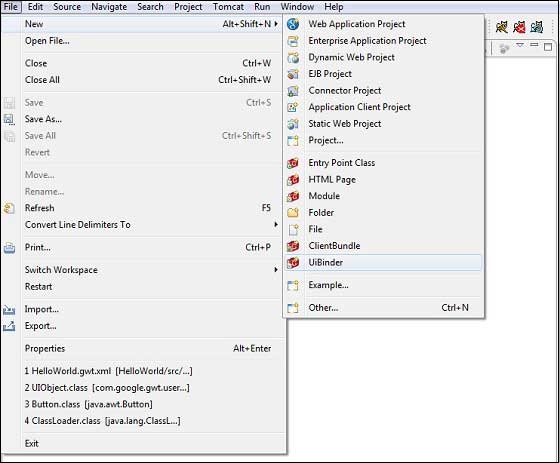
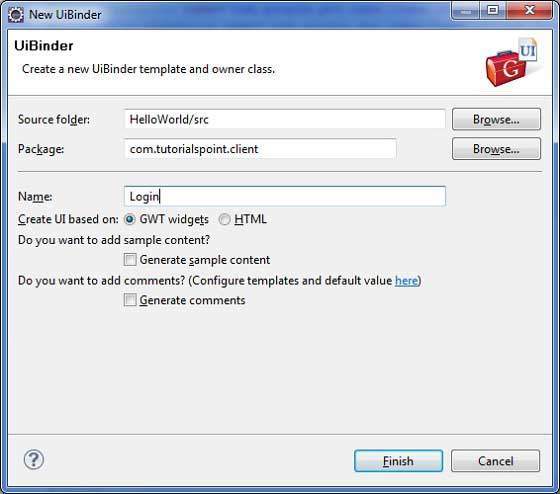
為專案選擇客戶端包,然後將其命名為 Login。保留所有其他預設值。單擊“完成”按鈕,外掛將建立一個新的 UiBinder 模板和所有者類。
現在在 **src/com.tutorialspoint/client** 包中建立 Login.css 檔案,並將以下內容放在其中
.blackText {
   font-family: Arial, Sans-serif;
   color: #000000;
   font-size: 11px;
   text-align: left;
}

.redText {
   font-family: Arial, Sans-serif;
   color: #ff0000;
   font-size: 11px;
   text-align: left;
}

.loginButton {
   border: 1px solid #3399DD;
   color: #FFFFFF;
   background: #555555;
   font-size: 11px;
   font-weight: bold;
   margin: 0 5px 0 0;
   padding: 4px 10px 5px;
   text-shadow: 0 -1px 0 #3399DD;
}

.box {
   border: 1px solid #AACCEE;
   display: block;
   font-size: 12px;
   margin: 0 0 5px;
   padding: 3px;
   width: 203px;
}

.background {
   background-color: #999999;
   border: 1px none transparent;
   color: #000000;
   font-size: 11px;
   margin-left: -8px;
   margin-top: 5px;
   padding: 6px;
}
現在在 **src/com.tutorialspoint/client** 包中建立 LoginResources.java 檔案,並將以下內容放在其中
package com.tutorialspoint.client;

import com.google.gwt.resources.client.ClientBundle;
import com.google.gwt.resources.client.CssResource;

public interface LoginResources extends ClientBundle {
   /**
    * Sample CssResource.
    */
   public interface MyCss extends CssResource {
      String blackText();

      String redText();

      String loginButton();

      String box();

      String background();
   }

   @Source("Login.css")
   MyCss style();
}
將 **src/com.tutorialspoint/client** 包中 Login.ui.xml 的內容替換為以下內容
<ui:UiBinder xmlns:ui = 'urn:ui:com.google.gwt.uibinder'
   xmlns:gwt = 'urn:import:com.google.gwt.user.client.ui'
   xmlns:res = 'urn:with:com.tutorialspoint.client.LoginResources'>

   <ui:with type = "com.tutorialspoint.client.LoginResources" field = "res">
   </ui:with>

   <gwt:HTMLPanel>
      <div align = "center">

         <gwt:VerticalPanel res:styleName = "style.background">
            <gwt:Label text = "Login" res:styleName = "style.blackText" />
            <gwt:TextBox ui:field="loginBox" res:styleName = "style.box" />
            <gwt:Label text = "Password" res:styleName = "style.blackText" />
            <gwt:PasswordTextBox ui:field = "passwordBox" res:styleName = "style.box" />

            <gwt:HorizontalPanel verticalAlignment = "middle">
               <gwt:Button ui:field = "buttonSubmit" text="Submit"
                  res:styleName = "style.loginButton" />
               <gwt:CheckBox ui:field = "myCheckBox" />
               <gwt:Label ui:field = "myLabel" text = "Remember me"
                  res:styleName = "style.blackText" />
            </gwt:HorizontalPanel>

            <gwt:Label ui:field = "completionLabel1" res:styleName = "style.blackText" />
            <gwt:Label ui:field = "completionLabel2" res:styleName = "style.blackText" />
         </gwt:VerticalPanel>

      </div>
   </gwt:HTMLPanel>

</ui:UiBinder>
將 **src/com.tutorialspoint/client** 包中 Login.java 的內容替換為以下內容
package com.tutorialspoint.client;

import com.google.gwt.core.client.GWT;
import com.google.gwt.event.dom.client.ClickEvent;
import com.google.gwt.event.logical.shared.ValueChangeEvent;
import com.google.gwt.uibinder.client.UiBinder;
import com.google.gwt.uibinder.client.UiField;
import com.google.gwt.uibinder.client.UiHandler;
import com.google.gwt.uibinder.client.UiTemplate;
import com.google.gwt.user.client.Window;
import com.google.gwt.user.client.ui.Composite;
import com.google.gwt.user.client.ui.Label;
import com.google.gwt.user.client.ui.TextBox;
import com.google.gwt.user.client.ui.Widget;

public class Login extends Composite {

   private static LoginUiBinder uiBinder = GWT.create(LoginUiBinder.class);

   /*
    * @UiTemplate is not mandatory but allows multiple XML templates
    * to be used for the same widget.
    * Default file loaded will be <class-name>.ui.xml
    */
   @UiTemplate("Login.ui.xml")
   interface LoginUiBinder extends UiBinder<Widget, Login> {
   }

   @UiField(provided = true)
   final LoginResources res;

   public Login() {
      this.res = GWT.create(LoginResources.class);
      res.style().ensureInjected();
      initWidget(uiBinder.createAndBindUi(this));
   }

   @UiField
   TextBox loginBox;

   @UiField
   TextBox passwordBox;

   @UiField
   Label completionLabel1;

   @UiField
   Label completionLabel2;

   private Boolean tooShort = false;

   /*
    * Method name is not relevant, the binding is done according to the class
    * of the parameter.
    */
   @UiHandler("buttonSubmit")
   void doClickSubmit(ClickEvent event) {
      if (!tooShort) {
         Window.alert("Login Successful!");
      } else {
         Window.alert("Login or Password is too short!");
      }
   }

   @UiHandler("loginBox")
   void handleLoginChange(ValueChangeEvent<String> event) {
      if (event.getValue().length() < 6) {
         completionLabel1.setText("Login too short (Size must be > 6)");
         tooShort = true;
      } else {
         tooShort = false;
         completionLabel1.setText("");
      }
   }

   @UiHandler("passwordBox")
   void handlePasswordChange(ValueChangeEvent<String> event) {
      if (event.getValue().length() < 6) {
         tooShort = true;
         completionLabel2.setText("Password too short (Size must be > 6)");
      } else {
         tooShort = false;
         completionLabel2.setText("");
      }
   }
}
讓我們將 Java 檔案 **src/com.tutorialspoint/HelloWorld.java** 的內容如下,它將演示 UiBinder 的用法。
package com.tutorialspoint.client;

import com.google.gwt.core.client.EntryPoint;
import com.google.gwt.user.client.ui.RootPanel;

public class HelloWorld implements EntryPoint {
   public void onModuleLoad() {
      RootPanel.get().add(new Login());
   }
}
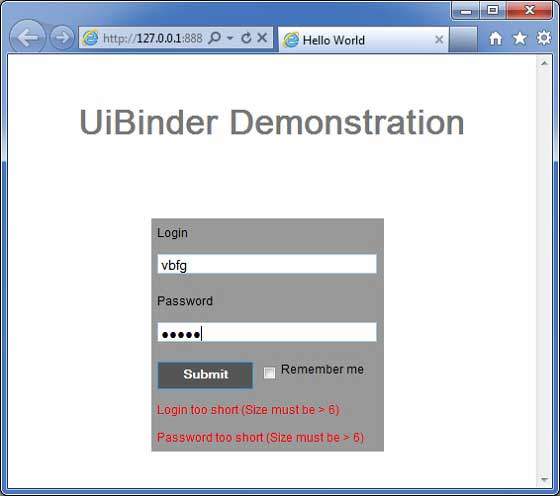
完成所有更改後,讓我們像在 GWT - 建立應用 章節中一樣,在開發模式下編譯並執行應用程式。如果您的應用程式一切正常,這將產生以下結果: