
 資料結構
資料結構 網路
網路 關係資料庫管理系統 (RDBMS)
 作業系統
作業系統 Java
Java MS Excel
 iOS
iOS HTML
HTML CSS
CSS Android
 Python
 C語言程式設計
 C++
C++ C#
C# MongoDB
 MySQL
MySQL Javascript
 PHP
PHP 物理學
物理學 化學
化學 生物學
生物學 數學
數學 英語
英語 經濟學
經濟學 心理學
心理學 社會學
社會學 服裝學
服裝學 法學
法學尤拉路徑與歐拉回路
尤拉路徑是一條路徑,我們可以透過它精確訪問每條邊一次。我們可以多次使用相同的頂點。歐拉回路是一種特殊的尤拉路徑。當尤拉路徑的起始頂點也與該路徑的結束頂點相連時,則稱為歐拉回路。
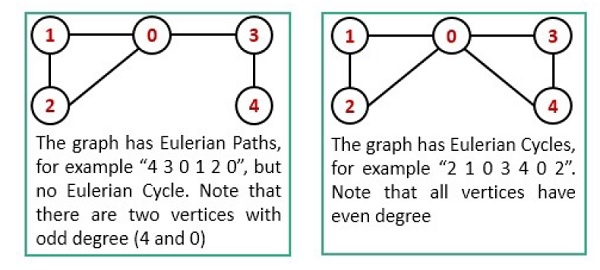
為了檢測路徑和迴路,我們必須遵循以下條件:
- 圖必須是連通的。
- 當恰好有兩個頂點具有奇數度時,它是一條尤拉路徑。
- 現在,當無向圖的任何頂點都沒有奇數度時,它就是一個歐拉回路。
輸入和輸出
Input:
Adjacency matrix of a graph.
0 1 1 1 0
1 0 1 0 0
1 1 0 0 0
1 0 0 0 1
0 0 0 1 0

Output:
The graph has an Eulerian path.
演算法
traverse(u, visited)
輸入:起始節點 u 和已訪問節點,用於標記哪個節點已被訪問。
輸出:遍歷所有連通頂點。
Begin
   mark u as visited
   for all vertex v, if it is adjacent with u, do
      if v is not visited, then
         traverse(v, visited)
   done
End
isConnected(graph)
輸入:圖。
輸出:如果圖是連通的,則返回 True。
Begin
   define visited array
   for all vertices u in the graph, do
      make all nodes unvisited
      traverse(u, visited)
      if any unvisited node is still remaining, then
         return false
   done
   return true
End
isEulerian(Graph)
輸入:給定的圖。
輸出:如果是非尤拉圖則返回 0,如果具有尤拉路徑則返回 1,如果找到歐拉回路則返回 2。
Begin
   if isConnected() is false, then
      return false
   define list of degree for each node
   oddDegree := 0

   for all vertex i in the graph, do
      for all vertex j which are connected with i, do
         increase degree
      done
      if degree of vertex i is odd, then
         increase dooDegree
   done

   if oddDegree > 2, then
      return 0
   if oddDegree = 0, then
      return 2
   else
      return 1
End
示例
#include<iostream>
#include<vector>
#define NODE 5
using namespace std;

int graph[NODE][NODE] = {
   {0, 1, 1, 1, 0},
   {1, 0, 1, 0, 0},
   {1, 1, 0, 0, 0},
   {1, 0, 0, 0, 1},
   {0, 0, 0, 1, 0}
};

/* int graph[NODE][NODE] = {
   {0, 1, 1, 1, 1},
   {1, 0, 1, 0, 0},
   {1, 1, 0, 0, 0},
   {1, 0, 0, 0, 1},
   {1, 0, 0, 1, 0}
};
*/    //uncomment to check Euler Circuit

/* int graph[NODE][NODE] = {
   {0, 1, 1, 1, 0},
   {1, 0, 1, 1, 0},
   {1, 1, 0, 0, 0},
   {1, 1, 0, 0, 1},
   {0, 0, 0, 1, 0}
};
*/    //Uncomment to check Non Eulerian Graph

void traverse(int u, bool visited[]) {
   visited[u] = true;    //mark v as visited

   for(int v = 0; v<NODE; v++) {
      if(graph[u][v]) {
         if(!visited[v])
            traverse(v, visited);
      }
   }
}

bool isConnected() {
   bool *vis = new bool[NODE];
   //for all vertex u as start point, check whether all nodes are visible or not
   for(int u; u < NODE; u++) {
      for(int i = 0; i<NODE; i++)
         vis[i] = false;    //initialize as no node is visited

      traverse(u, vis);

      for(int i = 0; i<NODE; i++) {
         if(!vis[i])    //if there is a node, not visited by traversal, graph is not connected
            return false;
      }
   }
   return true;
}

int isEulerian() {
   if(isConnected() == false)    //when graph is not connected
      return 0;
   vector<int> degree(NODE, 0);
   int oddDegree = 0;

   for(int i = 0; i<NODE; i++) {
      for(int j = 0; j<NODE; j++) {
         if(graph[i][j])
            degree[i]++;    //increase degree, when connected edge found
      }

      if(degree[i] % 2 != 0)    //when degree of vertices are odd
         oddDegree++; //count odd degree vertices
   }

   if(oddDegree > 2)    //when vertices with odd degree greater than 2
      return 0;

   return (oddDegree)?1:2;    //when oddDegree is 0, it is Euler circuit, and when 2, it is Euler path
}

int main() {
   int check;
   check = isEulerian();

   switch(check) {
      case 0: cout << "The graph is not an Eulerian graph.";
         break;
      case 1: cout << "The graph has an Eulerian path.";
         break;
      case 2: cout << "The graph has a Eulerian circuit.";
         break;
   }
}
輸出
The graph has an Eulerian path.

更新於:2020年6月16日
7K+ 次瀏覽

廣告