
 資料結構
資料結構 網路連線
網路連線 關係型資料庫管理系統
 作業系統
作業系統 Java
Java MS Excel
 iOS
iOS HTML
HTML CSS
CSS Android
 Python
 C 程式設計
 C++
C++ C#
C# MongoDB
 MySQL
MySQL Javascript
 PHP
PHP 物理
物理 化學
化學 生物
生物 數學
數學 英語
英語 經濟
經濟 心理學
心理學 社會學
社會學 時尚研究
時尚研究 法律研究
法律研究Fleury 的演算法在 C++ 中用於列印尤拉路徑或尤拉環
Fleury 的演算法用於顯示給定圖中的尤拉路徑或尤拉環。在此演算法中,從一條邊開始,它嘗試透過刪除先前的頂點來移動其他相鄰頂點。使用此技巧後,此圖中的每個步驟都會變得簡單,便於查詢尤拉路徑或尤拉環。
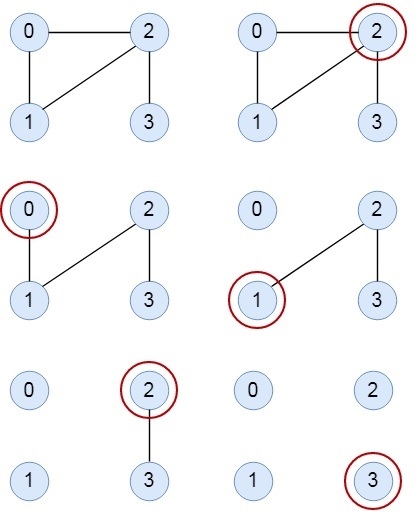
我們必須檢查一些規則才能獲得路徑或環指示: -
- 此圖必須是尤拉圖。
- 當有兩條邊時,一條是橋,另一條是非橋時,我們必須首先選擇非橋。
選擇起點也很重要,我們不能將任何頂點用作起點,如果此圖沒有奇偶度頂點,則可以選擇任何頂點作為起點,否則當一個頂點具有奇偶度時,我們必須首先選擇它。
輸入 - 圖的鄰接矩陣
| 0 | 1 | 1 | 1 | 1 |
| 1 | 0 | 1 | 1 | 1 |
| 1 | 1 | 0 | 1 | 1 |
| 1 | 1 | 1 | 0 | 1 |
| 1 | 1 | 1 | 1 | 0 |
輸出 - 尤拉路徑或尤拉環: 1--0 0--2 2--1 1--3 3--0 0--4 4--3 3--2
操作
findStartVert(graph)
Input: The given graph.
Output: Find the starting vertex to start algorithm.
Begin
   for all vertex i, in the graph, do
      deg := 0
      for all vertex j, which are adjacent with i, do
         deg := deg + 1
      done
      if deg is odd, then
         return i
      done
      when all degree is even return 0
End
isBridge(u, v)
Input: The start and end node.
Output: True when u and v are forming a bridge.
Begin
   deg := 0
   for all vertex i which are adjacent with v, do
      deg := deg + 1
   done
   if deg > 1, then
      return false
   return true
End
fleuryAlgorithm(start)
Input: The starting vertex.
Output: Display the Euler path or circuit.
Begin
   edge := get the number of edges in the graph //it will not initialize in next
   recursion call
   for all vertex v, which are adjacent with start, do
      if edge <= 1 OR isBridge(start, v) is false, then
         display path from start and v
         remove edge (start,v) from the graph
         decrease edge by 1
         fleuryAlgorithm(v)
   done
End
示例
#include<iostream>
#include<vector>
#define NODE 5
using namespace std;
int graph[NODE][NODE] = {{0, 1, 1, 1, 1},
   {1, 0, 1, 1, 0},
   {1, 1, 0, 1, 0},
   {1, 1, 1, 0, 1},
   {1, 0, 0, 1, 0}
};
int tempGraph[NODE][NODE];
int findStartVert(){
   for(int i = 0; i<NODE; i++){
      int deg = 0;
      for(int j = 0; j<NODE; j++){
         if(tempGraph[i][j])
         deg++; //increase degree, when connected edge found
      }
      if(deg % 2 != 0) //when degree of vertices are odd
      return i; //i is node with odd degree
   }
   return 0; //when all vertices have even degree, start from 0
}
bool isBridge(int u, int v){
   int deg = 0;
   for(int i = 0; i<NODE; i++)
      if(tempGraph[v][i])
         deg++;
      if(deg>1){
         return false; //the edge is not forming bridge
      }
   return true; //edge forming a bridge
}
int edgeCount(){
   int count = 0;
   for(int i = 0; i<NODE; i++)
      for(int j = i; j<NODE; j++)
         if(tempGraph[i][j])
            count++;
   return count; //count nunber of edges in the graph
}
void fleuryAlgorithm(int start){
   static int edge = edgeCount();
   for(int v = 0; v<NODE; v++){
      if(tempGraph[start][v]){ //when (u,v) edge is presnt and not forming bridge
         if(edge <= 1 || !isBridge(start, v)){
            cout << start << "--" << v << " ";
            tempGraph[start][v] = tempGraph[v][start] = 0; //remove edge from graph
            edge--; //reduce edge
            fleuryAlgorithm(v);
         }
      }
   }
}
int main(){
   for(int i = 0; i<NODE; i++) //copy main graph to tempGraph
   for(int j = 0; j<NODE; j++)
   tempGraph[i][j] = graph[i][j];
   cout << "Euler Path Or Circuit: ";
   fleuryAlgorithm(findStartVert());
}
輸出
Euler Path Or Circuit: 1--0 0--2 2--1 1--3 3--0 0--4 4--3 3—2

更新於: 25-9-2019
2K+ 次瀏覽

廣告