
 資料結構
資料結構 網路
網路 關係型資料庫管理系統
 作業系統
作業系統 Java
Java MS Excel
 iOS
iOS HTML
HTML CSS
CSS Android
 Python
 C 程式設計
 C++
C++ C#
C# MongoDB
 MySQL
MySQL Javascript
 PHP
PHP 物理學
物理學 化學
化學 生物學
生物學 數學
數學 英語
英語 經濟學
經濟學 心理學
心理學 社會研究
社會研究 時尚研究
時尚研究 法律研究
法律研究正割法求解非線性方程\n
正割法也可用於求解非線性方程。此方法類似於牛頓-拉夫遜法,但在此處我們不需要找出函式的導數 f(x)。僅使用 f(x),我們可以透過使用牛頓差分公式來按數值找出 f’(x)。從牛頓-拉夫遜公式我們知道,
我們知道,
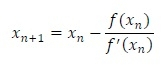
現在,使用差分公式,我們得到,

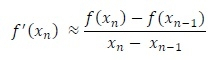
透過用新的 f’(x) 替換牛頓-拉夫遜公式中的 f’(x),我們可以找出正割公式來求解非線性方程。
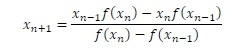
注意:對於此方法,我們需要任意兩個初始猜測來開始找出非線性方程的根。
輸入和輸出
Input:
The function f(x) = (x*x) - (4*x) - 10
Output:
The root is: -1.74166
演算法
secant(x1, x2)
輸入:兩個初始猜測為根。
輸出:非線性方程 f(x) 中的近似根。
Begin
   f1 := f(x1)
   f2 := f(x2)
   x3 := ((f2*x1) – (f1*x2)) / (f2 – f1)
   while relative error of x3 and x2 are > precision, do
      x1 := x2
      f1 := f2
      x2 := x3
      f2 := f(x2)
      x3 := ((f2*x1) – (f1*x2)) / (f2 – f1)
   done
   root := x3
   return root
End
示例
#include<iostream>
#include<cmath>
using namespace std;

double absolute(double value) {             //to find magnitude of value
   if(value < 0)
      return (-value);
   return value;
}

double f(double x) {              //the given function x^2-4x-10
   return ((x*x)-(4*x)-10);
}

double secant(double x1, double x2) {
   double x3, root;
   double f1, f2;
   f1 = f(x1);
   f2 = f(x2);
   x3 = (f2*x1-f1*x2)/(f2-f1);

   while(absolute((x3-x2)/x3) > 0.00001) {         //test accuracy of x3
      x1 = x2;           //shift x values
      f1 = f2;
      x2 = x3;
      f2 = f(x2);                 //find new x2
      x3 = (f2*x1-f1*x2)/(f2-f1);          //calculate x3
   }

   root = x3;
   return root;              //root of the equation
}

main() {
   double a, b, res;
   a = 0.5;
   b = 0.75;
   res = secant(a, b);
   cout << "The root is: " << res;
}
輸
The root is: -1.74166

更新時間: 2020年6月17日
1K+ 瀏覽次數

廣告