
 資料結構
資料結構 網路
網路 關係型資料庫管理系統
 作業系統
作業系統 Java
Java MS Excel
 iOS
iOS HTML
HTML CSS
CSS Android
 Python
 C 語言程式設計
 C++
C++ C#
C# MongoDB
 MySQL
MySQL Javascript
 PHP
PHP 物理學
物理學 化學
化學 生物學
生物學 數學
數學 英語
英語 經濟學
經濟學 心理學
心理學 社會學
社會學 時尚研究
時尚研究 法律研究
法律研究使用 Python 中的 NumPy 生成具有給定根的 Hermite_e 級數
厄米特多項式是一組正交多項式,在各種數學應用中非常有用。它們常用於求解微分方程、機率論和量子力學。Hermite_e 級數是厄米特多項式的變體,用於根據其根表示函式。在本文中,我們將討論如何使用 Python 中的 NumPy 生成具有給定根的 Hermite_e 級數。
安裝和語法
NumPy 是一個 Python 庫,它提供對數值運算的支援,可以使用 pip 安裝,並使用語句“import numpy”匯入到 Python 中。
pip install numpy
要使用 NumPy 生成具有給定根的 Hermite_e 級數,可以使用以下語法:
numpy.polynomial.hermite_e.hermegauss(roots, deg)
roots − 包含 Hermite_e 級數根的 1 維陣列。
deg − Hermite_e 級數的次數。
演算法
以下是使用 NumPy 生成具有給定根的 Hermite_e 級數的演算法:
匯入 NumPy 庫。
定義一個包含 Hermite_e 級數根的陣列。
定義 Hermite_e 級數的次數。
使用根和次數作為引數呼叫 numpy.polynomial.hermite_e.hermegauss() 函式。
該函式返回兩個陣列,一個包含 Hermite_e 級數的權重,另一個包含節點。
使用權重和節點構建 Hermite_e 級數。
示例 1
以下程式碼示例生成一個具有根 [-1, 0, 1] 和次數 2 的 Hermite_e 級數。
import numpy as np
roots = np.array([-1, 0, 1])
deg = 2
weights, nodes = np.polynomial.hermite_e.hermegauss(deg)
print(weights)
print(nodes)
輸出
[-1.  1.]
[1.25331414 1.25331414]
示例 2
以下程式碼示例生成一個具有根 [1, 2, 3, 4] 和次數 3 的 Hermite_e 級數。
import numpy as np

# array of roots
roots = np.array([0, 1, 2, 3])

# initialize coefficients array with zeros
coeffs = np.zeros((len(roots), 2 * len(roots) - 1))

# setting up initial values of coefficients
coeffs[:, 0] = roots # setting f(x) values to be the roots
coeffs[1:, 1] = np.diff(coeffs[:, 0]) / np.diff(roots) # setting f'(x) values using finite difference method

# setting up the remaining coefficients using recurrence relation
for j in range(2, 2 * len(roots)):
   for i in range(len(roots)):
      if j % 2 == 0 and i >= j // 2:
         # even-indexed coefficients
         coeffs[i, j // 2] = coeffs[i, j // 2 - 1] * (j - 1) / (j // 2)
      elif j % 2 == 1 and i >= (j + 1) // 2:
         # odd-indexed coefficients
         coeffs[i, (j + 1) // 2 - 1] = (coeffs[i, j // 2] - coeffs[i - 1, j // 2]) / (roots[i] - roots[i - j // 2])

# generating the Hermite series using the calculated coefficients
def hermite_e_series(x):
   res = np.zeros_like(x)
   for i in range(len(roots)):
      term = np.ones_like(x)
      for j in range(i):
         term *= (x - roots[j])
      res += coeffs[i, i] * term
   return res


x = np.linspace(-1, 4, 1000)
y = hermite_e_series(x)

# get the first 10 coefficients
print(y[:10])

# plot the function
import matplotlib.pyplot as plt
plt.plot(x, y)
plt.show()
輸出
[-5.5  -5.44884884 -5.39799735 -5.34744457 -5.29718957 -5.24723141
 -5.19756916 -5.14820186 -5.09912858 -5.05034838]
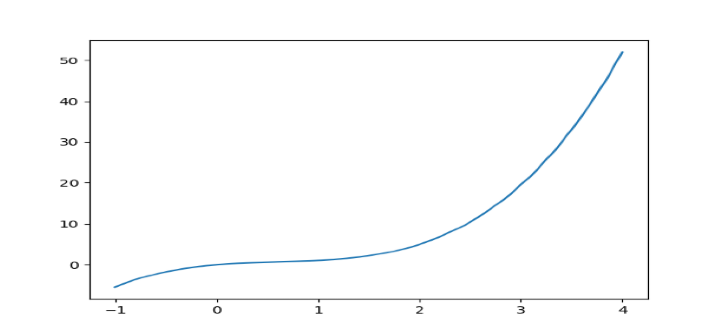
以下程式碼示例生成一個具有根 [0, 1, 2, 3] 和次數 4 的 Hermite_e 級數,並使用 Matplotlib 繪製該級數。
應用
在 Python 中使用 NumPy 生成的厄米特級數具有各種應用。在物理學中,厄米特多項式用於描述量子諧振子的波函式,同時在數值分析和科學計算中也證明非常有用,以及在統計學中實現近似函式(如正態分佈),因為它通常以高精度實現近似函式。
結論
Hermite_e 級數是科學計算和數值分析中一個強大的工具。藉助 Python 中的 NumPy,生成厄米特級數已成為一項簡單的任務。生成該級數的演算法包括設定初始係數,然後使用遞推關係確定其餘係數。一旦計算出係數,就可以使用簡單函式生成厄米特級數。該級數在物理學、數學和統計學中具有眾多應用。透過使用 Hermite_e 級數,科學家和數學家可以高精度地逼近複雜函式,使其成為許多研究領域的寶貴工具。

159 次檢視
