
 資料結構
資料結構 網路
網路 關係型資料庫管理系統
 作業系統
作業系統 Java
Java MS Excel
 iOS
iOS HTML
HTML CSS
CSS Android
 Python
 C 程式設計
 C++
C++ C#
C# MongoDB
 MySQL
MySQL Javascript
 PHP
PHP 物理
物理 化學
化學 生物
生物 數學
數學 英語
英語 經濟學
經濟學 心理學
心理學 社會學
社會學 服裝設計
服裝設計 法律研究
法律研究C++ 迷宮 III
假設有一個迷宮,其中包含空的空間和牆壁,迷宮中還有一個球。球可以透過向上 (u)、向下 (d)、向左 (l) 或向右 (r) 滾動穿過空的空間,但它會一直滾動直到碰到牆壁。當球停止時,它可以選擇下一個方向。迷宮中還有一個洞。如果球滾到洞上,它就會掉進洞裡。
因此,如果我們有球的位置、洞的位置和迷宮,我們必須找出球如何透過移動最短距離掉入洞中。這裡的距離由球從起點(不包括)到洞(包括)經過的空空間的數量定義。
使用 'u'、'd'、'l' 和 'r' 返回移動方向。由於可能存在幾種不同的最短路徑,輸出應為字典序最小的路徑。如果球無法到達洞,則顯示“impossible”。
這裡迷宮由一個二進位制矩陣表示。1 表示牆壁,0 表示空空間。球和洞的座標由行和列索引表示。
所以,如果輸入像這樣
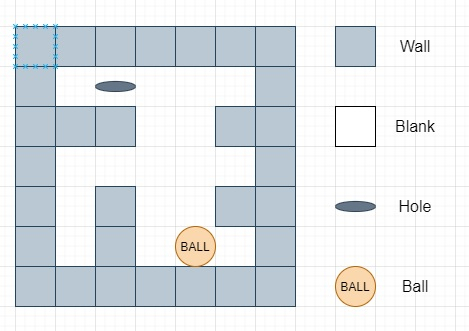
則輸出將為 'lul',表示先向左移動,然後向上,再向左,另一個結果可能是 'ul',先向上再向左,兩者長度均為 6,但它在字典序上不小於 'lul'
為了解決這個問題,我們將遵循以下步驟:
定義一個名為 Data 的資料型別,它將包含距離、字串 d 和座標 x、y。
定義一個大小為 4 x 2 的陣列 dir:={{1, 0}, {0, - 1}, {0, 1}, { - 1, 0}}
定義一個大小為 4 的陣列 dirst:={'d', 'l', 'r', 'u'}
定義一個函式 ok(),它將接收 x1、y1、x2、y2,
如果 x1 等於 x2 且 y1 等於 y2,則返回 true
從主方法執行以下操作:
n := 迷宮的行大小
m := (如果 n 不為零,則為迷宮的列大小,否則為 0)
定義一個優先順序佇列 pq
將新的資料 (0, ball[0], ball[1], "") 插入 pq
定義一個大小為 n x m 的二維陣列 visited
當 (pq 不為空) 時,執行以下操作:
curr := pq 的頂部元素
x := curr.x
y := curr.y
dist := curr.dist
d := curr.d
如果 ok(x, y, hole[0], hole[1]),則:
返回 d
visited[x, y] := true
從 pq 中刪除元素
從 k 初始化為 0,當 k - 4 時,更新(k 增加 1),執行以下操作:
nx := x,ny := y
tempDist := 0
當 nx + dir[k, 0] < n 且 nx + dir[k, 0] >= 0 且 ny + dir[k, 1] < m 且 ny + dir[k, 1] >= 0 且 maze[nx + dir[k, 0], ny + dir[k, 1]] 為 0 時,執行以下操作:
nx := nx + dir[k, 0]
ny := ny + dir[k, 1]
(tempDist 增加 1)
如果 ok(nx, ny, hole[0], hole[1]),則:
退出迴圈
如果 visited[nx, ny] 為零,則:
將新的 Data(dist + tempDist, nx, ny, d + dirst[k]) 插入 pq
返回“impossible”
示例
讓我們看看下面的實現,以便更好地理解:
#include <bits/stdc++.h>
using namespace std;
int dir[4][2] = {{1, 0}, {0, -1}, {0, 1}, {-1, 0}};
char dirst[4] = {'d', 'l', 'r', 'u'};
class Solution {
public:
   struct Data {
      int dist;
      string d;
      int x, y;
      Data(int a, int b, int c, string s) {
         d = s;
         dist = a;
         x = b;
         y = c;
      }
   };
   struct Comparator {
      bool operator()(Data a, Data b) {
         return a.dist != b.dist ? !(a.dist < b.dist) : !(a.d < b.d);
      }
   };
   bool ok(int x1, int y1, int x2, int y2) { return x1 == x2 && y1 == y2; }
   string findShortestWay(vector<vector<int>> &maze, vector<int>&ball,
      vector<int> &hole) {
         int n = maze.size();
         int m = n ? maze[0].size() : 0;
         priority_queue<vector<Data>, vector<Data>, Comparator> pq;
         pq.push(Data(0, ball[0], ball[1], ""));
         vector<vector<bool>> visited(n, vector<bool>(m));
         while (!pq.empty()) {
            Data curr = pq.top();
            int x = curr.x;
            int y = curr.y;
            int dist = curr.dist;
            string d = curr.d;
            if (ok(x, y, hole[0], hole[1])) {
               return d;
            }
            visited[x][y] = true;
            pq.pop();
            for (int k = 0; k < 4; k++) {
               int nx = x;
               int ny = y;
               int tempDist = 0;
               while (nx + dir[k][0] < n && nx + dir[k][0] >= 0 && ny + dir[k][1] < m && ny + dir[k][1] >= 0 && !maze[nx + dir[k][0]][ny + dir[k][1]]) {
                  nx += dir[k][0];
                  ny += dir[k][1];
                  tempDist++;
                  if (ok(nx, ny, hole[0], hole[1]))
                     break;
               }
               if (!visited[nx][ny]) {
                  pq.push(Data(dist + tempDist, nx, ny, d + dirst[k]));
               }
            }
         }
         return "impossible";
   }
};
main() {
   Solution ob;
   vector<vector<int>> v = {
      {0, 0, 0, 0, 0},
      {1, 1, 0, 0, 1},
      {0, 0, 0, 0, 0},
      {0, 1, 0, 0, 1},
      {0, 1, 0, 0, 0}};
   vector<int> v1 = {4, 3}, v2 = {0, 1};
   cout << (ob.findShortestWay(v, v1, v2));
}
輸入
vector<vector<int>> v = {{0, 0, 0, 0, 0},
{1, 1, 0, 0, 1},
{0, 0, 0, 0, 0},
{0, 1, 0, 0, 1},
{0, 1, 0, 0, 0}};
vector<int> v1 = {4, 3}, v2 = {0, 1};
輸出
lul

407 次瀏覽
