
 資料結構
資料結構 網路
網路 RDBMS
RDBMS 作業系統
作業系統 Java
Java MS Excel
 iOS
iOS HTML
HTML CSS
CSS Android
 Python
 C 語言程式設計
 C++
C++ C#
C# MongoDB
 MySQL
MySQL Javascript
 PHP
PHP 物理學
物理學 化學
化學 生物學
生物學 數學
數學 英語
英語 經濟學
經濟學 心理學
心理學 社會學
社會學 時尚研究
時尚研究 法律研究
法律研究C++ 迷宮 II
假設在一個迷宮中有一個球,迷宮中有空的空間和牆壁。現在球可以透過滾動任何方向(例如上、下、左或右)穿過空路徑,但它不會停止滾動,直到撞到牆壁。當球停止時,它可以選擇下一個方向。
我們必須給出球的起始位置、目的地和迷宮,我們必須找到球到達目的地的最短距離。這裡的距離實際上是由球覆蓋的空單元格的數量定義的(不包括起始位置,包括起始位置)。如果無法讓球停在目的地,則返回 -1。
迷宮由一個二維陣列表示。這裡 1 表示牆壁,0 表示空空間。迷宮的邊界都是牆壁。起始和目標座標由行和列索引表示。
因此,如果輸入類似於由二維陣列表示的迷宮
| 0 | 0 | 1 | 0 | 0 |
| 0 | 0 | 0 | 0 | 0 |
| 0 | 0 | 0 | 1 | 0 |
| 1 | 1 | 0 | 1 | 1 |
| 0 | 0 | 0 | 0 | 0 |
起始位置為 (0, 4) 目標位置為 (4, 4),則輸出將為 12,一種可能的方式是:左到下到左到下到右到下到右。(1+1+3+1+2+2+2) = 12
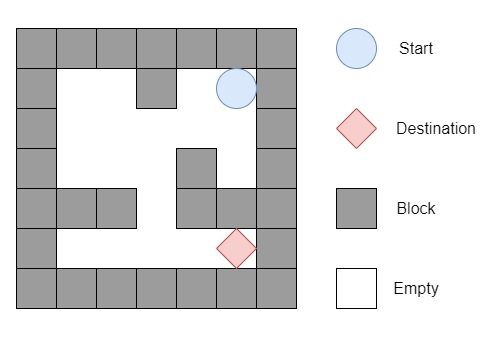
為了解決這個問題,我們將遵循以下步驟:
n := 行數,m := 列數
ret := 無窮大
定義一個 n x m 階的二維陣列 dist
定義一個佇列 q
將起點插入 q
dist[start[0], start[1]] := 0
當 (q 不為空) 時,執行:
curr := q 的第一個元素
從 q 中刪除元素
x := curr[0], y := curr[1]
如果 x 等於 destination[0] 且 y 等於 destination[1],則:
ret := ret 和 dist[x, y] 的最小值
currDist := dist[x, y]
tempDist := 0
i := x
當 (i + 1 < n 且 grid[i + 1, y] 為零) 時,執行:
(i 加 1)
(tempDist 加 1)
如果 currDist + tempDist < dist[i, y],則:
dist[i, y] := currDist + tempDist
將 { i, y } 插入 q
i := x
tempDist := 0
當 (i - 1 >= 0 且 grid[i - 1, y] 為零) 時,執行:
(tempDist 加 1)
(i 減 1)
如果 currDist + tempDist *lt; dist[i, y],則:
dist[i, y] := currDist + tempDist
將 { i, y } 插入 q
i := y
tempDist := 0
當 (i - 1 >= 0 且 grid[x, i - 1] 為零) 時,執行:
(i 減 1)
(tempDist 加 1)
如果 currDist + tempDist < dist[x, i],則:
dist[x, i] := currDist + tempDist
將 { x, i } 插入 q
i := y
tempDist := 0
當 (i + 1 < m 且 grid[x, i + 1] 為零) 時,執行:
(i 加 1)
(tempDist 加 1)
如果 currDist + tempDist < dist[x, i],則:
dist[x, i] := currDist + tempDist
將 { x, i } 插入 q
返回 (如果 ret 等於 inf,則返回 -1,否則返回 ret)
示例
讓我們看看以下實現以獲得更好的理解:
#include <bits/stdc++.h>
using namespace std;
class Solution {
public:
   int shortestDistance(vector<vector<int<>& grid, vector<int<& start, vector<int<& destination) {
   int n = grid.size();
   int m = n? grid[0].size() : 0;
   int ret = INT_MAX;
   vector < vector <int< > dist(n, vector <int<(m, INT_MAX));
   queue < vector <int< > q;
   q.push(start);
   dist[start[0]][start[1]] = 0;
   while(!q.empty()){
      vector <int< curr = q.front();
      q.pop();
      int x = curr[0];
      int y = curr[1];
      if(x == destination[0] && y == destination[1]){
         ret = min(ret, dist[x][y]);
      }
      int currDist = dist[x][y];
      int tempDist = 0;
      int i = x;
      while(i + 1 < n && !grid[i + 1][y]){
         i++;
         tempDist++;
      }
      if(currDist + tempDist < dist[i][y]){
         dist[i][y] = currDist + tempDist;
         q.push({i, y});
      }
      i = x;
      tempDist = 0;
      while(i - 1 >= 0 && !grid[i - 1][y]){
         tempDist++;
         i--;
      }
      if(currDist + tempDist < dist[i][y]){
         dist[i][y] = currDist + tempDist;
         q.push({i, y});
      }
      i = y;
      tempDist = 0;
      while(i - 1 >= 0 && !grid[x][i - 1]){
         i--;
         tempDist++;
      }
      if(currDist + tempDist < dist[x][i]){
         dist[x][i] = currDist + tempDist;
         q.push({x, i});
      }
      i = y;
      tempDist = 0;
      while(i + 1 < m && !grid[x][i + 1]){
         i++;
         tempDist++;
      }
      if(currDist + tempDist < dist[x][i]){
         dist[x][i] = currDist + tempDist;
         q.push({x, i});
      }
   }
   return ret == INT_MAX ? - 1 : ret;
};
main(){
   Solution ob;
   vector<vector<int<> v = {{0,0,1,0,0},{0,0,0,0,0},{0,0,0,1,0},{1,1,0,1,1},{0,0,0,0,0}};
   vector<int< v1 = {0,4}, v2 = {4,4};
   cout << (ob.shortestDistance(v, v1, v2));
}
輸入
{{0,0,1,0,0},{0,0,0,0,0},{0,0,0,1,0},{1,1,0,1,1},{0,0,0,0,0}}, {0,4},{4,4}輸出
12

455 次瀏覽
