
 資料結構
資料結構 網路
網路 關係資料庫管理系統 (RDBMS)
 作業系統
作業系統 Java
Java MS Excel
 iOS
iOS HTML
HTML CSS
CSS Android
 Python
 C語言程式設計
 C++
C++ C#
C# MongoDB
 MySQL
MySQL Javascript
 PHP
PHP 物理學
物理學 化學
化學 生物學
生物學 數學
數學 英語
英語 經濟學
經濟學 心理學
心理學 社會學
社會學 服裝學
服裝學 法學
法學如何在OpenCV Python中計算Hu矩?
Hu矩可以使用cv2.HuMoments()函式計算。它返回七個對平移、旋轉和縮放不變的矩。第七矩是對傾斜不變的。
要計算Hu矩,我們首先需要找到影像。影像矩是使用物件的輪廓為物件計算的。因此,首先,我們檢測物件的輪廓,然後應用cv2.moments()函式計算矩。
語法
此函式使用以下語法:
M = cv2.moments(cnt)
cv2.HuMoments(M)
這裡:
cnt - 它是影像中物件輪廓點的NumPy陣列。
M - 上面計算的影像矩。
步驟
您可以使用以下步驟來計算影像中的Hu矩:
匯入所需的庫。在以下所有Python示例中,所需的Python庫是OpenCV。確保您已安裝它。
import cv2
使用cv2.imread()讀取輸入影像並將其轉換為灰度影像。
img = cv2.imread('shape.png')
gray = cv2.cvtColor(img, cv2.COLOR_BGR2GRAY)
對灰度影像應用閾值處理以建立二值影像。
ret,thresh = cv2.threshold(gray,150,255,0)
使用cv2.findContours()函式查詢影像中的輪廓。
contours, _ = cv2.findContours(thresh, cv2.RETR_TREE,cv2.CHAIN_APPROX_SIMPLE)
使用cv2.moments(cnt)函式查詢輪廓的矩。
cnt = contours[0]
M = cv2.moments(cnt)
對於特定輪廓,使用cv2.HuMoments(M)函式查詢Hu矩。
Hm = cv2.HuMoments(M)
在輸入影像上繪製輪廓。
cv2.drawContours(img, [cnt], -1, (0,255,255), 3)
列印Hu矩並顯示帶有已繪製輪廓的影像。
print("Hu-Moments of first contour:\n", Hm)
cv2.imshow(Hu-Moments", img)
cv2.waitKey(0)
cv2.destroyAllWindows()
讓我們看一些例子以便更好地理解。
我們將在下面的示例中使用以下影像作為輸入檔案。

示例1
在下面的Python程式中,我們檢測影像中的輪廓並找到第一個輪廓的Hu矩。我們還在影像上繪製第一個輪廓。
# import the required libraries
import cv2

# Read the input image
img = cv2.imread('shape.png')

# Convert the input image to grayscale
gray = cv2.cvtColor(img, cv2.COLOR_BGR2GRAY)

# apply thresholding on gray image
ret,thresh = cv2.threshold(gray,150,255,0)

# Find the contours in the image
contours,hierarchy = cv2.findContours(thresh, cv2.RETR_TREE,cv2.CHAIN_APPROX_SIMPLE)
print("Number of Contours detected:",len(contours))

# Find the moments of first contour
cnt = contours[0]
M = cv2.moments(cnt)
Hm = cv2.HuMoments(M)

# Draw the contour
cv2.drawContours(img, [cnt], -1, (0,255,255), 3)
x1, y1 = cnt[0,0]
cv2.putText(img, 'Contour:1', (x1, y1), cv2.FONT_HERSHEY_SIMPLEX, 0.6, (0, 255, 0), 2)

# print the moments of the first contour
print("Hu-Moments of first contour:\n", Hm)
cv2.imshow("Hu-Moments", img)
cv2.waitKey(0)
cv2.destroyAllWindows()
輸出
執行上述程式碼時,將產生以下輸出:
Number of Contours detected: 3
Hu-Moments of first contour:
   [[ 1.59307685e-01]
   [ 4.69721864e-05]
   [ 1.89651880e-10]
   [ 8.95011994e-14]
   [ 2.03401550e-25]
   [ 4.24017740e-16]
   [-3.07567885e-25]]
我們將得到以下輸出視窗,顯示影像中第一個檢測到的輪廓:

示例2
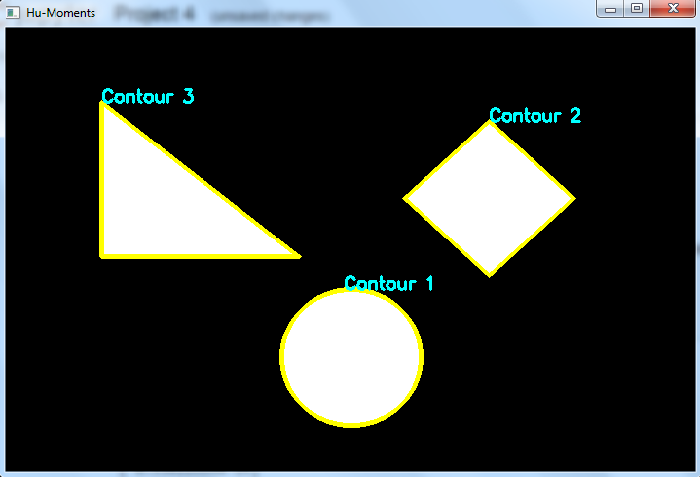
在下面的Python程式中,我們檢測影像中的輪廓並找到所有輪廓的Hu矩。我們還在影像上繪製所有輪廓。
import cv2
import numpy as np

img = cv2.imread('shape.png')
gray = cv2.cvtColor(img, cv2.COLOR_BGR2GRAY)
ret,thresh = cv2.threshold(gray,170,255,0)
contours,hierarchy = cv2.findContours(thresh, cv2.RETR_TREE,cv2.CHAIN_APPROX_SIMPLE)
print("Number of contours detected:",len(contours))

# compute HuMoments for all the contours detected in the image
for i, cnt in enumerate(contours):
   x,y = cnt[0,0]
   moments = cv2.moments(cnt)
   hm = cv2.HuMoments(moments)
   cv2.drawContours(img, [cnt], -1, (0,255,255), 3)
   cv2.putText(img, f'Contour {i+1}', (x, y), cv2.FONT_HERSHEY_SIMPLEX, 0.6, (255, 255, 0), 2)
   print(f"\nHuMoments for Contour {i+1}:\n", hm)

cv2.imshow("Hu-Moments", img)
cv2.waitKey(0)
cv2.destroyAllWindows()
輸出
執行上述程式碼時,將產生以下輸出:
Number of contours detected: 3
HuMoments for Contour 1:
   [[ 1.59307685e-01]
   [ 4.69721864e-05]
   [ 1.89651880e-10]
   [ 8.95011994e-14]
   [ 2.03401550e-25]
   [ 4.24017740e-16]
   [-3.07567885e-25]]
HuMoments for Contour 2:
   [[ 1.67576439e-01]
   [ 3.03541843e-04]
   [ 2.96933966e-10]
   [ 8.49276231e-12]
   [-3.47095391e-22]
   [ 2.67821989e-14]
   [ 2.47818355e-22]]
HuMoments for Contour 3:
   [[2.29748674e-01]
   [1.57527336e-02]
   [5.92081089e-03]
   [4.77994195e-04]
   [4.24175667e-07]
   [1.65030169e-05]
   [6.83150707e-07]]
我們將得到以下輸出視窗,顯示影像中檢測到的輪廓:

更新於:2022年9月28日
3K+ 瀏覽量

廣告