
 資料結構
資料結構 網路
網路 RDBMS
RDBMS 作業系統
作業系統 Java
Java MS Excel
 iOS
iOS HTML
HTML CSS
CSS Android
 Python
 C 程式設計
 C++
C++ C#
C# MongoDB
 MySQL
MySQL Javascript
 PHP
PHP 物理
物理 化學
化學 生物
生物 數學
數學 英語
英語 經濟學
經濟學 心理學
心理學 社會研究
社會研究 時尚研究
時尚研究 法律研究
法律研究深度優先搜尋(DFS)演算法
深度優先搜尋(DFS)是一種圖遍歷演算法。在此演算法中,給出一個起始頂點,當找到一個鄰接頂點時,它首先移動到該鄰接頂點,並嘗試以相同的方式遍歷。
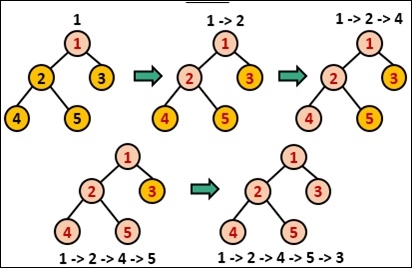
它遍歷整個深度,儘可能深入,之後它回溯到先前的頂點以找到新的路徑。
要以迭代方式實現 DFS,我們需要使用堆疊資料結構。如果想以遞迴方式進行,則不需要外部堆疊,可以使用內部堆疊進行遞迴呼叫。
輸入和輸出
Input:
The Adjacency matrix of a graph.

        A B C D E F
      A 0 1 1 1 0 0
      B 1 0 0 1 1 0
      C 1 0 0 1 1 0
      D 1 1 1 0 1 1
      E 0 1 0 1 0 1
      F 0 0 1 1 1 0

Output:
DFS Traversal: C F E B D A
演算法
dfs(vertices, start)
輸入:所有頂點的列表和起始節點。
輸出:遍歷圖中的所有節點。
Begin
   initially make the state to unvisited for all nodes
   push start into the stack

   while stack is not empty, do
      pop element from stack and set to u
      display the node u

      if u is not visited, then
         mark u as visited
         for all nodes i connected to u, do
            if ith vertex is unvisited, then
               push ith vertex into the stack
               mark ith vertex as visited
         done
   done
End
示例
#include<iostream>
#include<stack>
using namespace std;
#define NODE 6

typedef struct node {
   int val;
   int state; //status
}node;

int graph[NODE][NODE] = {
   {0, 1, 1, 1, 0, 0},
   {1, 0, 0, 1, 1, 0},
   {1, 0, 0, 1, 0, 1},
   {1, 1, 1, 0, 1, 1},
   {0, 1, 0, 1, 0, 1},
   {0, 0, 1, 1, 1, 0}
};

void dfs(node *vertex, node start) {
   node u;
   stack<node> myStack;

   for(int i = 0; i<NODE; i++) {
      vertex[i].state = 0;   //not visited
   }

   myStack.push(start);
   while(!myStack.empty()) {
      //pop and print node
      u = myStack.top();
      myStack.pop();
      cout << char(u.val+'A') << " ";

      if(u.state != 1) {
         //update vertex status to visited
         u.state = 1;
         vertex[u.val].state = 1;

         for(int i = 0; i<NODE; i++) {
            if(graph[i][u.val]) {
               if(vertex[i].state == 0) {
                  myStack.push(vertex[i]);
                  vertex[i].state = 1;
               }
            }
         }
      }
   }
}

int main() {
   node vertices[NODE];
   node start;
   char s;

   for(int i = 0; i<NODE; i++) {
      vertices[i].val = i;
   }

   s = 'C';   //starting vertex C
   start.val = s-'A';
   cout << "DFS Traversal: ";
   dfs(vertices, start);
   cout << endl;
}
輸出
DFS Traversal: C F E B D A

更新於:2020 年 6 月 16 日
3 千次瀏覽

廣告