
- Pascal 教程
- Pascal - 首頁
- Pascal - 概述
- Pascal - 環境設定
- Pascal - 程式結構
- Pascal - 基本語法
- Pascal - 資料型別
- Pascal - 變數型別
- Pascal - 常量
- Pascal - 運算子
- Pascal - 決策
- Pascal - 迴圈
- Pascal - 函式
- Pascal - 過程
- Pascal - 變數作用域
- Pascal - 字串
- Pascal - 布林值
- Pascal - 陣列
- Pascal - 指標
- Pascal - 記錄
- Pascal - 變體
- Pascal - 集合
- Pascal - 檔案處理
- Pascal - 記憶體
- Pascal - 單元
- Pascal - 日期和時間
- Pascal - 物件
- Pascal - 類
- Pascal 有用資源
- Pascal - 快速指南
- Pascal - 有用資源
- Pascal - 討論
Pascal - if then else 語句
一個if-then語句後面可以跟一個可選的else語句,當布林表示式為false時,該語句將執行。
語法
if-then-else 語句的語法如下:
if condition then S1 else S2;
其中,S1 和 S2 是不同的語句。請注意,語句 S1 後面不跟分號。在 if-then-else 語句中,當測試條件為真時,執行語句 S1 並跳過 S2;當測試條件為假時,跳過 S1 並執行語句 S2。
例如:
if color = red then
   writeln('You have chosen a red car')

else
   writeln('Please choose a color for your car');
如果布林表示式condition計算結果為真,則執行 if-then 程式碼塊,否則執行 else 程式碼塊。
Pascal 將任何非零和非 nil 值視為真,如果值為零或 nil,則將其視為假值。
流程圖
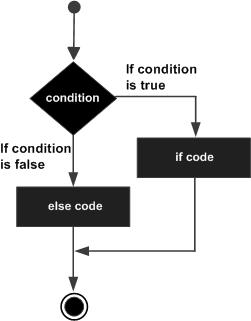
示例
讓我們嘗試一個完整的示例來說明這個概念:
program ifelseChecking;
var
   { local variable definition }
   a : integer;

begin
   a := 100;
   (* check the boolean condition *)
   if( a < 20 ) then
      (* if condition is true then print the following *)
      writeln('a is less than 20' )

   else
      (* if condition is false then print the following *)
      writeln('a is not less than 20' );
      writeln('value of a is : ', a);
end.
當以上程式碼編譯並執行時,會產生以下結果:
a is not less than 20
value of a is : 100
if-then-else if-then-else 語句
一個 if-then 語句後面可以跟一個可選的 else if-then-else 語句,這對於使用單個 if-then-else if 語句測試各種條件非常有用。
使用 if-then、else if-then、else 語句時,需要注意以下幾點。
一個 if-then 語句可以有零個或一個 else,並且它必須出現在任何 else if 之後。
一個 if-then 語句可以有零到多個 else if,並且它們必須出現在 else 之前。
一旦某個 else if 成功,就不會測試任何剩餘的 else if 或 else。
最後一個 else 關鍵字前沒有分號 (;),但所有語句都可以是複合語句。
語法
Pascal 程式語言中 if-then-else if-then-else 語句的語法如下:
if(boolean_expression 1)then
   S1 (* Executes when the boolean expression 1 is true *)

else if( boolean_expression 2) then
   S2 (* Executes when the boolean expression 2 is true *)

else if( boolean_expression 3) then
   S3 (* Executes when the boolean expression 3 is true *)

else
   S4; ( * executes when the none of the above condition is true *)
示例
以下示例說明了這個概念:
program ifelse_ifelseChecking;
var
   { local variable definition }
   a : integer;

begin
   a := 100;
   (* check the boolean condition *)
   if (a = 10)  then
      (* if condition is true then print the following *)
      writeln('Value of a is 10' )

   else if ( a = 20 ) then
      (* if else if condition is true *)
      writeln('Value of a is 20' )

   else if( a = 30 ) then
      (* if else if condition is true  *)
      writeln('Value of a is 30' )

   else
      (* if none of the conditions is true *)
      writeln('None of the values is matching' );
      writeln('Exact value of a is: ', a );
end.
當以上程式碼編譯並執行時,會產生以下結果:
None of the values is matching
Exact value of a is: 100
pascal_decision_making.htm
廣告