
 資料結構
資料結構 網路
網路 RDBMS
RDBMS 作業系統
作業系統 Java
Java MS Excel
 iOS
iOS HTML
HTML CSS
CSS Android
 Python
 C 程式設計
 C++
C++ C#
C# MongoDB
 MySQL
MySQL Javascript
 PHP
PHP 物理
物理 化學
化學 生物
生物 數學
數學 英語
英語 經濟學
經濟學 心理學
心理學 社會學
社會學 時尚學
時尚學 法律學
法律學如何使用 Java OpenCV 對兩幅影像進行按位異或運算?
你可以使用org.opencv.core.Core 類的bitwise_xor()方法計算兩幅影像的按位異或。
此方法接受三個Mat 物件表示源、目標和結果矩陣,計算源矩陣中每個元素的按位異或,並將結果儲存在目標矩陣中。
示例
在以下 Java 示例中,我們轉換一張影像為二進位制和灰度,然後計算結果的按位異或。
import org.opencv.core.Core;
import org.opencv.core.Mat;
import org.opencv.highgui.HighGui;
import org.opencv.imgcodecs.Imgcodecs;
import org.opencv.imgproc.Imgproc;
public class BitwiseXORExample {
   public static void main(String args[]) throws Exception {
      //Loading the OpenCV core library
      System.loadLibrary( Core.NATIVE_LIBRARY_NAME );
      //Reading the Image
      String file ="D://images//elephant.jpg";
      Mat src = Imgcodecs.imread(file, Imgcodecs.IMREAD_GRAYSCALE );
      HighGui.imshow("Grayscale Image", src);
      //Creating an empty matrix to store the results
      Mat dst = new Mat(src.rows(), src.cols(), src.type());
      Mat threshold = new Mat(src.rows(), src.cols(), src.type());
      Mat gray = new Mat(src.rows(), src.cols(), src.type());
      //Converting the gray scale image to binary image
      Imgproc.threshold(src, threshold, 100, 255, Imgproc.THRESH_BINARY_INV);
      HighGui.imshow("Binary Image", threshold);
      //Applying bitwise Or operation
      Core.bitwise_xor(src, threshold, dst);
      HighGui.imshow("Bitwise XOR operation", dst);
      HighGui.waitKey();
   }
}
輸入影像

輸出
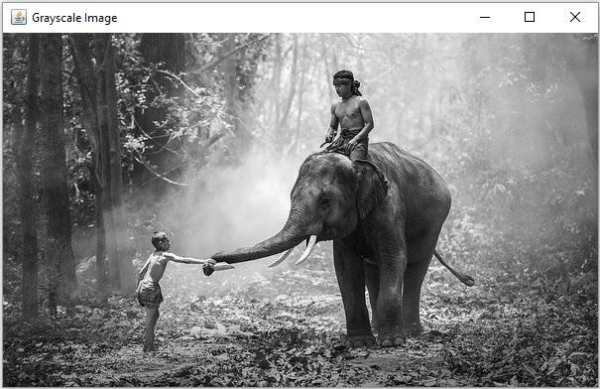
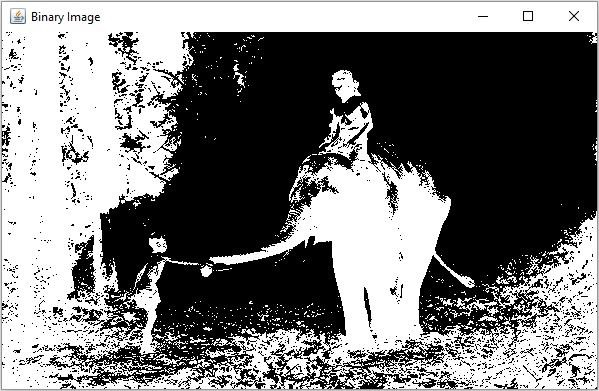
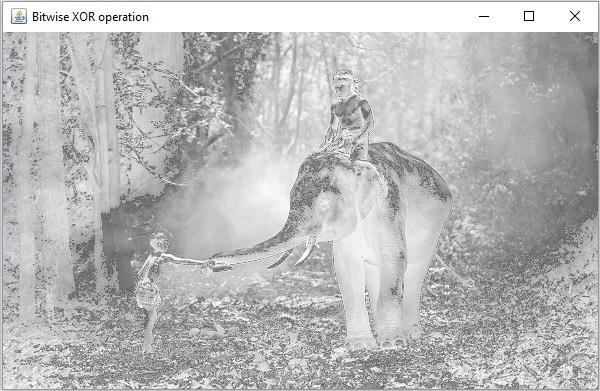
執行後,上述程式生成以下視窗 -
灰度影像 -
二進位制影像 -
按位異或 -

更新於: 09-4-2020
388 次觀看

廣告