
- Groovy 教程
- Groovy - 首頁
- Groovy - 概述
- Groovy - 環境
- Groovy - 基本語法
- Groovy - 資料型別
- Groovy - 變數
- Groovy - 運算子
- Groovy - 迴圈
- Groovy - 決策制定
- Groovy - 方法
- Groovy - 檔案 I/O
- Groovy - 可選值
- Groovy - 數字
- Groovy - 字串
- Groovy - 範圍
- Groovy - 列表
- Groovy - 對映
- Groovy - 日期和時間
- Groovy - 正則表示式
- Groovy - 異常處理
- Groovy - 面向物件
- Groovy - 泛型
- Groovy - 特性
- Groovy - 閉包
- Groovy - 註解
- Groovy - XML
- Groovy - JMX
- Groovy - JSON
- Groovy - DSL
- Groovy - 資料庫
- Groovy - 構建器
- Groovy - 命令列
- Groovy - 單元測試
- Groovy - 模板引擎
- Groovy - 元物件程式設計
- Groovy 有用資源
- Groovy - 快速指南
- Groovy - 有用資源
- Groovy - 討論
Groovy - Switch 語句
有時,巢狀的 if-else 語句非常常見且使用頻率很高,因此設計了一個更簡單的語句,稱為switch 語句。
switch(expression) {
   case expression #1:
   statement #1
   ...
   case expression #2:
   statement #2
   ...
   case expression #N:
   statement #N
   ...
   default:
   statement #Default
   ...
}
此語句的一般工作原理如下:
要評估的表示式放在 switch 語句中。
將定義多個 case 表示式,以根據表示式的評估結果確定應執行哪一組語句。
在每組 case 語句的末尾添加了break 語句。 這是為了確保一旦執行了相關的語句集,迴圈就會退出。
還有一個default case 語句,如果前面的任何 case 表示式都不為真,則會執行該語句。
下圖顯示了switch-case 語句的流程。
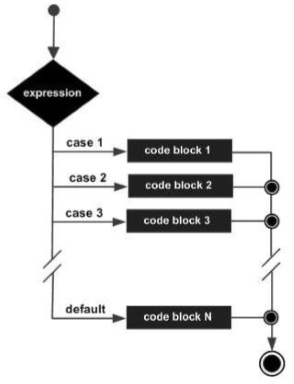
以下是 switch 語句的示例:
class Example {
   static void main(String[] args) {
      //initializing a local variable
      int a = 2

      //Evaluating the expression value
      switch(a) {
         //There is case statement defined for 4 cases
         // Each case statement section has a break condition to exit the loop

         case 1:
            println("The value of a is One");
            break;
         case 2:
            println("The value of a is Two");
            break;
         case 3:
            println("The value of a is Three");
            break;
         case 4:
            println("The value of a is Four");
            break;
         default:
            println("The value is unknown");
            break;
      }
   }
}
在上面的示例中,我們首先將一個變數初始化為 2 的值。然後,我們有一個 switch 語句,它評估變數 a 的值。根據變數的值,它將執行相關的 case 語句集。上述程式碼的輸出將是:
The value of a is Two
groovy_decision_making.htm
廣告