
 資料結構
資料結構 網路
網路 關係資料庫管理系統 (RDBMS)
 作業系統
作業系統 Java
Java MS Excel
 iOS
iOS HTML
HTML CSS
CSS Android
 Python
 C語言程式設計
 C++
C++ C#
C# MongoDB
 MySQL
MySQL Javascript
 PHP
PHP 物理學
物理學 化學
化學 生物學
生物學 數學
數學 英語
英語 經濟學
經濟學 心理學
心理學 社會學
社會學 服裝設計
服裝設計 法學
法學C++中刪除樹節點
假設我們有一棵樹,這棵樹的根節點為0,如下所示:
- 節點數為nodes
- 第i個節點的值為value[i]
- 第i個節點的父節點為parent[i]
我們必須移除所有節點值之和為0的子樹,之後返回樹中剩餘的節點數。例如:
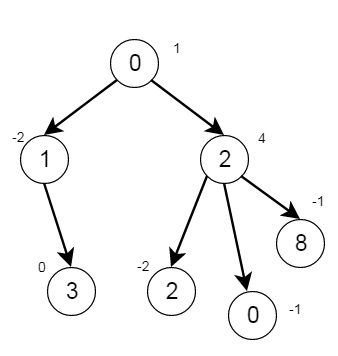
共有7個節點,輸出結果為2
為了解決這個問題,我們將遵循以下步驟:
- 建立一個名為children的對映
- 定義一個名為dfs()的方法,它將接收節點、一個值陣列和圖作為引數
- temp := 一個pair (value[node], 1)
- 對於i in range 0 to size of graph[node]
- temp2 := dfs(graph[node, i], value, graph)
- 將temp的第一項加上temp2的第一項,將temp的第二項加上temp2的第二項
- 如果temp的第一項為0,則ans := ans – temp的第二項,並將temp的第二項設定為0
- 返回temp
- 在主方法中,它將接收節點數、父節點陣列和值陣列
- n := 值陣列中存在的數值個數
- ans := n
- 定義一個大小為n + 1的陣列graph
- 對於i in range 1 to n – 1
- 將i插入到graph[parent[i]]中
- dfs(0, value, graph)
- 返回ans
示例(C++)
讓我們看下面的實現來更好地理解:
#include <bits/stdc++.h>
using namespace std;
class Solution {
public:
   map <int, int> children;
   int ans;
   pair <int, int> dfs(int node, vector<int>& value, vector <int> graph[]){
      pair <int, int> temp = {value[node], 1};
      for(int i = 0; i < graph[node].size(); i++){
         pair <int, int> temp2 = dfs(graph[node][i], value, graph);
         temp.first += temp2.first;
         temp.second += temp2.second;
      }
      if(temp.first == 0){
         ans -= temp.second;
         temp.second = 0;
      }
      return temp;
   }
   int deleteTreeNodes(int nodes, vector<int>& parent, vector<int>& value) {
      int n = value.size();
      ans = n;
      children.clear();
      vector < int > graph[n + 1];
      for(int i = 1; i < n; i++){
         graph[parent[i]].push_back(i);
      }
      dfs(0, value, graph);
      return ans;
   }
};
main(){
   vector<int> v1 = {-1,0,0,1,2,2,2};
   vector<int> v2 = {1,-2,4,0,-2,-1,-1};
   Solution ob;
   cout << (ob.deleteTreeNodes(7,v1, v2));
}
輸入
7
[-1,0,0,1,2,2,2]
[1,-2,4,0,-2,-1,-1]
輸出
2

更新於:2020年4月30日
210 次瀏覽

廣告