
 資料結構
資料結構 網路
網路 關係資料庫管理系統
 作業系統
作業系統 Java
Java MS Excel
 iOS
iOS HTML
HTML CSS
CSS Android
 Python
 C語言程式設計
 C++
C++ C#
C# MongoDB
 MySQL
MySQL Javascript
 PHP
PHP 物理學
物理學 化學
化學 生物學
生物學 數學
數學 英語
英語 經濟學
經濟學 心理學
心理學 社會學
社會學 時尚研究
時尚研究 法律研究
法律研究JavaScript中的廣度優先搜尋遍歷
BFS在訪問子節點之前先訪問相鄰節點,並且在搜尋過程中使用佇列。以下是BFS的工作原理:
- 訪問相鄰的未訪問節點。將其標記為已訪問。顯示它。將其插入佇列。
- 如果未找到相鄰節點,則從佇列中移除第一個節點。
- 重複規則1和規則2,直到佇列為空。
讓我們來看一個BFS遍歷如何工作的示例
步驟 | 遍歷 | 描述 |
|---|---|---|
1 | 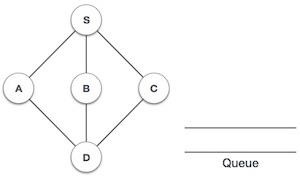 | 初始化佇列。 |
2 | 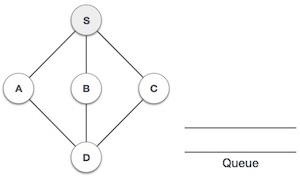 | 我們首先訪問S(起始節點)並將其標記為已訪問。 |
3 | 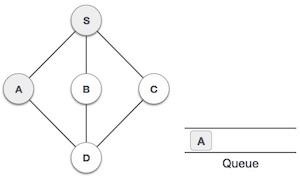 | 然後我們從S檢視未訪問的相鄰節點。在這個例子中,我們有三個節點,但按字母順序我們選擇A,將其標記為已訪問並將其入隊。 |
4 | 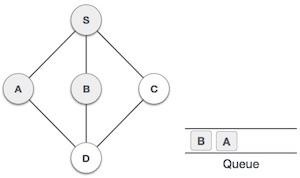 | 接下來,來自S的未訪問相鄰節點是B。我們將其標記為已訪問並將其入隊。 |
5 | 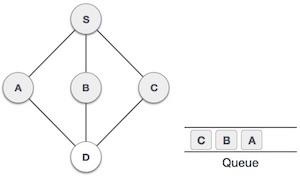 | 接下來,來自S的未訪問相鄰節點是C。我們將其標記為已訪問並將其入隊。 |
6 | 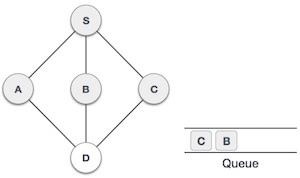 | 現在,S沒有未訪問的相鄰節點了。因此,我們出隊並找到A。 |
7 | 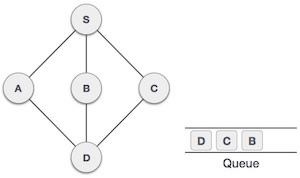 | 從A,我們有D作為未訪問的相鄰節點。我們將其標記為已訪問並將其入隊。 |
在這個階段,我們沒有未標記(未訪問)的節點了。但根據演算法,我們繼續出隊以獲取所有未訪問的節點。當佇列清空時,程式結束。
讓我們看看如何在JavaScript中實現它。
示例
BFS(node) {
   // Create a Queue and add our initial node in it
   let q = new Queue(this.nodes.length);
   let explored = new Set();
   q.enqueue(node);

   // Mark the first node as explored explored.
   add(node);

   // We'll continue till our queue gets empty
   while (!q.isEmpty()) {
      let t = q.dequeue();

      // Log every element that comes out of the Queue
      console.log(t);

      // 1. In the edges object, we search for nodes this node is directly connected to.
      // 2. We filter out the nodes that have already been explored.
      // 3. Then we mark each unexplored node as explored and add it to the queue.
      this.edges[t]
      .filter(n => !explored.has(n))
      .forEach(n => {
         explored.add(n);
         q.enqueue(n);
      });
   }
}
您可以使用以下方法測試此函式:
示例
let g = new Graph();
g.addNode("A");
g.addNode("B");
g.addNode("C");
g.addNode("D");
g.addNode("E");
g.addNode("F");
g.addNode("G");

g.addEdge("A", "C");
g.addEdge("A", "B");
g.addEdge("A", "D");
g.addEdge("D", "E");
g.addEdge("E", "F");
g.addEdge("B", "G");

g.BFS("A");
輸出
這將給出以下輸出:
A
C
B
D
G
E
F

更新於: 2020年6月15日
4K+瀏覽量

廣告