
- Sass 教程
- Sass - 主頁
- Sass - 概述
- Sass - 安裝
- Sass - 語法
- 使用 Sass
- Sass - CSS 擴充套件
- Sass - 註釋
- Sass - 指令碼
- Sass - @- 規則和指令
- 控制指令和表示式
- Sass - Mixin 指令
- Sass - 函式指令
- Sass - 輸出樣式
- 擴充套件 Sass
- Sass 實用資源
- Sass - 面試問題
- Sass - 快速指南
- Sass - 實用資源
- Sass - 討論
Sass - 插值
說明
它使用 #{ } 語法在選擇器和屬性名稱中提供 SassScript 變數。您可以在大括號內指定變數或屬性名稱。
語法
#{$name}
其中 $name 是變數或屬性名稱。
例項
以下示例演示在 SCSS 檔案中使用插值 -
<html>
   <head>
      <title>Interpolation</title>
      <link rel = "stylesheet" type = "text/css" href = "style.css" />
      <link rel = "stylesheet" href = "https://maxcdn.bootstrapcdn.com/bootstrap/3.3.5/css/bootstrap.min.css">
      <script src = "https://ajax.googleapis.com/ajax/libs/jquery/2.1.3/jquery.min.js"></script>
      <script src = "https://maxcdn.bootstrapcdn.com/bootstrap/3.3.5/js/bootstrap.min.js"></script>
   </head>

   <body>
      <div class = "container">
         <h2>Example using Interpolation</h2>
         <p>SASS stands for Syntactically Awesome Stylesheet...</p>
      </div>
   </body>
</html>
接下來,建立檔案 style.scss。
style.scss
p:after {
   content: "I have #{8 + 2} books on SASS!";
}
您可以透過使用以下命令告訴 SASS 監視檔案並在 SASS 檔案發生更改時更新 CSS -
sass --watch C:\ruby\lib\sass\style.scss:style.css
接下來,執行上述命令;它會自動使用以下程式碼建立 style.css 檔案 -
style.css
p:after {
   content: "I have 10 books on SASS!";
}
輸出
讓我們執行以下步驟來了解上述程式碼如何工作 -
將上述給定的 html 程式碼儲存在 interpolation.html 檔案中。
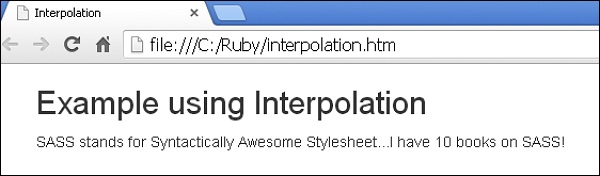
在瀏覽器中開啟此 HTML 檔案,輸出如下所示。
sass_script.htm
廣告