
 資料結構
資料結構 網路
網路 關係資料庫管理系統
 作業系統
作業系統 Java
Java MS Excel
 iOS
iOS HTML
HTML CSS
CSS Android
 Python
 C 程式設計
 C++
C++ C#
C# MongoDB
 MySQL
MySQL Javascript
 PHP
PHP 物理學
物理學 化學
化學 生物學
生物學 數學
數學 英語
英語 經濟學
經濟學 心理學
心理學 社會學
社會學 時尚研究
時尚研究 法律研究
法律研究二叉樹中兩個節點之間距離查詢 - C++ 中 O(logn) 方法
在這個問題中,我們給定一棵二叉樹和 Q 個查詢。我們的任務是建立一個程式來解決二叉樹中兩個節點之間距離查詢 - C++ 中 O(logn) 方法。
問題描述
在每個查詢中,我們給定二叉樹的兩個節點,我們需要找到這兩個節點之間的距離,即從一個節點到達另一個節點需要遍歷的邊數。
讓我們舉個例子來理解這個問題,
輸入:二叉樹
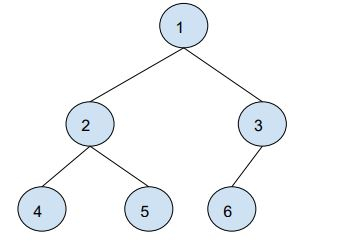
查詢 = 3
Q1 -> [2, 6]
Q2 -> [4, 1]
Q3 -> [5, 3]
輸出3, 2, 3
解決方案方法
為了解決這個問題,我們將使用距離公式,該公式使用最低公共祖先 (LCA) 及其距離。
Distance(n1, n2) = distance(root,n1) + distance(root,n1) - 2 * distance(root,LCA)
為了解決這個問題,我們將遵循以下步驟,
找到每個節點的層級,即 N1、N2、LCA。
然後,我們將根據樹的尤拉遍歷建立二叉樹的陣列。
然後,我們將為 LCA 建立一個線段樹。
示例
#include <bits/stdc++.h>
#define MAX 1000
using namespace std;
int eulerArray[MAX];
int eIndex = 0;
int vis[MAX];
int L[MAX];
int H[MAX];
int level[MAX];
struct Node {
   int data;
   struct Node* left;
   struct Node* right;
};
struct Node* newNode(int data) {
   struct Node* temp = new struct Node;
   temp->data = data;
   temp->left = temp->right = NULL;
   return temp;
}
void FindNodeLevels(struct Node* root) {
   if (!root)
      return;
   queue<pair<struct Node*, int> > q;
   q.push({ root, 0 });
   pair<struct Node*, int> p;
   while (!q.empty()) {
      p = q.front();
      q.pop();
      level[p.first->data] = p.second;
      if (p.first->left)
         q.push({ p.first->left, p.second + 1 });
      if (p.first->right)
         q.push({ p.first->right, p.second + 1 });
   }
}
void createEulerTree(struct Node* root) {
   eulerArray[++eIndex] = root->data;
   if (root->left) {
      createEulerTree(root->left);
      eulerArray[++eIndex] = root->data;
   }
   if (root->right) {
      createEulerTree(root->right);
      eulerArray[++eIndex] = root->data;
   }
}
void creareEulerArray(int size) {
   for (int i = 1; i <= size; i++) {
      L[i] = level[eulerArray[i]];
      if (vis[eulerArray[i]] == 0) {
         H[eulerArray[i]] = i;
         vis[eulerArray[i]] = 1;
      }
   }
}
pair<int, int> seg[4 * MAX];
pair<int, int> min(pair<int, int> a, pair<int, int> b) {
   if (a.first <= b.first)
      return a;
   else
      return b;
}
pair<int, int> buildSegTree(int low, int high, int pos) {
   if (low == high) {
      seg[pos].first = L[low];
      seg[pos].second = low;
      return seg[pos];
   }
   int mid = low + (high - low) / 2;
   buildSegTree(low, mid, 2 * pos);
   buildSegTree(mid + 1, high, 2 * pos + 1);
   seg[pos] = min(seg[2 * pos], seg[2 * pos + 1]);
}
pair<int, int> LCA(int qlow, int qhigh, int low, int high, int pos) {
   if (qlow <= low && qhigh >= high)
      return seg[pos];
   if (qlow > high || qhigh < low)
      return { INT_MAX, 0 };
   int mid = low + (high - low) / 2;
   return min(LCA(qlow, qhigh, low, mid, 2 * pos), LCA(qlow, qhigh,mid + 1, high, 2 * pos +1));
}
int CalcNodeDistance(int node1, int node2, int size) {
   int prevn1 = node1, prevn2 = node2;
   node1 = H[node1];
   node2 = H[node2];
   if (node2 < node1)
      swap(node1, node2);
   int lca = LCA(node1, node2, 1, size, 1).second;
   lca = eulerArray[lca];
   return level[prevn1] + level[prevn2] - 2 * level[lca];
}
int main() {
   int N = 6;
   Node* root = newNode(1);
   root->left = newNode(2);
   root->right = newNode(3);
   root->left->left = newNode(4);
   root->left->right = newNode(5);
   root->right->left = newNode(6);
   FindNodeLevels(root);
   createEulerTree(root);
   creareEulerArray(2 * N - 1);
   buildSegTree(1, 2 * N - 1, 1);
   int Q = 4;
   int query[Q][2] = {{1, 5}, {4, 6}, {3, 4}, {2, 4} };
   for(int i = 0; i < Q; i++)
      cout<<"The distance between two nodes of binary tree is "<<CalcNodeDistance(query[i][0], query[i][1], 2 * N - 1)<<endl;
   return 0;
}
輸出
The distance between two nodes of binary tree is 2
The distance between two nodes of binary tree is 4
The distance between two nodes of binary tree is 3
The distance between two nodes of binary tree is 1

更新於: 2020-10-09
117 次檢視

廣告