
 資料結構
資料結構 網路
網路 關係型資料庫管理系統 (RDBMS)
 作業系統
作業系統 Java
Java MS Excel
 iOS
iOS HTML
HTML CSS
CSS Android
 Python
 C語言程式設計
 C++
C++ C#
C# MongoDB
 MySQL
MySQL Javascript
 PHP
PHP 物理學
物理學 化學
化學 生物學
生物學 數學
數學 英語
英語 經濟學
經濟學 心理學
心理學 社會學
社會學 服裝設計
服裝設計 法學
法學如何使用 TensorFlow 實現邏輯迴歸?
TensorFlow 是 Google 提供的一個機器學習框架。它是一個開源框架,與 Python 結合使用以實現演算法、深度學習應用程式等等。它用於研究和生產目的。它具有最佳化技術,有助於快速執行復雜的數學運算。這是因為它使用了 NumPy 和多維陣列。
多維陣列也稱為“張量”。該框架支援使用深度神經網路。它具有高度可擴充套件性,並附帶許多流行的資料集。它使用 GPU 計算並自動管理資源。
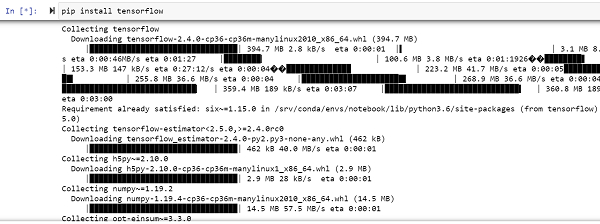
可以使用以下程式碼行在 Windows 上安裝“tensorflow”包:
pip install tensorflow
張量是 TensorFlow 中使用的一種資料結構。它有助於連線資料流圖中的邊。此資料流圖稱為“資料流圖”。張量只不過是多維陣列或列表。
MNIST 資料集包含手寫數字,其中 60000 個用於訓練模型,10000 個用於測試訓練後的模型。這些數字已進行大小歸一化和居中處理,以適應固定大小的影像。
以下是一個示例:
示例
from __future__ import absolute_import, division, print_function
import tensorflow as tf
import numpy as np
num_classes = 10
num_features = 784
learning_rate = 0.01
training_steps = 1000
batch_size = 256
display_step = 50
from tensorflow.keras.datasets import mnist
(x_train, y_train), (x_test, y_test) = mnist.load_data()
x_train, x_test = np.array(x_train, np.float32), np.array(x_test, np.float32)
x_train, x_test = x_train.reshape([-1, num_features]), x_test.reshape([−1, num_features])
x_train, x_test = x_train / 255., x_test / 255.
train_data = tf.data.Dataset.from_tensor_slices((x_train, y_train))
train_data = train_data.repeat().shuffle(5000).batch(batch_size).prefetch(1)
A = tf.Variable(tf.ones([num_features, num_classes]), name="weight")
b = tf.Variable(tf.zeros([num_classes]), name="bias")
def logistic_reg(x):
   return tf.nn.softmax(tf.matmul(x, A) + b)
def cross_entropy(y_pred, y_true):
   y_true = tf.one_hot(y_true, depth=num_classes)
   y_pred = tf.clip_by_value(y_pred, 1e−9, 1.)
   return tf.reduce_mean(−tf.reduce_sum(y_true * tf.math.log(y_pred),1))
def accuracy_val(y_pred, y_true):
   correct_prediction = tf.equal(tf.argmax(y_pred, 1), tf.cast(y_true, tf.int64))
   return tf.reduce_mean(tf.cast(correct_prediction, tf.float32))
   optimizer = tf.optimizers.SGD(learning_rate)
def run_optimization(x, y):
   with tf.GradientTape() as g:
      pred = logistic_reg(x)
      loss = cross_entropy(pred, y)
      gradients = g.gradient(loss, [A, b])
      optimizer.apply_gradients(zip(gradients, [A, b]))
      for step, (batch_x, batch_y) in enumerate(train_data.take(training_steps), 1):
         run_optimization(batch_x, batch_y)
         if step % display_step == 0:
            pred = logistic_regression(batch_x)
            loss = cross_entropy(pred, batch_y)
            acc = accuracy_val(pred, batch_y)
            print("step: %i, loss: %f, accuracy: %f" % (step, loss, acc))
pred = logistic_reg(x_test)
print("Test accuracy is : %f" % accuracy_val(pred, y_test))
import matplotlib.pyplot as plt
n_images = 4
test_images = x_test[:n_images]
predictions = logistic_reg(test_images)
for i in range(n_images):
   plt.imshow(np.reshape(test_images[i], [28, 28]), cmap='gray')
   plt.show()
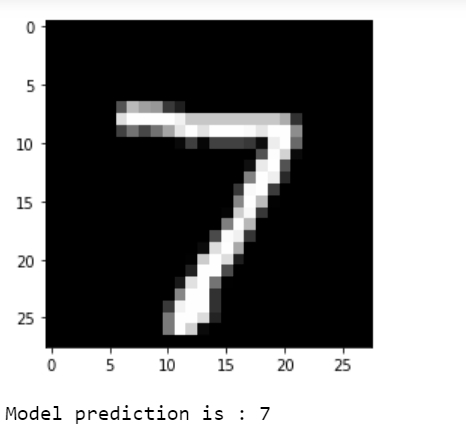
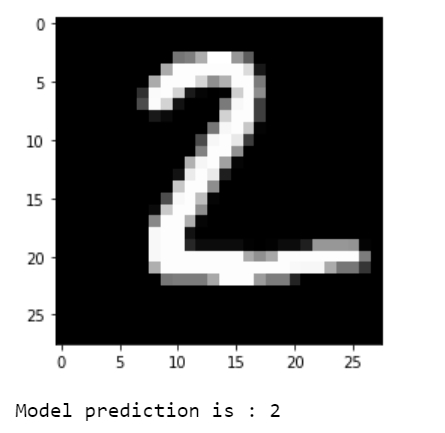
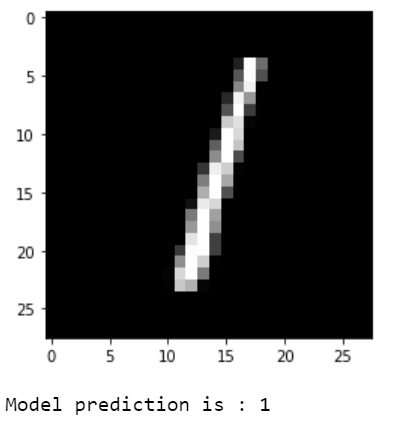
print("Model prediction is : %i" % np.argmax(predictions.numpy()[i]))輸出
step: 50, loss: 2.301992, accuracy: 0.132812
step: 100, loss: 2.301754, accuracy: 0.125000
step: 150, loss: 2.303200, accuracy: 0.117188
step: 200, loss: 2.302409, accuracy: 0.117188
step: 250, loss: 2.303324, accuracy: 0.101562
step: 300, loss: 2.301391, accuracy: 0.113281
step: 350, loss: 2.299984, accuracy: 0.140625
step: 400, loss: 2.303896, accuracy: 0.093750
step: 450, loss: 2.303662, accuracy: 0.093750
step: 500, loss: 2.297976, accuracy: 0.148438
step: 550, loss: 2.300465, accuracy: 0.121094
step: 600, loss: 2.299437, accuracy: 0.140625
step: 650, loss: 2.299458, accuracy: 0.128906
step: 700, loss: 2.302172, accuracy: 0.117188
step: 750, loss: 2.306451, accuracy: 0.101562
step: 800, loss: 2.303451, accuracy: 0.109375
step: 850, loss: 2.303128, accuracy: 0.132812
step: 900, loss: 2.307874, accuracy: 0.089844
step: 950, loss: 2.309694, accuracy: 0.082031
step: 1000, loss: 2.302263, accuracy: 0.097656
Test accuracy is : 0.869700
解釋
匯入併為所需的包設定別名。
定義 MNIST 資料集的學習引數。
從源載入 MNIST 資料集。
將資料集拆分為訓練資料集和測試資料集。資料集中的影像被展平為具有 28 x 28 = 784 個特徵的一維向量。
影像值被歸一化到 [0,1] 而不是 [0,255]。
定義了一個名為“logistic_reg”的函式,該函式給出輸入資料的 softmax 值。它將 logits 歸一化為機率分佈。
定義交叉熵損失函式,它將標籤編碼為獨熱向量。預測值被格式化以減少 log(0) 錯誤。
需要計算準確性指標,因此定義了一個函式。
定義隨機梯度下降最佳化器。
定義了一個用於最佳化的函式,該函式計算梯度並更新權重和偏差的值。
對資料進行指定步數的訓練。
在驗證集上測試構建的模型。
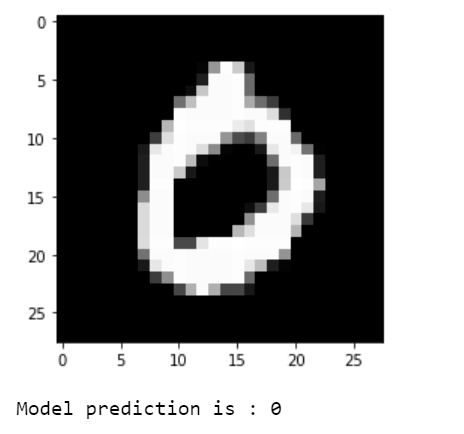
視覺化預測結果。

更新於:2021年1月19日
211 次檢視

廣告