
 資料結構
資料結構 網路
網路 關係資料庫管理系統 (RDBMS)
 作業系統
作業系統 Java
Java MS Excel
 iOS
iOS HTML
HTML CSS
CSS Android
 Python
 C語言程式設計
 C++
C++ C#
C# MongoDB
 MySQL
MySQL Javascript
 PHP
PHP 物理學
物理學 化學
化學 生物學
生物學 數學
數學 英語
英語 經濟學
經濟學 心理學
心理學 社會學
社會學 服裝設計
服裝設計 法律研究
法律研究SVM中的分離平面
支援向量機 (SVM) 是一種廣泛應用於手寫識別、情感分析等領域的監督學習演算法。為了分離不同的類別,SVM 計算最優超平面,該超平面或多或少準確地在兩個類別之間建立了一個邊界。
以下是一些在 SVM 中分離超平面的方法。
資料預處理 - SVM 需要經過標準化、縮放和中心化處理的資料,因為它們對這些特徵敏感。
選擇核函式 - 核函式用於將輸入轉換為更高維的空間。其中一些包括線性核、多項式核和徑向基函式。
讓我們考慮 SVM 超平面可以區分的兩種情況。
線性可分情況。
非線性可分情況。
示例 1
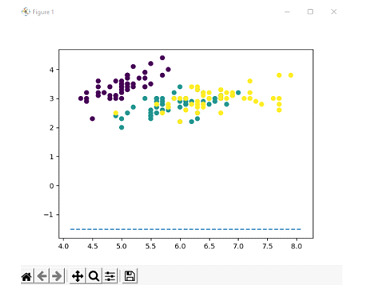
對於線性可分情況,讓我們考慮具有二維特徵的鳶尾花資料集。線性可分情況是指特徵可以透過超平面線性分離。鳶尾花資料集是展示線性可分超平面的一個很好的初學者友好方法。目標是顯示一個本質上是線性的超平面。
演算法
匯入所有庫
載入鳶尾花資料集,並將資料和目標特徵分別分配給變數 x 和 y。
使用 train_test_split 函式,為 x_train、x_test、y_train 和 y_test 分配值。
使用線性核構建 SVM 模型,並根據訓練資料點擬合模型。
預測標籤並列印模型的準確率。
使用模型將模型的權重和偏置分別作為模型的係數和直線的截距。
使用權重和偏置計算斜率和 y 截距。
在圖表中繪製資料點並展示它。
from sklearn import datasets
from sklearn.svm import SVC
from sklearn.model_selection import train_test_split as tts
from sklearn.metrics import accuracy_score
import matplotlib.pyplot as plt
import numpy as np

iris=datasets.load_iris()
x=iris.data
y=iris.target

x_train, x_test, y_train, y_test = tts(x,y,test_size=0.3,random_state=10)

#build an SVM model with linear kernel
clf=SVC(kernel='linear')

#fit the model
clf.fit(x_train,y_train)

#predict the labels
y_pred=clf.predict(x_test)

#calculate the accuracy
acc=accuracy_score(y_test,y_pred)
print("Accuracy: ", acc)

#get the hyperplane parameters
w=clf.coef_[0]
b=clf.intercept_[0]

#calculate the slope and intercept
slope = -w[0]/w[1]
y_int = -b/w[1]

#plot the dataset and hyperplane
plt.scatter(x[:,0], x[:,1], c=y)
axes=plt.gca()
x_vals=np.array(axes.get_xlim())
y_vals=y_int+slope*x_vals
plt.plot(x_vals, y_vals, '--')
plt.show()
我們將資料集分成訓練集和測試集,其中測試集佔總資料的 30%。然後,我們建立一個具有線性核的 SVM 分類器,並將模型擬合到訓練資料。
我們預測測試資料的標籤,並將獲得的結果儲存在單獨的變數中,透過將預測值與真實值進行比較來計算模型的準確率,並列印獲得的準確率,即 1.0。
然後從訓練資料集檢索超平面的引數,並計算超平面的斜率和截距,然後使用散點圖繪製,每個類別使用不同的顏色。
Accuracy: 1.0
輸出
示例 2
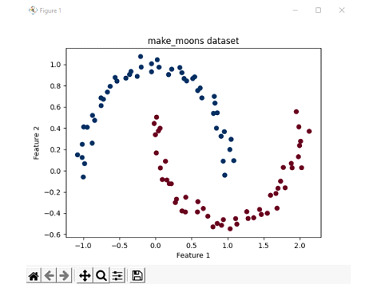
考慮一個案例不線性可分的情況。在這種情況下,我們使用 scikit-learn 庫中提供的 make_moons 資料集。make_moons 資料集是展示 2 個或多個類別不線性可分情況的好方法。因此,此示例用於描述非線性可分情況。
讓我們首先列印資料集的資料點,以便了解我們正在處理什麼。
演算法
匯入所有必要的庫。
使用 100 個樣本生成 make_moons 資料集,並具有最小的噪聲水平。
在圖表中繪製這些資料點並列印,並將顏色圖設定為紅色和藍色。
import matplotlib.pyplot as plt
from sklearn.datasets import make_moons

# Generate the make_moons dataset with 100 samples and a noise level of 0.05
X, y = make_moons(n_samples=100, noise=0.05, random_state=42)

# To show the dataset
plt.scatter(X[:, 0], X[:, 1], c=y, cmap=plt.cm.RdBu_r)

# Set the plot labels and title
plt.xlabel('Feature 1')
plt.ylabel('Feature 2')
plt.title('make_moons dataset')

# Show the plot
plt.show()
輸出
演算法
匯入程式中使用的所有庫
從 make_moons 資料集中生成 100 個數據樣本,噪聲儘可能低。
使用徑向基函式 (RBF) 核初始化 SVC 分類器,並根據分類器訓練資料點。
根據資料點,將前面初始化的分類器擬合到資料集。
查詢資料中特徵和標籤的最大值和最小值。
使用上述值,使用 linspace 函式構造網格。
要返回網格的一維表示,應用 ravel 函式並使用 np.c_ 沿第二軸切片。
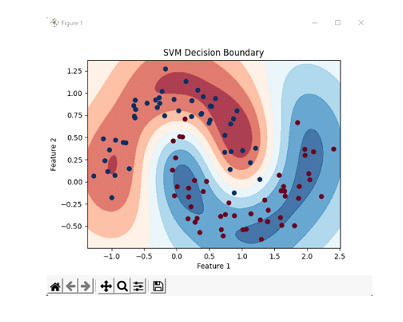
要定義決策邊界,建立決策邊界的等高線圖。
列印影像和標籤。
示例
import numpy as np
import matplotlib.pyplot as plt
from sklearn import datasets
from sklearn.svm import SVC

# load moons dataset
x, y = datasets.make_moons(n_samples=100, noise=0.15, random_state=42)

# create an SVM classifier implementing RBF kernel
clf = SVC(kernel='rbf', gamma=2)

# train the classifier on the dataset
clf.fit(X, y)

# create a meshgrid representing features and labels
x_min, x_max = x[:, 0].min() - 0.1, x[:, 0].max() + 0.1
y_min, y_max = x[:, 1].min() - 0.1, x[:, 1].max() + 0.1
xx, yy = np.meshgrid(np.linspace(x_min, x_max, 500), np.linspace(y_min, y_max, 500))
z = clf.decision_function(np.c_[xx.ravel(), yy.ravel()])
z = z.reshape(xx.shape)

# create a contour plot of the decision boundary
plt.contourf(xx, yy, z, cmap=plt.cm.RdBu, alpha=0.8)
plt.scatter(x[:, 0], x[:, 1], c=y, cmap=plt.cm.RdBu_r)

# set the plot labels and title
plt.xlabel('Feature 1')
plt.ylabel('Feature 2')
plt.title('SVM Decision Boundary')

# show the plot
plt.show()
我們透過建立 100 個樣本(噪聲級別為 0.15,隨機種子為 42)生成資料集,並建立一個 SVM 分類器,並在資料集上訓練分類器。然後,我們定義一組點來表示特徵和標籤。然後,我們計算這些點的決策函式值,並將其重新整形以匹配網格的維度。然後,我們建立決策邊界的等高線圖,其中決策函式值決定區域的顏色。我們還繪製原始資料點,不同顏色代表不同類別。
輸出
結論
支援向量機是更廣泛使用的演算法之一,用於各種領域,主要是文字和語音分類,或 NLP 中的情感分析。它在分類方面的多功能性使其成為更受歡迎的演算法之一。
在其他情況下,它有其自身的缺點。有時,SVM 在計算上可能非常密集,並且由於模型的敏感性,需要仔細檢查提供給模型的資料。

93 次瀏覽
