
 資料結構
資料結構 網路
網路 RDBMS
RDBMS 作業系統
作業系統 Java
Java MS Excel
 iOS
iOS HTML
HTML CSS
CSS Android
 Python
 C程式語言
C程式語言 C++
C++ C#
C# MongoDB
 MySQL
MySQL Javascript
 PHP
PHP 物理
物理 化學
化學 生物
生物 數學
數學 英語
英語 經濟學
經濟學 心理學
心理學 社會研究
社會研究 時尚研究
時尚研究 法律研究
法律研究Python程式——將POS轉換為SOP
在本文中,我們將會了解如何解決以下給出的問題陳述。
問題陳述 − 給定POS形式,我們需要將其轉換成等效的SOP形式
轉換可以透過首先計算POS形式中字母的數量,然後計算所有最大項和最小項來完成。
現在讓我們觀察以下實現中的概念−
範例
# Python code to convert standard POS form
# to standard SOP form
# to calculate number of variables
def count_no_alphabets(POS):
   i = 0
   no_var = 0
   # total no. of alphabets before will be equal to alphabets before first '.' character
   while (POS[i]!='.'):
      # character is a alphabet or not
      if (POS[i].isalpha()):
         no_var+= 1
      i+= 1
   return no_var
# maximum terms in an integer
def Cal_Max_terms(Max_terms, POS):
   a = ""
   i = 0
   while (i<len(POS)):
      if (POS[i]=='.'):
         # binary to decimal conversion
         b = int(a, 2)
         # append each min term(integer type) into the list
         Max_terms.append(b)
         # assign empty strings
         a =""
         i+= 1
      elif(POS[i].isalpha()):
         # checking whether variable is having complement as superscript
         if(i + 1 != len(POS) and POS[i + 1]=="'"):
            # concatenating the string with '1'
            a += '1'
            # incrementing by 2 because 1 for alphabet and another for a symbol "'"
            i += 2
         else:
            # concatenating the string with '0'
            a += '0'
            i += 1
      else:
         i+= 1
   # append last min term(integer type) into the list
   Max_terms.append(int(a, 2))
# conversion of minterms in binary and finally converting it to SOP
def Cal_Min_terms(Max_terms, no_var, start_alphabet):
   # declaration of the list
   Min_terms =[]
   # calculation of total no. of terms formed by all variables max = 2**no_var
   for i in range(0, max):
      # is current term present in max_terms or not
      if (Max_terms.count(i)== 0):
         # converting integer to binary
         b = bin(i)[2:]
         # loop used for inserting 0's before the
         # binary value so that its length will be
         # equal to no. of variables present in
         # each product term
         while(len(b)!= no_var):
            b ='0'+b
         # appending the max terms(integer) in the list
         Min_terms.append(b)
   SOP = ""
   # iterated untill minterms are available
   for i in Min_terms:
      # fetching the variable
      value = start_alphabet
      # iterate till there are 0's and 1's
      for j in i:
         # check whether the varailble is complemented or not
         if (j =='0'):
            # concatenating vaue and complement operator
            SOP = SOP + value+ "'"
         # check the non complement variable
         else:
            # concatenating value
            SOP = SOP + value
         # increment the alphabet by the next adjacent alaphabet
         value = chr(ord(value)+1)
      # concatenating the "+" operator
      SOP = SOP+ "+"
   # for discarding the extra '+'
   SOP = SOP[:-1]
   return SOP
# main function
def main():
   # input
   POS_expr ="(A'+B'+C).(A+B+C').(A+B'+C).(A'+B+C)"
   Max_terms = []
   no_var = count_no_alphabets(POS_expr)
   Cal_Max_terms(Max_terms, POS_expr)
   SOP_expr = Cal_Min_terms(Max_terms, no_var, POS_expr[1])
   print("Standard SOP form of " + POS_expr + " ==> " + SOP_expr)
# Driver code
if __name__=="__main__":
   main()
輸出
Standard SOP form of (A'+B'+C).(A+B+C').(A+B'+C).(A'+B+C) ==>
A'B'C'+A'BC+AB'C+ABC
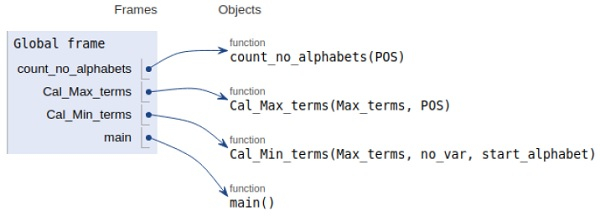
所有變數都宣告在區域性範圍內,其引用關係如圖所示。
結論
在本文中,我們已經瞭解瞭如何將POS轉換為SOP形式

更新於: 2019-12-24
194 次瀏覽

廣告