
 資料結構
資料結構 網路
網路 關係資料庫管理系統 (RDBMS)
 作業系統
作業系統 Java
Java MS Excel
 iOS
iOS HTML
HTML CSS
CSS Android
 Python
 C語言程式設計
 C++
C++ C#
C# MongoDB
 MySQL
MySQL Javascript
 PHP
PHP 物理學
物理學 化學
化學 生物學
生物學 數學
數學 英語
英語 經濟學
經濟學 心理學
心理學 社會學
社會學 服裝設計
服裝設計 法學
法學C++程式設計中不使用遞迴列印根到葉路徑。
給定二叉樹,程式必須找出從根到葉的多個路徑,這意味著應該列印所有路徑,但挑戰是不使用遞迴。
我們將迭代遍歷樹,因為約束是不使用遞迴。為了實現這一點,我們可以使用一個STL map,它將儲存根元素,並且每當透過層序遍歷識別葉節點時,它將列印從根到葉的路徑,因為有一個map指標指向根節點。
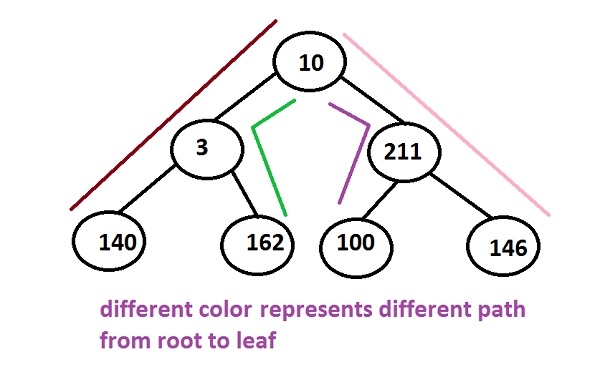
在上圖的樹中,可以生成多條從根到葉的路徑:
10 -> 3 -> 140
10 -> 3 -> 162
10 -> 211 -> 100
10 -> 211 -> 146
因此,程式必須將所有給定的路徑作為給定二叉樹的輸出打印出來。
演算法
START
Step 1 -> create a structure of a node as
   struct Node
      struct node *left, *right
      int data
   End
Step 2 -> function to create a node
   node* newnode(int data)
   node->data = data
   node->left = node->right = NULL;
   return (node)
Step 3 -> create function to calculate the path
   void calculatePath(Node* curr, map<Node*, Node*> first)
   create STL stack<Node*> stk
   Loop While (curr)
      stk.push(curr)
      curr = first[curr]
   End
   Loop While !stk.empty()
      curr = stk.top()
      stk.pop()
      print curr->data
   End
Step 4 -> create function to find the leaf nodes
   void leaf(Node* root)
   IF root = NULL
      Return
   End
   Create STL stack<Node*> stc
   stc.push(root)
   Create STL map<Node*, Node*> prnt
   prnt[root] = NULL
   Loop while !stc.empty()
      Node* curr = stc.top()
      stc.pop()
      IF!(curr->left) && !(curr->right)
         calculatePath(curr, prnt)
      End
      IF curr->right
         prnt[curr->right] = curr
         stc.push(curr->right)
      End
      IF curr->left
         prnt[curr->left] = curr
         stc.push(curr->left)
      End
   End
STOP
示例
#include <bits/stdc++.h>
using namespace std;
//structure of a node
struct Node{
   int data;
   struct Node *left, *right;
};
//function to create a new node
Node* newNode(int data){
   Node* node = new Node;
   node->data = data;
   node->left = node->right = NULL;
   return node;
}
//this function will calculate the path
void calculatePath(Node* curr, map<Node*, Node*> first){
   stack<Node*> stk;
   while (curr){
      stk.push(curr);
      curr = first[curr];
   }
   while (!stk.empty()){
      curr = stk.top();
      stk.pop();
      cout << curr->data << " ";
   }
   cout << endl;
}
//this function will lead to the leafs
void leaf(Node* root){
   if (root == NULL)
      return;
   stack<Node*> stc;
   stc.push(root);
   map<Node*, Node*> prnt;
   prnt[root] = NULL;
   while (!stc.empty()){
      Node* curr = stc.top();
      stc.pop();
      if (!(curr->left) && !(curr->right))
         calculatePath(curr, prnt);
      if (curr->right){
         prnt[curr->right] = curr;
         stc.push(curr->right);
      }
      if (curr->left){
         prnt[curr->left] = curr;
         stc.push(curr->left);
      }
   }
}
int main(){
   Node* root = newNode(67); //it will insert the nodes to create a tree
   root->left = newNode(34);
   root->right = newNode(89);
   root->left->left = newNode(23);
   root->left->right = newNode(95);
   root->right->left = newNode(12);
   leaf(root); //call the function leaf
   return 0;
}
輸出
如果我們執行上述程式,它將生成以下輸出
67 34 23
67 34 95
67 89 12

更新於:2019年9月4日
170 次瀏覽

廣告