
 資料結構
資料結構 網路
網路 關係資料庫管理系統
 作業系統
作業系統 Java
Java MS Excel
 iOS
iOS HTML
HTML CSS
CSS Android
 Python
 C 程式設計
 C++
C++ C#
C# MongoDB
 MySQL
MySQL Javascript
 PHP
PHP 物理
物理 化學
化學 生物
生物 數學
數學 英語
英語 經濟
經濟 心理學
心理學 社會學
社會學 時尚
時尚 法律
法律如何使用 Android 播放任意音調?
本示例演示如何使用 Android 播放任意音調。
步驟 1 − 在 Android Studio 中建立一個新專案,轉到“檔案 ⇒ 新建專案”並填寫所有必需的詳細資訊以新建一個專案。
步驟 2 − 將以下程式碼新增到 res/layout/activity_main.xml 中。
<?xml version="1.0" encoding="utf-8"?>
<LinearLayout xmlns:android="http://schemas.android.com/apk/res/android"
   xmlns:tools="http://schemas.android.com/tools"
   android:layout_width="match_parent"
   android:layout_height="match_parent"
   android:gravity="center"
   android:orientation="vertical"
   android:padding="16dp"
   tools:context=".MainActivity">
   <ImageView
      android:layout_width="200dp"
      android:layout_height="300dp"
      android:src="@drawable/ic_music_note_black_24dp"/>
   <TextView
      android:text="Increase the emulator Volume, Listen to the arbitrary tone!"
      android:textSize="16sp"
      android:textStyle="bold|italic"
      android:layout_width="wrap_content"
      android:layout_height="wrap_content"/>
</LinearLayout>
步驟 3 − 將以下程式碼新增到 src/MainActivity.java 中
import androidx.appcompat.app.AppCompatActivity;
import android.media.AudioFormat;
import android.media.AudioManager;
import android.media.AudioTrack;
import android.os.Bundle;
import android.os.Handler;
public class MainActivity extends AppCompatActivity {
   private final int duration = 10;
   private final int sampleRate = 8000;
   private final int numSamples = duration * sampleRate;
   private final double[] sample = new double[numSamples];
   private final byte[] generatedSnd = new byte[2 * numSamples];
   Handler handler = new Handler();
   @Override
   protected void onCreate(Bundle savedInstanceState) {
      super.onCreate(savedInstanceState);
      setContentView(R.layout.activity_main);
   }
   @Override
   protected void onResume() {
      super.onResume();
      final Thread thread = new Thread(new Runnable() {
         public void run() {
            genTone();
            handler.post(new Runnable() {
               public void run() {
                  playSound();
               }
            });
         }
      });
      thread.start();
   }
   void genTone(){
      for (int i = 0; i < numSamples; ++i) {
         double freqOfTone = 440;
         sample[i] = Math.sin(2 * Math.PI * i / (sampleRate/ freqOfTone));
      }
      int idx = 0;
      for (final double dVal : sample) {
         final short val = (short) ((dVal * 32767));
         generatedSnd[idx++] = (byte) (val & 0x00ff);
         generatedSnd[idx++] = (byte) ((val & 0xff00) >>> 8);
      }
   }
   void playSound(){
      final AudioTrack audioTrack = new AudioTrack(AudioManager.STREAM_MUSIC,
      sampleRate, AudioFormat.CHANNEL_OUT_MONO,
      AudioFormat.ENCODING_PCM_16BIT, generatedSnd.length,
      AudioTrack.MODE_STATIC);
      audioTrack.write(generatedSnd, 0, generatedSnd.length);
      audioTrack.play();
   }
}
步驟 4 − 將以下程式碼新增到 androidManifest.xml 中
<?xml version="1.0" encoding="utf-8"?>
<manifest xmlns:android="http://schemas.android.com/apk/res/android"
package="app.com.sample">
   <application
      android:allowBackup="true"
      android:icon="@mipmap/ic_launcher"
      android:label="@string/app_name"
      android:roundIcon="@mipmap/ic_launcher_round"
      android:supportsRtl="true"
      android:theme="@style/AppTheme">
         <activity android:name=".MainActivity">
            <intent-filter>
               <action android:name="android.intent.action.MAIN" />
               <category android:name="android.intent.category.LAUNCHER" />
            </intent-filter>
         </activity>
   </application>
</manifest>
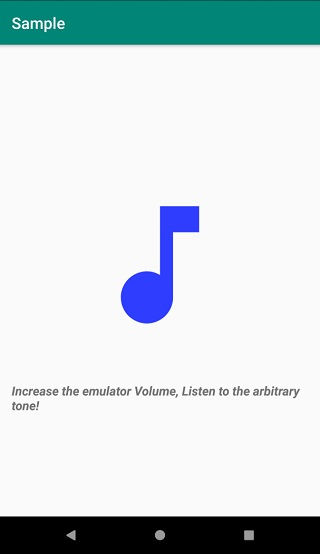
讓我們嘗試執行您的應用程式。我假設您已將您的 Android 移動裝置與您的計算機連線。要從 Android 工作室執行應用,請開啟專案中的一個活動檔案,並點選工具欄中的執行  圖示。將您的移動裝置選擇為一個選項,然後檢視您的移動裝置,它將顯示您的預設螢幕 −

更新於: 2020-07-08
183 次瀏覽

廣告