
 資料結構
資料結構 網路
網路 RDBMS
RDBMS 作業系統
作業系統 Java
Java MS Excel
 iOS
iOS HTML
HTML CSS
CSS Android
 Python
 C 語言程式
 C++
C++ C#
C# MongoDB
 MySQL
MySQL Javascript
 PHP
PHP 物理學
物理學 化學
化學 生物學
生物學 數學
數學 英語
英語 經濟學
經濟學 心理學
心理學 社會研究
社會研究 時尚研究
時尚研究 法律研究
法律研究將給定的數字轉換成單詞的 C 語言程式
給定一個由數值組成的字串,任務是將給定的數字轉換成單詞。
例如,我們有一個輸入“361”,那麼輸出應該用單詞表示,即“Three hundred sixty one”。要解決以下問題,我們必須記住數字和數字所在的位置,例如個位、十位、千位等。
該程式碼僅支援最多 4 位數字,即 0 到 9999。因此,輸入應該在 0 到 9999 之間。
讓我們考慮 1,111,所以位置將如下所示:
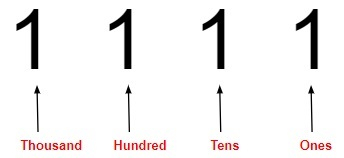
示例
Input: “1234”
Output: one thousand two hundred thirty four
Input: “7777”
Output: seven thousand seven hundred seventy seven
我們用來解決給定問題的思路 −
- 將輸入作為字串。
- 為不同的值建立陣列。
- 檢查輸入長度,根據長度,我們將決定將顯示輸出到哪些位置。
- 根據位置顯示輸出。
演算法
Start
   Step 1 → In function convert(char *num)
      Declare and initialize int len = strlen(num)
      If len == 0 then,
         fprintf(stderr, "empty string
")
         Return
      End If
      If len > 4 then,
         fprintf(stderr, "Length more than 4 is not supported
")
         Return
      End If
      Declare and initialize a char *single_digit[] = { "zero", "one", "two","three", "four","five","six", "seven", "eight", "nine"}
      Declare and initialize a char *tens_place[] = {"", "ten", "eleven", "twelve","thirteen", "fourteen","fifteen", "sixteen","seventeen", "eighteen", "nineteen"}
      Declare and Initialize a char *tens_multiple[] = {"", "", "twenty", "thirty", "forty", "fifty","sixty", "seventy", "eighty", "ninety"}
      Declare and initialize char *tens_power[] = {"hundred", "thousand"}
      Print num
      If len == 1 then,
         Print single_digit[*num - '0']
         Return
      End If
      While *num != '\0
         If len >= 3
            If *num -'0' != 0
               Print single_digit[*num - '0']
               Print tens_power[len-3]
            End If
               Decrement len by 1
            End If
         Else
            If *num == '1' then,
               Set sum = *num - '0' + *(num + 1)- '0'
               Print tens_place[sum]
               Return
            End If
            Else If *num == '2' && *(num + 1) == '0' then,
               Print “twenty”
               Return
            End else If
         Else
            Set i = *num - '0'
            Print i? tens_multiple[i]: ""
            Increment num by 1
            If *num != '0' then,
               Print single_digit[*num - '0']
            End If
            End Else
               Increment num by 1
            End Else
            End while
   Step 2 → In function main()
      Call function convert("9132")
Stop
示例
#include <stdio.h>
#include <string.h>
#include <stdlib.h>
//function to print the given number in words
void convert(char *num) {
   int len = strlen(num);
   // cases
   if (len == 0) {
      fprintf(stderr, "empty string
");
      return;
   }
   if (len > 4) {
      fprintf(stderr, "Length more than 4 is not supported
");
      return;
   }
   // the first string wont be used.
   char *single_digit[] = { "zero", "one", "two", "three", "four","five", "six", "seven", "eight", "nine"};
   // The first string is not used, it is to make
   // array indexing simple
      char *tens_place[] = {"", "ten", "eleven", "twelve", "thirteen", "fourteen", "fifteen", "sixteen", "seventeen", "eighteen", "nineteen"};
   // The first two string are not used, they are to make
   // array indexing simple
      char *tens_multiple[] = {"", "", "twenty", "thirty", "forty", "fifty","sixty", "seventy", "eighty", "ninety"};
      char *tens_power[] = {"hundred", "thousand"};
   // Used for debugging purpose only
   printf("
%s: ", num);

   // For single digit number
   if (len == 1) {
      printf("%s
", single_digit[*num - '0']);
      return;
   }
   // Iterate while num is not '\0'
   while (*num != '\0') {
      // Code path for first 2 digits
      if (len >= 3) {
         if (*num -'0' != 0) {
            printf("%s ", single_digit[*num - '0']);
            printf("%s ", tens_power[len-3]); // here len can be 3 or 4
         }
         --len;
      }
      // Code path for last 2 digits
      else {
         // Need to explicitly handle 10-19. Sum of the two digits is
         //used as index of "tens_place" array of strings
         if (*num == '1') {
            int sum = *num - '0' + *(num + 1)- '0';
            printf("%s
", tens_place[sum]);
            return;
         }
         // Need to explicitely handle 20
         else if (*num == '2' && *(num + 1) == '0') {
            printf("twenty
");
            return;
         }
         // Rest of the two digit numbers i.e., 21 to 99
         else {
            int i = *num - '0';
            printf("%s ", i? tens_multiple[i]: "");
            ++num;
            if (*num != '0')
               printf("%s ", single_digit[*num - '0']);
         }
      }
      ++num;
   }
}
int main() {
   convert("9132");
   return 0;
}
輸出
nine thousand one hundred thirty two

更新於:20-Nov-2019
1.1 萬次觀看

廣告