
 資料結構
資料結構 網路
網路 關係資料庫管理系統 (RDBMS)
 作業系統
作業系統 Java
Java MS Excel
 iOS
iOS HTML
HTML CSS
CSS Android
 Python
 C 程式設計
 C++
C++ C#
C# MongoDB
 MySQL
MySQL Javascript
 PHP
PHP 物理學
物理學 化學
化學 生物學
生物學 數學
數學 英語
英語 經濟學
經濟學 心理學
心理學 社會學
社會學 服裝設計
服裝設計 法學
法學C++ 數獨求解器
假設我們有一個數獨網格,我們需要解決這個著名的數字謎題——數獨。我們知道數獨是一個 9 x 9 的數字網格,整個網格也細分為 3 x 3 的小方格。有一些規則需要遵循才能解決數獨。
我們需要使用數字 1 到 9 來解決這個問題。
同一行、同一列或同一個 3 x 3 方格內不能重複使用同一個數字。
我們將使用回溯演算法來嘗試解決數獨問題。當某個單元格填充了一個數字後,它會檢查該數字是否有效。如果無效,則會檢查其他數字。如果已經檢查了 1 到 9 的所有數字,並且沒有找到有效的數字可以放置,則回溯到之前的選擇。
所以如果輸入是這樣的:
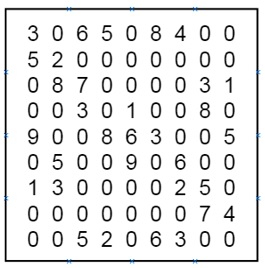
輸出將是:
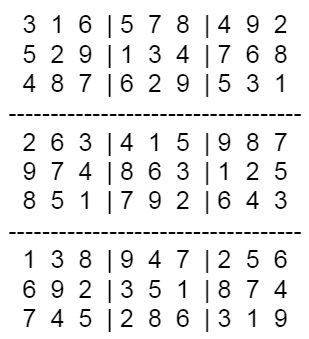
為了解決這個問題,我們將遵循以下步驟:
定義一個名為 isPresentInCol() 的方法,它將接收列和數字作為引數。
對於網格中的每一行 r,執行:
如果 grid[r, col] = num,則返回 true
否則返回 false
定義一個名為 isPresentInRow() 的方法,它將接收行和數字作為引數。
對於網格中的每一列 c,執行:
如果 grid[row, c] = num,則返回 true
否則返回 false
定義一個名為 isPresentInBox() 的方法,它將接收方格起始行、方格起始列和數字作為引數。
對於從 boxStartRow 到接下來的 3 行的每一行 r,執行:
對於從 boxStartCol 到接下來的 3 列的每一列 c,執行:
如果 grid[r, c] = num,則返回 true
否則返回 false
定義一個名為 findEmptyPlace() 的方法,它將接收行和列作為引數。
對於網格中的每一行 r,執行:
對於網格中的每一列 c,執行:
如果 grid[r, c] = 0,則返回 true
返回 false
定義一個名為 isValidPlace() 的方法,它將接收行、列和數字作為引數。
如果 isPresentInRow(row, num)、isPresentInCol(col, num) 和 isPresentInBox(row – row % 3, col – col % 3, num) 全部為 false,則返回 true
定義一個名為 solveSudoku() 的方法,它將接收網格作為引數。
如果網格中沒有空位置,則返回 true
對於數字 1 到 9,執行:
如果 isValidPlace(row, col, number) 為 true,則:
grid[row, col] := number
如果 solveSudoku() 返回 true,則返回 true
grid[row, col] := 0
返回 false
示例 (C++)
讓我們看看下面的實現來更好地理解:
#include <iostream>
#define N 9
using namespace std;
int grid[N][N] = {
   {3, 0, 6, 5, 0, 8, 4, 0, 0},
   {5, 2, 0, 0, 0, 0, 0, 0, 0},
   {0, 8, 7, 0, 0, 0, 0, 3, 1},
   {0, 0, 3, 0, 1, 0, 0, 8, 0},
   {9, 0, 0, 8, 6, 3, 0, 0, 5},
   {0, 5, 0, 0, 9, 0, 6, 0, 0},
   {1, 3, 0, 0, 0, 0, 2, 5, 0},
   {0, 0, 0, 0, 0, 0, 0, 7, 4},
   {0, 0, 5, 2, 0, 6, 3, 0, 0}
};
bool isPresentInCol(int col, int num){ //check whether num is present in col or not
   for (int row = 0; row < N; row++)
      if (grid[row][col] == num)
         return true;
   return false;
}
bool isPresentInRow(int row, int num){ //check whether num is present in row or not
   for (int col = 0; col < N; col++)
      if (grid[row][col] == num)
         return true;
   return false;
}
bool isPresentInBox(int boxStartRow, int boxStartCol, int num){
//check whether num is present in 3x3 box or not
   for (int row = 0; row < 3; row++)
      for (int col = 0; col < 3; col++)
         if (grid[row+boxStartRow][col+boxStartCol] == num)
            return true;
   return false;
}
void sudokuGrid(){ //print the sudoku grid after solve
   for (int row = 0; row < N; row++){
      for (int col = 0; col < N; col++){
         if(col == 3 || col == 6)
            cout << " | ";
         cout << grid[row][col] <<" ";
      }
      if(row == 2 || row == 5){
         cout << endl;
         for(int i = 0; i<N; i++)
            cout << "---";
      }
      cout << endl;
   }
}
bool findEmptyPlace(int &row, int &col){ //get empty location and update row and column
   for (row = 0; row < N; row++)
      for (col = 0; col < N; col++)
         if (grid[row][col] == 0) //marked with 0 is empty
            return true;
   return false;
}
bool isValidPlace(int row, int col, int num){
   //when item not found in col, row and current 3x3 box
   return !isPresentInRow(row, num) && !isPresentInCol(col, num) && !isPresentInBox(row - row%3 ,
col - col%3, num);
}
bool solveSudoku(){
   int row, col;
   if (!findEmptyPlace(row, col))
      return true; //when all places are filled
   for (int num = 1; num <= 9; num++){ //valid numbers are 1 - 9
      if (isValidPlace(row, col, num)){ //check validation, if yes, put the number in the grid
         grid[row][col] = num;
         if (solveSudoku()) //recursively go for other rooms in the grid
            return true;
         grid[row][col] = 0; //turn to unassigned space when conditions are not satisfied
      }
   }
   return false;
}
int main(){
   if (solveSudoku() == true)
      sudokuGrid();
   else
      cout << "No solution exists";
}
輸入
{3, 0, 6, 5, 0, 8, 4, 0, 0},
{5, 2, 0, 0, 0, 0, 0, 0, 0},
{0, 8, 7, 0, 0, 0, 0, 3, 1},
{0, 0, 3, 0, 1, 0, 0, 8, 0},
{9, 0, 0, 8, 6, 3, 0, 0, 5},
{0, 5, 0, 0, 9, 0, 6, 0, 0},
{1, 3, 0, 0, 0, 0, 2, 5, 0},
{0, 0, 0, 0, 0, 0, 0, 7, 4},
{0, 0, 5, 2, 0, 6, 3, 0, 0}
輸出
3 1 6 | 5 7 8 | 4 9 2
5 2 9 | 1 3 4 | 7 6 8
4 8 7 | 6 2 9 | 5 3 1
---------------------------
2 6 3 | 4 1 5 | 9 8 7
9 7 4 | 8 6 3 | 1 2 5
8 5 1 | 7 9 2 | 6 4 3
---------------------------
1 3 8 | 9 4 7 | 2 5 6
6 9 2 | 3 5 1 | 8 7 4
7 4 5 | 2 8 6 | 3 1 9

16K+ 次瀏覽
