
 資料結構
資料結構 網路
網路 關係資料庫管理系統 (RDBMS)
 作業系統
作業系統 Java
Java MS Excel
 iOS
iOS HTML
HTML CSS
CSS Android
 Python
 C語言程式設計
 C++
C++ C#
C# MongoDB
 MySQL
MySQL Javascript
 PHP
PHP 物理學
物理學 化學
化學 生物學
生物學 數學
數學 英語
英語 經濟學
經濟學 心理學
心理學 社會學
社會學 時尚研究
時尚研究 法律研究
法律研究透過位操作將數字加1
位操作使用按位運算子(如 AND(&)、OR(|)、NOT(~)、XOR(^)、左移(<<) 和右移(>>))對位流進行邏輯運算以獲得所需結果。使用按位運算子是有益的,因為我們可以操作單個位,並且它們比其他運算子更快。
問題陳述
給定一個數字。僅使用按位運算子將數字加1。(不要使用像 ‘+’、‘-’、‘*’ 或 ‘/’ 這樣的算術運算子)
方法一:使用反碼/非運算子
按位補碼/反碼是使用 NOT(~) 運算子實現的。
對於數字 n,n 的按位補碼,即 ~n = -(n+1)。因此,我們可以透過僅取 ~n 的值並忽略符號來得到 n+1。這可以使用 abs() 函式來完成,該函式返回變數的值並忽略符號。
虛擬碼
procedure inc (num)
   num = |~n| // | | represents the abs() function
end procedure
示例
在下面的程式中,我們透過使用按位補碼運算子和絕對值函式來計算數字加1的結果。
#include <bits/stdc++.h>
using namespace std;
// Function for finding the increment of input by 1
int inc(int num){

   // using the abs() function to get the value obtained by applying the ~ operator
   num = abs(~num);
   return num;
}
int main(){
   int input = 7;
   cout << input << " + 1 using bit manipulation = " << inc(input);
   return 0;
}
輸出
7 + 1 using bit manipulation = 8
時間複雜度 − O(1),因為沒有實現迴圈。
空間複雜度 − O(1),因為沒有使用額外的空間。
方法二
來看一些二進位制加法的例子,如下所示:
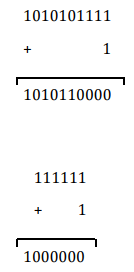
從上面的例子可以看出,在對1進行二進位制加法時,數字右邊第一個未設定位的左邊二進位制位保持不變。但是,右邊第一個未設定位被設定,右邊所有的位都被反轉,即設定位被取消設定,未設定位被設定(0 轉換為 1,1 轉換為 0)。
因此,我們可以將我們的問題分解成兩個基本部分:
設定右邊第一個未設定位。
反轉右邊所有的位。
遞迴方法虛擬碼
procedure inc (num)
   if num & 1 == 0
      ans = num | 1
   else
      ans = inc (num >> 1) << 1
   end if
end procedure
示例
在下面的程式中,我們使用遞迴根據上面解釋的思想將數字加1。
#include <bits/stdc++.h>
using namespace std;
// Function for finding the increment of input
int inc(int num){

   // check if the LSB is set or not. If it is unset, it enters if otherwise, it goes to else
   if ((num & 1) == 0) {

      // LSB is set
      return num | 1;
   }
   else {

      // The number is right shifted and the function is called again
      // After obtaining the return number from called function, the number is left shifted
      return inc(num >> 1) << 1;
   }
}
int main(){
   int input = 14;
   cout << input << " + 1 using bit manipulation = " << inc(input);
   return 0;
}
輸出
14 + 1 using bit manipulation = 15
時間複雜度 − O(k),其中 k 是從右邊第一個未設定位的位數。
空間複雜度 − O(k),由於遞迴堆疊空間。
迭代方法虛擬碼
procedure inc (num)
   m = 1
   while num & m
      num = num & (~m)
      m = m << 1
   end while
   num = num | m
end procedure
示例
在下面的程式中,我們使用一個掩碼數字,該數字在每次迭代中都會更改,直到我們得到右邊第一個未設定位。發現它後,將設定未設定位,並將右邊所有其他位反轉。
#include <bits/stdc++.h>
using namespace std;
// Function for finding the increment of input
int inc(int num){

   // declare a mask with value 1 which is used to find the first unset bit from right side
   int m = 1;

   // checks if LSB is set. If set enter the loop and repeat till we get to the unset bit
   while (num & m) {
      num &= ~m;

      // mask is changed at every iteration to set the unset bit and toggle bits when the loop ends
      m <<= 1;
   }

   // mask used to set the unset bit and toggle all the bits on the right-hand side
   num |= m;
   return num;
}
int main(){
   int input = 14;
   cout << input << " + 1 using bit manipulation = " << inc(input);
   return 0;
}
輸出
14 + 1 using bit manipulation = 15
時間複雜度 − O(k),其中 k 是從右邊第一個未設定位的位數。
空間複雜度 − O(1)
方法三
在這種方法中,我們試圖透過減少查詢第一個未設定位的時間來降低時間複雜度。在這種方法中,我們將首先找到從右邊第一個未設定位,設定它並反轉右邊所有的位。
虛擬碼
procedure inc (num)
   pos = log2 (num & ~num)
   add = 1 << pos
   num = num | add
   if pos != 0
      toggle = (1 << pos) - 1
      num = num ^ toggle
   end if
   ans = num
end procedure
示例
在下面的程式中,使用 Log2() 操作來查詢未設定位,左移和 OR 來設定位,以及左移和 XOR 來反轉位。
#include <bits/stdc++.h>
using namespace std;
// Function for finding the increment of input
int inc(int num){

   // finds the position of the first unset bit from right
   int pos = log2(num & ~num);

   // the following 2 operations combined set the unset bit
   int add = 1 << pos;
   num |= add;

   // Toggling bits only for the numbers where the first unset bit was not the LSB
   if (pos != 0){

      // Using left shift and XOR operations to toggle bits
      int toggle = (1 << pos) - 1;
      num ^= toggle;
   }
   return num;
}

int main(){
   int input = 14;
   cout << input << " + 1 using bit manipulation = " << inc(input);
   return 0;
}
輸出
14 + 1 using bit manipulation = 15
時間複雜度 − O(1)
空間複雜度 − O(1)
結論
總之,為了將數字加1,我們可以使用反碼概念,或者透過分析加1時位的性質,我們可以遵循上述方法來獲得所需的結果。

863 次瀏覽
