
 資料結構
資料結構 網路
網路 關係資料庫管理系統
 作業系統
作業系統 Java
Java MS Excel
 iOS
iOS HTML
HTML CSS
CSS Android
 Python
 C語言程式設計
 C++
C++ C#
C# MongoDB
 MySQL
MySQL Javascript
 PHP
PHP 物理學
物理學 化學
化學 生物學
生物學 數學
數學 英語
英語 經濟學
經濟學 心理學
心理學 社會學
社會學 服裝設計
服裝設計 法律研究
法律研究如何在Android中獲取ListView中所有選中的項?
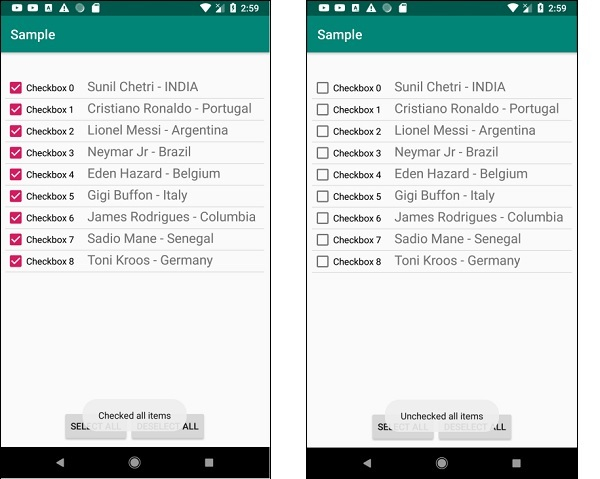
此示例演示瞭如何在 Android 中獲取 ListView 中所有選中的項。
步驟 1 - 在 Android Studio 中建立一個新專案,轉到檔案 ⇒ 新建專案,並填寫所有必需的詳細資訊以建立新專案。
步驟 2 - 將以下程式碼新增到 res/layout/activity_main.xml 中。
<?xml version="1.0" encoding="utf-8"?>
<LinearLayout xmlns:android="http://schemas.android.com/apk/res/android"
   xmlns:tools="http://schemas.android.com/tools"
   android:layout_width="match_parent"
   android:layout_height="match_parent"
   android:orientation="vertical"
   tools:context="MainActivity">
   <LinearLayout
      android:layout_width="match_parent"
      android:layout_height="wrap_content"
      android:gravity="center"
      android:orientation="horizontal">
   <Button
      android:id="@+id/viewCheckedItem"
      android:layout_width="wrap_content"
      android:layout_height="wrap_content"
      android:text="Select all" />
   </LinearLayout>
   <ListView
      android:id="@+id/listView"
      android:layout_width="match_parent"
      android:layout_height="0dp"
      android:layout_marginTop="30dp"
      android:layout_weight="1">
   </ListView>
</LinearLayout>
步驟 3 - 建立一個 Java 類(CustomAdapter.java)並新增以下程式碼 -
import android.annotation.SuppressLint;
import android.content.Context;
import android.view.LayoutInflater;
import android.view.View;
import android.view.ViewGroup;
import android.widget.BaseAdapter;
import android.widget.CheckBox;
import android.widget.TextView;
import android.widget.Toast;
import java.util.ArrayList;
import java.util.Objects;
class CustomAdapter extends BaseAdapter {
   private Context context;
   private static ArrayList<Model> modelArrayList;
   CustomAdapter(Context context, ArrayList<Model> modelArrayList) {
      this.context = context;
      CustomAdapter.modelArrayList = modelArrayList;
   }
   @Override
   public int getViewTypeCount() {
      return getCount();
   }
   @Override
   public int getItemViewType(int position) {
      return position;
   }
   @Override
   public int getCount() {
      return modelArrayList.size();
   }
   @Override
   public Object getItem(int position) {
      return modelArrayList.get(position);
   }
   @Override
      public long getItemId(int position) {
      return 0;
   }
   @SuppressLint("InflateParams")
   @Override
   public View getView(int position, View convertView, ViewGroup parent) {
      final ViewHolder holder;
      if (convertView == null) {
         holder = new ViewHolder();
         LayoutInflater inflater = (LayoutInflater)
         context.getSystemService(Context.LAYOUT_INFLATER_SERVICE);
         convertView = Objects.requireNonNull(inflater).inflate(R.layout.listitem, null, true);
         holder.checkBox = convertView.findViewById(R.id.checkBox);
         holder.tvPlayer = convertView.findViewById(R.id.playerNameList);
         convertView.setTag(holder);
      } else {
         holder = (ViewHolder) convertView.getTag();
      }
      holder.checkBox.setText("Checkbox " + position);
      holder.tvPlayer.setText(modelArrayList.get(position).getPlayer());
      holder.checkBox.setChecked(modelArrayList.get(position).getSelected());
      holder.checkBox.setTag(R.integer.btnPlusView, convertView);
      holder.checkBox.setTag(position);
      holder.checkBox.setOnClickListener(new View.OnClickListener() {
         @Override
         public void onClick(View v) {
            Integer pos = (Integer) holder.checkBox.getTag();
            Toast.makeText(context, "Checkbox " +pos+ "Clicked!",
            Toast.LENGTH_SHORT).show();
            if (modelArrayList.get(pos).getSelected()) {
               modelArrayList.get(pos).setSelected(false);
            } else {
               modelArrayList.get(pos).setSelected(true);
            }
         }
      });
      return convertView;
   }
   private class ViewHolder {
      CheckBox checkBox;
      private TextView tvPlayer;
   }
}
步驟 4 - 建立一個 Java 類(Model.java)並新增以下程式碼 -
class Model {
   private boolean isSelected;
   private String player;
   String getPlayer() {
      return player;
   }
   void setPlayer(String player) {
      this.player = player;
   }
   boolean getSelected() {
      return isSelected;
   }
   void setSelected(boolean selected) {
      isSelected = selected;
   }
}
步驟 5 - 在 res/values/strings.xml 中新增以下程式碼
<resources>
   <string name="app_name">Sample</string>
   <integer name="btnPlusView">1</integer>
   <integer name="btnPlusPos">2</integer>
</resources>
步驟 6 - 為您的 ListView 建立一個佈局(listItem.xml)並新增以下程式碼 -
<?xml version="1.0" encoding="utf-8"?>
<LinearLayout xmlns:android="http://schemas.android.com/apk/res/android"
   android:orientation="horizontal" android:layout_width="match_parent"
   android:layout_height="match_parent">
   <CheckBox
      android:layout_width="wrap_content"
      android:layout_height="wrap_content"
      android:id="@+id/checkBox" />
      <TextView
         android:layout_width="wrap_content"
         android:layout_height="wrap_content"
         android:id="@+id/playerNameList"
         android:layout_marginStart="20dp"
         android:textSize="20sp" />
</LinearLayout>
步驟 7 - 將以下程式碼新增到 src/MainActivity.java 中
import androidx.appcompat.app.AppCompatActivity;
import android.os.Bundle;
import android.view.View;
import android.widget.Button;
import android.widget.ListView;
import android.widget.Toast;
import java.util.ArrayList;
public class MainActivity extends AppCompatActivity {
   private ListView listView;
   private ArrayList<Model> modelArrayList;
   private CustomAdapter customAdapter;
   Button btnSelect, btnDeselect;
   public static String[] playerList = new String[]{"Sunil Chetri - INDIA",
      "Cristiano Ronaldo - Portugal",
      "Lionel Messi - Argentina",
      "Neymar Jr - Brazil",
      "Eden Hazard - Belgium",
      "Gigi Buffon - Italy",
      "James Rodrigues - Columbia",
      "Sadio Mane - Senegal",
      "Toni Kroos - Germany"};
      @Override
      protected void onCreate(Bundle savedInstanceState) {
         super.onCreate(savedInstanceState);
         setContentView(R.layout.activity_main);
         listView = findViewById(R.id.listView);
         btnSelect = findViewById(R.id.viewCheckedItem);
         btnDeselect = findViewById(R.id.deSelect);
         modelArrayList = getModel(false);
         customAdapter = new CustomAdapter(MainActivity.this, modelArrayList);
         listView.setAdapter(customAdapter);
         btnSelect.setOnClickListener(new View.OnClickListener() {
            @Override
            public void onClick(View v) {
               modelArrayList = getModel(true);
               customAdapter = new CustomAdapter(MainActivity.this, modelArrayList);
               listView.setAdapter(customAdapter);
               Toast.makeText(getApplicationContext(), "Checked all items",
               Toast.LENGTH_SHORT).show();
            }
         });
         btnDeselect.setOnClickListener(new View.OnClickListener() {
            @Override
            public void onClick(View v) {
               modelArrayList = getModel(false);
               customAdapter = new CustomAdapter(MainActivity.this,modelArrayList);
               listView.setAdapter(customAdapter);
               Toast.makeText(getApplicationContext(), "Unchecked all items",
               Toast.LENGTH_SHORT).show();
            }
         });
      }
      private ArrayList<Model> getModel(boolean isSelect) {
         ArrayList<Model>list = new ArrayList<>();
         for (int i = 0; i < 9; i++) {
            Model model = new Model();
            model.setSelected(isSelect);
            model.setPlayer(playerList[i]);
            list.add(model);
         }
         return list;
      }
   }
步驟 8 - 將以下程式碼新增到 androidManifest.xml 中
<?xml version="1.0" encoding="utf-8"?>
<manifest xmlns:android="http://schemas.android.com/apk/res/android"
   package="app.com.sample">
   <application
      android:allowBackup="true"
      android:icon="@mipmap/ic_launcher"
      android:label="@string/app_name"
      android:roundIcon="@mipmap/ic_launcher_round"
      android:supportsRtl="true"
      android:theme="@style/AppTheme">
      <activity android:name=".MainActivity">
         <intent-filter>
            <action android:name="android.intent.action.MAIN" />
            <category android:name="android.intent.category.LAUNCHER" />
         </intent-filter>
      </activity>
   </application>
</manifest>
讓我們嘗試執行您的應用程式。我假設您已將您的實際 Android 移動裝置連線到您的電腦。要從 Android Studio 執行應用程式,請開啟您專案中的一個 activity 檔案,然後單擊工具欄中的執行 圖示。選擇您的移動裝置作為選項,然後檢查您的移動裝置,它將顯示您的預設螢幕 -

更新於:2020年7月7日
2K+ 次瀏覽

廣告