
 資料結構
資料結構 網路
網路 RDBMS
RDBMS 作業系統
作業系統 Java
Java MS Excel
 iOS
iOS HTML
HTML CSS
CSS Android
 Python
 C 程式設計
 C++
C++ C#
C# MongoDB
 MySQL
MySQL Javascript
 PHP
PHP 物理學
物理學 化學
化學 生物學
生物學 數學
數學 英語
英語 經濟學
經濟學 心理學
心理學 社會學
社會學 時尚學
時尚學 法律學
法律學用連結串列表示圖的 C++ 程式
圖的關聯矩陣是圖的另一種表示形式,用於將其儲存到記憶體中。此矩陣不是一個方陣。關聯矩陣的階數是 V x E。其中 V 是頂點數,E 是圖中的邊數。
在此矩陣的每一行中,我們放置頂點,而在每列中放置邊。在此表示形式中,對於邊 e {u, v},將在列 e 中用 1 來標記 u 和 v 位置。
鄰接矩陣表示的複雜性
計算關聯矩陣表示需要 O(V x E) 量級空間。對於完全圖,邊數將是 V(V-1)/2。因此,關聯矩陣在記憶體中佔用的空間較大。
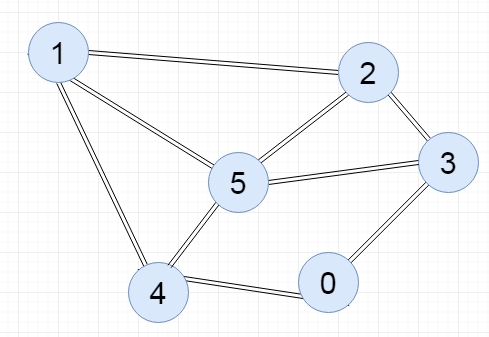
輸入
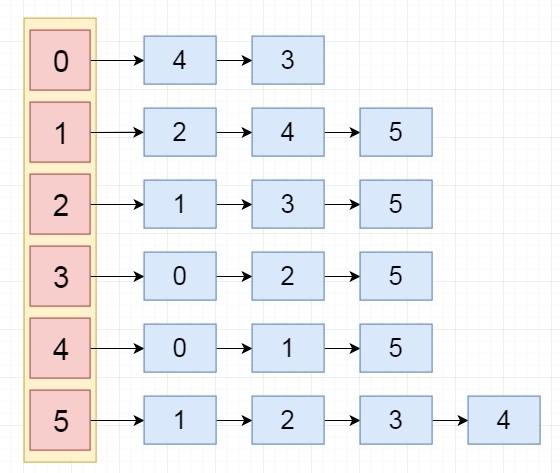
輸出
演算法
add_edge(adj_list, u, v)
輸入 − 邊 {u,v} 的 u 和 v 以及鄰接表
輸出 − 圖 G 的鄰接表
Begin
   Append v into the list at index u
   Append u into the list at index v
End
示例程式碼
#include<iostream>
#include<list>
#include<iterator>
using namespace std;
void displayAdjList(list<int> adj_list[], int v) {
   for(int i = 0; i<v; i++) {
      cout << i << "--->";
      list<int> :: iterator it;
      for(it = adj_list[i].begin(); it != adj_list[i].end(); ++it) {
         cout << *it << " ";
      }
      cout << endl;
   }
}
void add_edge(list<int> adj_list[], int u, int v) {    //add v into the list u, and u into list v
   adj_list[u].push_back(v);
   adj_list[v].push_back(u);
}
main(int argc, char* argv[]) {
   int v = 6; //there are 6 vertices in the graph
   //create an array of lists whose size is 6
   list<int> adj_list[v];
   add_edge(adj_list, 0, 4);
   add_edge(adj_list, 0, 3);
   add_edge(adj_list, 1, 2);
   add_edge(adj_list, 1, 4);
   add_edge(adj_list, 1, 5);
   add_edge(adj_list, 2, 3);
   add_edge(adj_list, 2, 5);
   add_edge(adj_list, 5, 3);
   add_edge(adj_list, 5, 4);
   displayAdjList(adj_list, v);
}
輸出
0--->4 3
1--->2 4 5
2--->1 3 5
3--->0 2 5
4--->0 1 5
5--->1 2 3 4

更新於: 2019 年 7 月 30 日
1 千次瀏覽

廣告