
 資料結構
資料結構 網路
網路 RDBMS
RDBMS 作業系統
作業系統 Java
Java MS Excel
 iOS
iOS HTML
HTML CSS
CSS Android
 Python
 C語言程式設計
 C++
C++ C#
C# MongoDB
 MySQL
MySQL Javascript
 PHP
PHP 物理學
物理學 化學
化學 生物學
生物學 數學
數學 英語
英語 經濟學
經濟學 心理學
心理學 社會學
社會學 時尚研究
時尚研究 法律研究
法律研究C++程式:找出網格中需要阻塞的單元格數量以建立路徑
假設有一個維度為h * w的網格。有一個機器人位於單元格位置(0, 0),它需要到達位置(h - 1, w - 1)。網格中有兩種型別的單元格:阻塞的和未阻塞的。機器人可以穿過未阻塞的單元格,但不能穿過阻塞的單元格。機器人可以向四個方向移動:左、右、上、下。但機器人可以從一個單元格移動到另一個單元格的任何方向(忽略它之前所在的單元格),因此我們只需要建立一條路徑並阻塞該路徑之外的所有其他單元格。我們必須找出並返回為了從(0, 0)到(h - 1, w - 1)為機器人建立一條路徑,我們需要阻塞多少個單元格,如果不存在可能的路徑,則返回-1。
因此,如果輸入像h = 4,w = 4,grid = {"..#.", "#.#.", "#.##", "#..."},則輸出將為2。
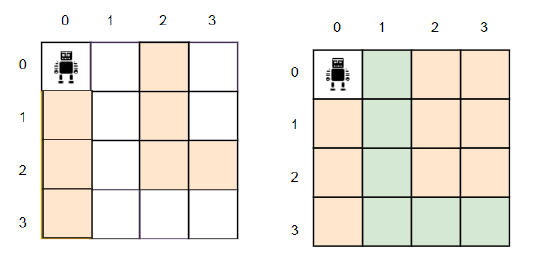
我們只需要阻塞兩個單元格即可從(0, 0)到(3, 3)建立一條路徑。
為了解決這個問題,我們將遵循以下步驟:
Define one 2D array dp
dp[0, 0] := 0
Define an array moves containing pairs = {{-1, 0}, {1, 0}, {0, -1}, {0, 1}}
Define one queue q
insert pair (0, 0) at the end of q
while (not q is empty), do:
   p := first element of q
   delete first element from q
   for initialize i := 0, when i < 4, update (increase i by 1), do:
      row := first value of p + first value of moves[i]
      col := second value of p + second value of moves[i]
      if row < 0 or row > h - 1 or col < 0 or col > w - 1, then:
         Ignore following part, skip to the next iteration
      if grid[row, col] is same as '#', then:
         Ignore following part, skip to the next iteration
      if dp[first value of p, second value of p] + 1 < dp[row, col], then:
         dp[row, col] := dp[first value of p, second value of p] + 1
         insert pair(row, col) into q
if dp[h - 1, w - 1] is same as 2500, then:
   return -1
count := 0
   for initialize i := 0, when i < h, update (increase i by 1), do:
      for initialize j := 0, when j < w, update (increase j by 1), do:
      if grid[i, j] is same as '.', then:
         (increase count by 1)
return count - (dp[h - 1, w - 1] + 1)
示例
讓我們檢視以下實現以更好地理解:
#include <bits/stdc++.h>
using namespace std;

int solve(int h, int w, vector<string> grid){
   vector<vector<int>> dp(h, vector<int>(w, 2500));
   dp[0][0] = 0;
   vector<pair<int, int>> moves = {{-1, 0}, {1, 0}, {0, -1}, {0, 1}};
   queue<pair<int, int>> q;
   q.push(make_pair(0, 0));
   while (!q.empty()) {
      auto p = q.front();
      q.pop();
      for (int i = 0; i < 4; i++) {
         int row = p.first + moves[i].first;
         int col = p.second + moves[i].second;
         if (row < 0 || row > h - 1 || col < 0 || col > w - 1) continue;
         if (grid[row][col] == '#')
            continue;
         if (dp[p.first][p.second] + 1 < dp[row][col]) {
            dp[row][col] = dp[p.first][p.second] + 1; q.push(make_pair(row, col));
         }
      }
   }
   if (dp[h - 1][w - 1] == 2500) {
      return -1;
   }
   int count = 0;
   for (int i = 0; i < h; i++) {
      for (int j = 0; j < w; j++) {
         if (grid[i][j] == '.') count++;
      }
   }
   return count - (dp[h - 1][w - 1] + 1);
}
int main() {
   int h = 4, w = 4;
   vector<string> grid = {"..#.", "#.#.", "#.##", "#..."};
   cout<< solve(h, w, grid);
   return 0;
}
輸入
4, 4, {"..#.", "#.#.", "#.##", "#..."}
輸出
2

更新於: 2022年3月2日
348 次檢視

廣告