
 資料結構
資料結構 網路
網路 關係資料庫管理系統
 作業系統
作業系統 Java
Java MS Excel
 iOS
iOS HTML
HTML CSS
CSS Android
 Python
 C語言程式設計
 C++
C++ C#
C# MongoDB
 MySQL
MySQL Javascript
 PHP
PHP 物理學
物理學 化學
化學 生物學
生物學 數學
數學 英語
英語 經濟學
經濟學 心理學
心理學 社會學
社會學 服裝設計
服裝設計 法律研究
法律研究C++記憶體管理中最佳適配演算法程式
給定兩個包含塊大小和程序大小的陣列;任務是根據記憶體管理中的最佳適配演算法列印結果。
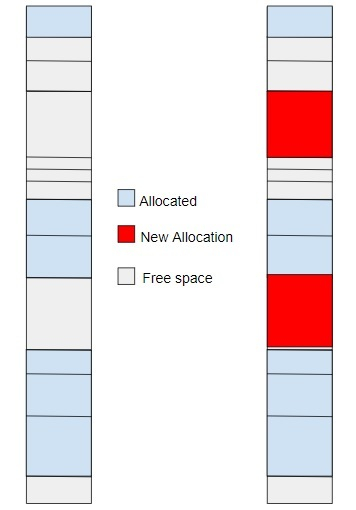
什麼是最佳適配演算法?
最佳適配是一種記憶體管理演算法;它處理分配滿足請求程序需求的最小空閒分割槽。在這種演算法中,我們查詢整個記憶體塊並檢查最適合程序的最小塊,然後查詢可用於滿足適當程序的緊鄰塊。
因此,我們將獲取塊大小和程序大小,並返回程序的輸出以及要分配給程序的塊。
示例
Input: bsize[] = {100, 500, 200, 300, 400}
   psize[] = {112, 518, 110, 526}
Output:
Process No. Process Size Block no.
1            112          3
2            518          Not Allocated
3            110          4
4            526         Not Allocated
將使用的方法來解決上述問題 -
- 獲取程序和塊大小的輸入。
- 最初將所有記憶體塊設定為空閒。
- 獲取每個程序並找到可以分配給塊的最小塊大小,這意味著大於程序大小的整個塊的最小值。
- 如果找到,則將其分配給當前程序,否則放棄該程序並檢查後續程序。
演算法
Start
Step 1-> In function void bestfit(int bsize[], int m, int psize[], int n)
   Declare int alloc[n]
   Call function memset(alloc, -1, sizeof(alloc))
   Loop For i=0 and i<n and i++
      Declare and Initialize bestIdx = -1
      Loop For j=0 and j<m and j++
         If bsize[j] >= psize[i] then,
            If bestIdx == -1 then,
               Set bestIdx = j
            Else If bsize[bestIdx] > bsize[j] then,
               Set bestIdx = j
            If bestIdx != -1 then,
               Set alloc[i] = bestIdx
               Set bsize[bestIdx] -= psize[i]
      Loop For i = 0 and i < n and i++
         Print i+1, psize[i]
         If alloc[i] != -1
            Print alloc[i] + 1
         Else
            Print "Not Allocated"
            Print newline
Step 2->In function int main()
   Declare and initialize bsize[] = {100, 500, 200, 300, 400}
   Declare and initialize psize[] = {112, 518, 110, 526}
   Set m = sizeof(bsize)/sizeof(bsize[0])
   Set n = sizeof(psize)/sizeof(psize[0])
   Call function bestfit(bsize, m, psize, n)
Stop
示例
#include <iostream>
#include <memory>
using namespace std;
// To allocate the memory to blocks as per Best fit
// algorithm
void bestfit(int bsize[], int m, int psize[], int n) {
   // To store block id of the block allocated to a
   // process
   int alloc[n];
   // Initially no block is assigned to any process
    memset(alloc, -1, sizeof(alloc));
   // pick each process and find suitable blocks
   // according to its size ad assign to it
   for (int i=0; i<n; i++) {
      // Find the best fit block for current process
      int bestIdx = -1;
      for (int j=0; j<m; j++) {
         if (bsize[j] >= psize[i]) {
            if (bestIdx == -1)
               bestIdx = j;
            else if (bsize[bestIdx] > bsize[j])
               bestIdx = j;
         }
      }
      // If we could find a block for current process
      if (bestIdx != -1) {
         // allocate block j to p[i] process
         alloc[i] = bestIdx;
         // Reduce available memory in this block.
         bsize[bestIdx] -= psize[i];
      }
   }
   cout << "\nProcess No.\tProcess Size\tBlock no.\n";
   for (int i = 0; i < n; i++) {
      cout << " " << i+1 << "\t\t\t\t" << psize[i] << "\t\t\t\t";
      if (alloc[i] != -1)
         cout << alloc[i] + 1;
      else
         cout << "Not Allocated";
         cout << endl;
   }
}
// Driver code
int main() {
   int bsize[] = {100, 500, 200, 300, 400};
   int psize[] = {112, 518, 110, 526};
   int m = sizeof(bsize)/sizeof(bsize[0]);
   int n = sizeof(psize)/sizeof(psize[0]);
   bestfit(bsize, m, psize, n);
   return 0 ;
}
輸出
Process No. Process Size    Block no.
 1              112             3
 2              518          Not Allocated
 3              110             4
 4              526          Not Allocated

更新於: 2019年12月20日
4K+ 次檢視

廣告