
 資料結構
資料結構 網路
網路 關係資料庫管理系統 (RDBMS)
 作業系統
作業系統 Java
Java MS Excel
 iOS
iOS HTML
HTML CSS
CSS Android
 Python
 C 語言程式設計
 C++
C++ C#
C# MongoDB
 MySQL
MySQL Javascript
 PHP
PHP 物理學
物理學 化學
化學 生物學
生物學 數學
數學 英語
英語 經濟學
經濟學 心理學
心理學 社會學
社會學 服裝設計
服裝設計 法學
法學Tarjan 演算法求解強連通分量
Tarjan 演算法用於查詢有向圖的強連通分量。它只需要一次深度優先搜尋 (DFS) 遍歷即可實現。
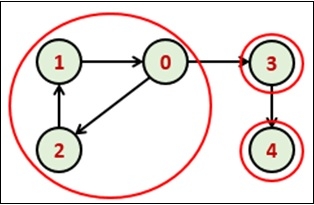
使用 DFS 遍歷,我們可以找到森林的 DFS 樹。從 DFS 樹中,可以找到強連通分量。當找到這樣的子樹的根時,我們可以顯示整個子樹。該子樹就是一個強連通分量。
輸入和輸出
Input:
Adjacency matrix of the graph.
0 0 1 1 0
1 0 0 0 0
0 1 0 0 0
0 0 0 0 1
0 0 0 0 0

Output:
The strongly connected components:
4
3
1 2 0
演算法
findComponent(u, disc, low, stack, stackItemFlag)
輸入:起始節點、發現時間、low 值。disc 儲存頂點的發現時間,low 儲存子樹資訊。stack 用於儲存頂點,另一個標誌陣列用於跟蹤哪個節點在 stack 中。
輸出:顯示強連通分量 (SCC)。
Begin
   time := 0      //the value of time will not be initialized for next function calls
   set disc[u] := time+1 and low[u] := time + 1
   time := time + 1
   push u into stack
   stackItemFalg[u] := true

   for all vertex v which is adjacent with u, do
      if v is not discovered, then
         fincComponent(v, disc, low, stack, stackItemFalg)
         low[u] = minimum of low[u] and low[v]
      else if stackItemFalg[v] is true, then
         low[u] := minimum of low[u] and disc[v]
   done

   poppedItem := 0
   if low[u] = disc[u], then
      while u is not in the stack top, do
         poppedItem := top of stack
         display poppedItem
         stackItemFlag[poppedItem] := false
         pop item from stack
      done

      poppedItem := top of stack
      display poppedItem
      stackItemFlag[poppedItem] := false
      pop item from stack
End
strongConComponent(graph)
輸入:給定的圖。
輸出:所有強連通分量。
Begin
   initially set all items in the disc array to undiscovered
   for all elements in low to φ
   and mark no item is stored into the stack

   for all node i in the graph, do
      if disc[i] is undiscovered, then
         findComponent(i, disc, low, stack, stackItemFlag)
End
示例
#include<iostream>
#include<stack>
#define NODE 5
using namespace std;

int graph[NODE][NODE] = {
   {0, 0, 1, 1, 0},
   {1, 0, 0, 0, 0},
   {0, 1, 0, 0, 0},
   {0, 0, 0, 0, 1},
   {0, 0, 0, 0, 0}
};

int min(int a, int b) {
   return (a<b)?a:b;
}

void findComponent(int u, int disc[], int low[], stack<int>&stk, bool stkItem[]) {
   static int time = 0;
   disc[u] = low[u] = ++time;    //inilially discovery time and low value is 1
   stk.push(u);
   stkItem[u] = true;    //flag as u in the stack

   for(int v = 0; v<NODE; v++) {
      if(graph[u][v]) {
         if(disc[v] == -1) {   //when v is not visited
            findComponent(v, disc, low, stk, stkItem);
            low[u] = min(low[u], low[v]);
         } else if(stkItem[v])    //when v is in the stack, update low for u
            low[u] = min(low[u], disc[v]);
      }
   }

   int poppedItem = 0;
   if(low[u] == disc[u]) {
      while(stk.top() != u) {
         poppedItem = stk.top();
         cout << poppedItem << " ";
         stkItem[poppedItem] = false;    //mark as item is popped
         stk.pop();
      }
      poppedItem = stk.top();
      cout << poppedItem <<endl;
      stkItem[poppedItem] = false;
      stk.pop();
   }
}

void strongConComponent() {
   int disc[NODE], low[NODE];
   bool stkItem[NODE];
   stack<int> stk;

   for(int i = 0; i<NODE; i++) {    //initialize all elements
      disc[i] = low[i] = -1;
      stkItem[i] = false;
   }

   for(int i = 0; i<NODE; i++)    //initialize all elements
      if(disc[i] == -1)
         findComponent(i, disc, low, stk, stkItem);
}

int main() {
   strongConComponent();
}
輸出
4
3
1 2 0

更新於: 2020年6月16日
2K+ 次瀏覽

廣告